April 1998
The 1998 Phenomenon Begins
In the 1998 academic year, the third class of the Northern School in Yamasaki had already been entangled with the Yamasaki phenomenon, although the students initially thought the disaster began after Kashiwahara Koji's arrival. Megumi Fujisaka died at K
Early May 1998
Koichi Enters North Yomi
Akimoto Haruhisa transferred from Tokyo to Yemisano Kitashinshu, recovering from pneumonia. He was assigned to Class 3, Grade 3, where the atmosphere was tense, students avoided explaining their behavior, and one desk was missing. His arrival brought him into contact with
Early May 1998
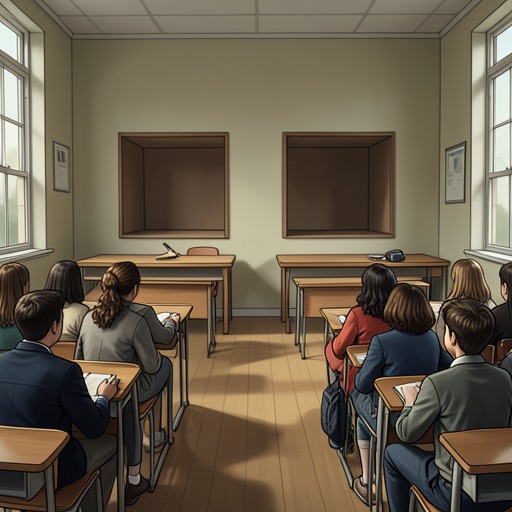
The Class Ignores Mei
Kasahara Shoichiro learned that the class had designated Mizaki Aoi as "not here." He refused to acknowledge her existence in class, conversations, and roll calls. At first, no one explained the reason, and this artificially created silence made Mizaki Aoi feel as if she
May 1998
The First Deaths
Yukimi Sakuragi learned that her mother died in a car accident and hurriedly left the classroom. She felt fear because she saw Shikisaka Haru and Mizaki Akari together, although Mizaki Akari was supposed to be absent. She changed direction and descended the western
May 1998
Koichi Meets Sanae Mizuno
Kashihara Haruhisa met Suino Hayase. She worked as a nurse at the Arakawa City General Hospital and was connected to the class through her brother. Their conversation provided Kashihara Haruhisa with information about Kizaki Nagisa's cousin and a recent tragedy at
June 1998
Sanae Mizuno’s Elevator Death
Suzuka Hayama died in a violent elevator accident at the Arakawa City General Hospital. Her death occurred after Takahashi Yutaka died from a heart attack, and it was confirmed that the disaster could affect not only the members of the third class of the third year but also their
Early June 1998
The Two Casualties Strategy
After the death of Sakura Yagiri, Shirohara Haruichi finally learned the class's strategy. A student was considered not part of reality, thus balancing the existence of the deceased. Since Shirohara Haruichi had already publicly interacted with Mizuaki Nagisa
June 1998
Koichi and Mei Withdraw
Akimoto Haruhisa and Mizaki Aoi began to avoid the classroom, having lunch on the roof, or retreating to the second library. The alone time they were forced to have turned out unexpectedly peaceful, allowing them to talk freely, while the other students in the class pretended not to see
Mid-June 1998
Mei’s Family and Art
While having a secret lunch, Mizuki sawaki told Kashiwagane Hideo about her difficult relationship with Mizuki Tousan, her limited family life, her preference for ancient Western art, and her abandonment of activities in the art club at Yumemiyama North Middle School
June 18, 1998
The Art Club Encounter
Kazaki Aoi leads Kashihara Haruki to Yamiyama North High School's art club, where they meet the lower grade members and Matsuyama Yūya. In order to avoid acknowledging their presence in front of students who don't know the class secret, Matsuy
June 18, 1998
The 1972 Yearbook Discovery
At the second library, Sakurahara Haruhisa checked the class photo from 1972 and recognized his mother, Sakurahara Ritsuko, among the students. He also recognized the young class teacher, Chibimaki Chenzhi, who is now a library
June 18, 1998
Chibiki Explains the Phenomenon
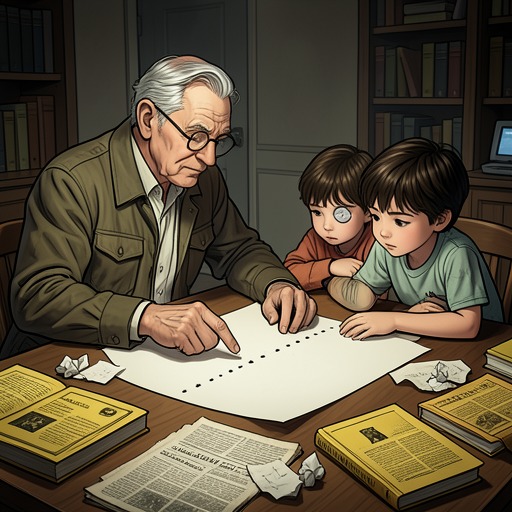
Chibimiki Chinzaburo explained that 26 years ago, a popular student named Yamiyama Misaki died, but his classmates refused to acknowledge the death and continued to treat him as if he were alive. This denial opened the "door of death," causing a recurring phenomenon
May 1972
Misaki Yomiyama’s Family Fire
Chibimiki Chinzaburo told that Yamanaka Misaki died in a fire that destroyed her family home. Her parents and younger brother also died in the fire. Later, rumors spread that the fire was caused by a plane crash or a meteor strike, but Chibimiki
1973 school year
The 1973 Casualty Revealed
Chibiki Shintarō explained that the following year, an additional student entered Class 3, Grade 3, and sixteen related persons died. After graduation, the teacher found out that the victims were actually the younger brother of Yonemori Mio, who had died in that house
1973年3月16日
The 1973 Graduation Photograph
A 1973 graduation photo shows that Yonemura Miki, despite existing in an impossible way, stands outside the class. This photo becomes an unsettling evidence of the Yonemura phenomenon, preserving the fact covered by altered memories. After that, Kashiwagi Hideo
1976 school year
Chibiki’s 1976 Experience
Chibiki describes serving as head teacher of Third-Year Class 3 in 1976, an on year in which five students and nine relatives died. Attempts to change classrooms and later class designations fail to stop the disasters.
His personal experience convinces him that the phenomenon is not tied to a particular room, name, or teacher. He eventually abandons teaching, fearing that becoming head teacher again would make him another target.
1988 school year and after
The Not-There Countermeasure Emerges
Chibiki explains that the school eventually developed the strategy of designating a living student as “not there” to compensate for the extra casualty. The method succeeds in some years but fails in others, and the exact rules are never stable enough to guarantee protection.
The strategy becomes the central inherited ritual of North Yomi. Its uncertain success explains why the 1998 class clings to it despite having no reliable theory of how it works.
June 18, 1998
The Two-Degree and Geographic Rules
Chibiki identifies two boundaries of the disasters. They generally affect class members and blood relatives within two generations, while distant relatives and nonblood relations are excluded. The phenomenon also weakens beyond [Yomiyama](entity:location-recall-location-yomiyama-e3a2a37539bb), making distance a possible though imperfect protection.
These rules lead Koichi to conclude that he cannot be the casualty: he did not previously live in Yomiyama or belong to the affected class. The rules also explain why families attempt to leave town during dangerous years.
1987年悲剧
The 1987 Bus Tragedy
Chibiki recounts the [1987 tragedy](entity:event-recall-event-1987-3-1dc1cbfbc9c5), when Third-Year Class 3 students were traveling to the airport for an off-campus trip. A truck struck their bus near the edge of [Yomiyama](entity:location-recall-location-yomiyama-e3a2a37539bb), killing the head teacher and six students.
The accident leads the school to prohibit third-year bus trips and later off-campus group activities. It becomes a reminder that leaving the geographic range does not guarantee safety when the phenomenon is able to reach the class in transit.
June 18, 1998
Ritsuko’s Death Reconsidered
Chibiki confirms that 1983 was an on year, the same year [Reiko Mikami](entity:character-recall-character-reiko-mikami-e1594549d6c7) attended Class 3 and [Ritsuko Sakakibara](entity:character-recall-character-ritsuko-sakakibara-0e440ed0c679) died after giving birth in [Yomiyama](entity:location-recall-location-yomiyama-e3a2a37539bb). Koichi realizes that his mother’s supposed illness may actually have been one of that year’s disasters.
The revelation transforms his family history. His mother’s death is no longer an isolated medical tragedy but a possible consequence of the same phenomenon now threatening Koichi’s classmates.
August 1983
The 1983 Disasters Stop
Reiko vaguely remembers that the 1983 disasters began and then stopped partway through the year after a summer camping trip. Chibiki’s class-list binder shows two Class 3 students dying in an accident on August 9, after which no further deaths are recorded.
The unexplained interruption offers the first evidence that an on-year disaster can end before graduation. It also points Koichi toward the school’s mountain lodge and the rumored role of [Yomiyama Shrine](entity:location-recall-location-yomiyama-shrine-e080ea28fe61).
Late June 1998
The Shrine Theory
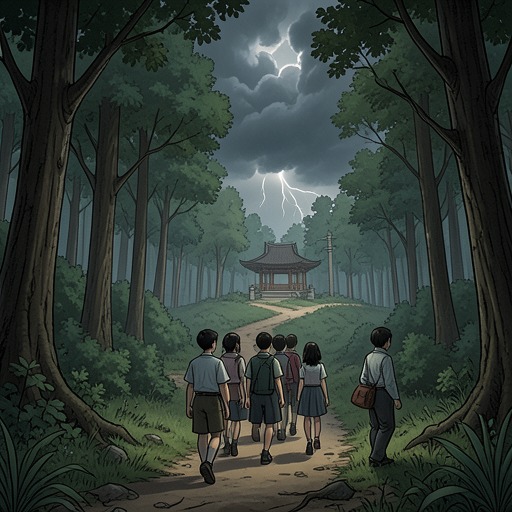
Chibiki says that the 1983 class visited [Yomiyama Shrine](entity:location-recall-location-yomiyama-shrine-e080ea28fe61) during its camping trip, prompting rumors that the shrine is a spiritual linchpin between the living world and the land of the dead. Later classes repeat the visit without achieving the same result, so the shrine’s power remains conjectural.
Nevertheless, Reiko seizes on the possibility and organizes a new class camping trip for August. Her desperation reflects both her knowledge of the past and the pressure of having failed to prevent the 1998 deaths.
July 13, 1998
Kubodera’s Classroom Suicide
[Mr. Kubodera](entity:character-recall-character-mr-kubodera-f763dd936cac) enters the classroom carrying an overnight bag, delivers a disjointed apology, and suddenly slashes his own throat with a carving knife. His suicide horrifies the class and ends the experiment of treating both Koichi and Mei as absent.
Police later discover that Kubodera had murdered his bedridden mother before coming to school. The deaths of teacher and mother become the July disasters, proving that the phenomenon has not been stopped by increasing the number of “not there” students.
Mid-July 1998
The Class Abandons the Strategy
After Kubodera’s death, the class stops pretending that Koichi and Mei do not exist. Students return to ordinary interactions, while the class is moved to another building because the original room has become a crime scene.
The shift restores social contact but destroys the group’s last illusion of control. Koichi and Mei are now openly implicated in a disaster that everyone knows is continuing, and the question of the casualty becomes more urgent.
July 30, 1998
Atsushi Ogura Dies
Atsushi Ogura, the older brother of a Class 3 student, dies when a construction vehicle crashes into his house. The accident destroys the room where he has isolated himself, making even staying indoors seem unable to protect anyone from the disasters.
His death becomes the third July disaster and persuades more students to join the planned camping trip. The class’s fear shifts from passive endurance to desperate participation in a ritual that might offer salvation.
July 21, 1998
Reiko’s Camp Announcement
At the end-of-semester assembly, Reiko announces a two-night camping trip to [Sakitani Memorial Hall](entity:location-recall-location-sakitani-memorial-ha-eae99cad6fb8) from August 8 to 10. She calls it an important ritual and asks students to participate, without explaining that it is modeled on the 1983 trip.
The announcement divides the class between those who distrust the ritual and those who believe it may be their only chance. Reiko’s decision sets the novel’s final movement in motion.
July 25, 1998
Koichi Calls His Father
Koichi speaks with [Yosuke Sakakibara](entity:character-recall-character-yosuke-sakakibara-1b70bc9afa97) in India about the anniversary of Ritsuko’s death. His father recalls that Ritsuko once mentioned a disturbing middle-school photograph, which she had left at her parents’ house.
The call prompts Koichi to ask his grandmother to search for the photograph. This family artifact will later reveal the visual presence of [Misaki Yomiyama](entity:character-recall-character-misaki-yomiyama-5000f84a53ab) and help Mei confirm her own supernatural perception.
July 17, 1998
The Police Investigate
[Detective Oba](entity:character-recall-character-detective-oba-7dc90f5a6b1f) of the [Yomiyama Police Department](entity:organization-recall-organization-yomiyama-police-c0bbc87a3a88) approaches Koichi outside school and discusses the strange cluster of deaths. He has found rumors about the curse of Third-Year Class 3 but cannot present them as an official police theory.
Koichi warns him not to become involved, fearing that proximity to the phenomenon may endanger him. Oba admits that he worries about his young daughter someday attending North Yomi, making the threat extend beyond the current class.
Late July 1998
Chibiki Confirms 1983
Koichi and Mei visit Chibiki to compare Reiko’s memories with the class-list binder. The records show that two students died together in an August 9 accident in 1983 and that the disasters ceased afterward, but no casualty is identified.
Chibiki suggests that the casualty may have disappeared before graduation, taking the relevant records and memories with them. The gap makes the 1983 case both promising and frustrating, since it may contain the key to ending 1998.
Late July 1998
Matsunaga’s Fragments Surface
At [Inoya](entity:location-recall-location-inoya-65163b815e4f), [Tomoka Inose](entity:character-recall-character-tomoka-inose-297414564085) tells [Yuya Mochizuki](entity:character-recall-character-yuya-mochizuki-d04df75bce5b), Koichi, and [Naoya Teshigawara](entity:character-recall-character-naoya-teshigawara-3166f57cbd70) about [Katsumi Matsunaga](entity:character-recall-character-katsumi-matsunaga-f7cbd44ebd62), a former Class 3 student from 1983. When drunk, Matsunaga has muttered that he “saved” everyone, hid something in the classroom, and did not act wrongly.
The fragments suggest that Matsunaga committed an act connected to the casualty and concealed evidence for future students. Teshigawara interprets the story as an invitation to search the old classroom.
Late July 1998
Mei Reveals the Doll
In "Blue Eyes in the Twilight of the Yellow Hell, Nothing for Everyone," Miki Mizuki explains that the mannequin made based on her represents the child that Mizuki Takumi gave birth to dead, not literally a sister. The mannequin is just part of Mizuki because it
July 30, 1998
The Old Classroom Search
Akimoto Haruhisa, Kishimura Nagahiro, and Mochizuki Yuya secretly entered the second floor of Building Zero, which was prohibited entry, to search for the old third grade classroom. They checked the desks, storage cabinets, and cleaning equipment room, while imagining the
July 30, 1998
The Cassette Is Found
The package contained a tape recorded by Matsunaga Katsuyoshi, but when the boys tore open the packaging tape, the tape was damaged. Nagayama Yuya was responsible for repairing it, making this hidden confession still possible to explain how the disaster in 1983 ended
Early August 1998
Mei Finds the Family Photograph
The grandmother of Kashiwahara Shoichiro found a photo left by Kashiwahara Riko in the side room. This faded photo, dated [March 16, 1973](entity:time-recall-time-1973-3-16-a521dea8f73e), shows the graduating class of Class 3, Grade 3, including Kashi
August 4, 1998
Mei Explains the Death Color
Kazuki Misaki told Kikuchi Haruichi that her artificial left eye can see an abnormal color related to people who are already dead or on the brink of death. She calls it the color of death. This ability began during her childhood eye surgery and was enhanced by multiple encounters with death
August 8, 1998
Mei Reveals the True Sisters
Kazasaki Nagisa explained that Kazasaki Tōgō is not her cousin, but her identical twin sister. Their mother, Amano Yukiko, and Tōgō Akiko are fraternal twins. After Amano Yukiko's child died shortly after birth, one of
August 4, 1998
The Tape Is Repaired
Mitsuyama Yūji repaired the audio tape of Matsunaga Katsuyoshi. Shirohara Kōichirō, Kishimura Naoki, and Mitsuyama Yūji listened to the tape together. Matsunaga Katsuyoshi described the camping
August 9, 1983
Matsunaga’s Killing of the Extra Person
During a camping trip in 1983, Matsunaga Katsuyoshi had a dispute with a boy who behaved abnormally after the shrine disaster. The fight ended when Matsunaga Katsuyoshi pushed him into the trees, causing branches to pierce his head and kill him
August 8, 1998
The Camping Group Assembles
Fourteen students and three Shino Mamiko gathered at the Sakuragi Memorial to join the class camping trip, with Chino Tatsuzumi as another adult joining the group. They took a group photo at the main gate, preserving Shino Mamiko's impossible presence before erasing
August 8, 1998
The Photograph with Reiko
After the disaster, when the world's memory returns to normal and Sanosuke Sanae disappears from the meaning of the photo, this photo becomes crucial. It records a temporary real existence and an extra person accepted by society
August 8, 1998
Chibiki Joins the Trip
Chibimiki Chotarou arrived at the Sakuragi Memorial, supporting Mikami Rina and supervising the students. He warned everyone to avoid accidents and confirmed that if the weather worsened, the shrine visit would be canceled. His presence gave the team an experienced observer, but
Night of August 8, 1998
The Tape’s Warning Spreads
Kashihara Shoichiro and his companions privately discussed the orders of Matsunaga Katsuyoshi regarding the killing of the victims. They were worried that revealing this information to the entire class would cause panic, suspicion, and even indiscriminate killing. However, this secret had already begun to
Night of August 8, 1998
Akazawa Accuses Mei
At dinner, Akazawa Sena publicly blamed Mizuki and Sashihara Kazuichi, believing that the deaths of and were caused by them. She claimed that Mizuki had not fulfilled his role in the "alibi" strategy
Night of August 8, 1998
Wakui’s Asthma Attack
At dinner, Kusunji suddenly suffered from a severe asthma attack, and his inhaler was empty. The hotel phone was not working, and all available mobile devices were also unreachable, so Chino Tatsuzumi had to drive him to the hospital. Although Kusunji survived
Night of August 8, 1998
Teshigawara Attacks Kazami
Kabukicho Hirohisa is certain that Fuyashiki Tomohiro is the deceased, because Fuyashiki Tomohiro cannot remember some childhood experiences, so he lures him to the leisure room and demands him to admit he is an imposter. The confrontation between the two
Late night August 8, 1998
The Caretaker Is Murdered
Koichi discovers [Manabu Maejima](entity:character-recall-character-manabu-maejima-0830ee3140a1) wounded in the dining hall and learns that the caretaker, [Kensaku Numata](entity:character-recall-character-kensaku-numata-19371a4c4874), attacked him with a kitchen knife. In the kitchen, Koichi finds Kensaku dead, stabbed with the metal skewers from dinner, while flames spread through the room.
The murder reveals that the night’s calamity has become an active massacre rather than a sequence of accidents. Koichi drags Maejima outside, while Mei runs upstairs to warn the other students.
Late night August 8, 1998
The Lodge Fire Begins
The fire consumes the kitchen and dining hall, then spreads through [Sakitani Memorial Hall](entity:location-recall-location-sakitani-memorial-ha-eae99cad6fb8). Students flee from rooms and exits in panic as windows shatter, the structure creaks, and an explosion intensifies the blaze.
The disaster kills students who have no apparent connection to the original ritual beyond their membership in or relationship to Class 3. The lodge becomes a physical embodiment of the phenomenon’s indiscriminate violence.
Near midnight August 8, 1998
Akazawa Falls
Koichi sees [Izumi Akazawa](entity:character-recall-character-izumi-akazawa-e359c3c21b81) grappling with an attacker on a second-floor balcony. An explosion throws both figures over the railing, and Akazawa dies in the fall while the attacker survives and emerges from the fire carrying a knife.
The scene adds Akazawa to the night’s death toll and transforms the surviving attacker into a seemingly supernatural predator. Koichi flees, carrying the wounded Maejima until Maejima dies from blood loss.
Near midnight August 8, 1998
Chibiki Subdues the Killer
A smoke-covered attacker pursues Koichi outside the burning lodge. [Tatsuji Chibiki](entity:character-recall-character-tatsuji-chibiki-5807cc610e94) intervenes, knocks away the knife, and restrains the assailant before discovering that the killer is [Mieko Numata](entity:character-recall-character-mieko-numata-6605fe470f04).
Mieko has murdered Kensaku, Maejima, and several students, then attempted suicide by biting through her tongue. Her sudden psychotic violence is treated as another manifestation of the disasters, without a comprehensible personal motive.
August 9, 1998
Mei Finds the Casualty
Mei tells Koichi by phone that she is in the storage shed’s yard with a person trapped beneath fallen lumber. She has removed her eye patch and sees the color of death on the injured figure, identifying them as the extra person.
Koichi reaches the shed and recognizes the trapped person as [Reiko Mikami](entity:character-recall-character-reiko-mikami-e1594549d6c7). Mei takes up a pickax and prepares to return Reiko to death, believing that killing the casualty is the only remaining way to end the disaster.
August 9, 1998
Reiko’s Hidden Death
Mei explains that Reiko died during the disasters two years earlier, after [Sakuma](entity:character-recall-character-sakuma-c9b2f8474055) abandoned the “not there” role and the calamities resumed. Reiko drowned in the swollen [Yomiyama](entity:location-recall-location-yomiyama-e3a2a37539bb) River, but the phenomenon later restored her as the casualty for 1998.
Koichi reconstructs the clues: Reiko’s unique assistant-head-teacher position, the art club’s history, the missing desk in the teachers’ office, and the family memories of her death. The revelation exposes the truth hidden inside his own altered memories.
August 9, 1998
Koichi Kills Reiko
Reiko protests that she is alive and begs Koichi not to believe Mei, but Mei insists that the color of death proves her identity. Koichi hesitates, overwhelmed by Reiko’s resemblance to his mother and by the possibility that Mei’s perception is mistaken.
Choosing to trust Mei, Koichi swings the pickax into Reiko’s back and kills her. The act fulfills Matsunaga’s recorded instruction to return the casualty to death, though its emotional cost leaves Koichi physically and psychologically shattered.
After Reiko’s death, August 9, 1998
The Disasters End
After Reiko’s death, the 1998 disasters cease, and the world begins repairing the contradictions created by her presence. Reiko’s identity, records, and relationships are erased or rewritten so that everyone remembers her as having died two years earlier.
Koichi survives a severe spontaneous pneumothorax, while the remaining students and adults slowly return to ordinary reality. Only Koichi and Mei retain an unusually strong awareness of what happened because they were directly involved in Reiko’s death.
August 9, 1998
The Official Death Toll
Firefighters find six bodies at [Sakitani Memorial Hall](entity:location-recall-location-sakitani-memorial-ha-eae99cad6fb8): [Kensaku Numata](entity:character-recall-character-kensaku-numata-19371a4c4874), [Manabu Maejima](entity:character-recall-character-manabu-maejima-0830ee3140a1), [Izumi Akazawa](entity:character-recall-character-izumi-akazawa-e359c3c21b81), Shigeki Yonemura, Takako Sugiura, and Junta Nakao. Autopsies show that nearly all died from stabbing or blunt trauma rather than the fire itself, confirming the massacre’s violence.
[Mieko Numata](entity:character-recall-character-mieko-numata-6605fe470f04) is identified as the killer, but she dies before a motive can be established. The official account explains the immediate crimes while leaving the deeper supernatural pattern untouched.
Following the massacre, August 1998
Wakui and Kazami Survive
Wakui recovers in hospital from his asthma attack, while [Tomohiko Kazami](entity:character-recall-character-tomohiko-kazami-c06665a90828) survives his fall with only a sprained ankle. [Naoya Teshigawara](entity:character-recall-character-naoya-teshigawara-3166f57cbd70)’s mistaken attack therefore produces guilt and fear but not another death.
Their survival reinforces the unpredictability of the phenomenon: some apparent deaths are averted, while others become irreversible through accidents, violence, or supernatural correction.
August 11, 1998
Koichi Undergoes Lung Surgery
Koichi’s left lung collapses during the final confrontation, and he is taken to [Yumigaoka Municipal Hospital](entity:location-recall-location-yumigaoka-municipal-038e0494ba48). His father gives permission from India, and Koichi undergoes successful thoracoscopic surgery to prevent further recurrences.
The operation gives the physical consequences of the summer’s trauma a concrete form. Koichi survives, but his recovery also separates him from the immediate aftermath, leaving him to reconstruct events through conversations and photographs.
August 13–15, 1998
Mei Confirms Reiko’s Erasure
Mei tells Koichi that no one remembers Reiko as a living teacher or camping chaperone. Everyone now recalls that Reiko died two years earlier, and the class list no longer contains her name as assistant head teacher.
The art club’s records are similarly revised, with another teacher now credited for its revival. These changes confirm that Reiko was the casualty and that the Memory-Erasure Rule has restored the world’s accepted version of events.
August 15, 1998
The Numatas’ Hidden Connection
Mei reveals that Kensaku and [Mieko Numata](entity:character-recall-character-mieko-numata-6605fe470f04) were [Ikuo Takabayashi](entity:character-recall-character-ikuo-takabayashi-660018aa1fbd)’s grandparents, placing both caretakers within the two-degree blood-relation range of the class. Their presence at [Sakitani Memorial Hall](entity:location-recall-location-sakitani-memorial-ha-eae99cad6fb8) was therefore another disaster connection rather than pure coincidence.
The discovery raises the August death toll to seven and shows how the phenomenon can conceal links until after the violence is over. Even the lodge’s caretakers had been drawn into the class’s invisible network.
August 15, 1998
The Missing Sixteenth Person
The camping trip is officially remembered as involving fourteen students and Chibiki, but Koichi and Mei realize that sixteen people were present before Reiko vanished from reality. The missing sixteenth person was Reiko, whose existence has been erased from the memories of everyone else.
The photographs preserve her body in the group, yet the social meaning of her presence has disappeared. Koichi understands that even his own memories may eventually be rewritten, including the fact that he killed her.
After the camping trip, August 1998
Mei Discards Her Phone
Mei tells Koichi that she threw her cell phone into the river after the trip and lied to Kirika by saying it had been lost in the fire. She dislikes the machine’s constant connection, yet agrees that she may allow Koichi to call her occasionally if he does not overdo it.
The gesture marks a quiet shift in their relationship. Their connection no longer depends on the crisis or on a shared investigation, but on the fragile possibility of meeting again after memory and distance have done their work.
Late August 1998
The Final Photographs
Koichi and Mei examine the two photographs taken at [Sakitani Memorial Hall](entity:location-recall-location-sakitani-memorial-ha-eae99cad6fb8). Reiko appears in both images, but Mei’s uncovered eye identifies her as bearing the color of death, while the others remain unaware of the contradiction.
Koichi wonders what the photographs will look like after his memories of Reiko fade. The images become a final emblem of the novel’s central tension: a person can disappear from reality’s story while remaining visible in the evidence.
Late August 1998
The Summer Ends
Koichi reflects on the approaching end of the summer in which he witnessed deaths, discovered the [Yomiyama phenomenon](entity:concept-recall-concept-yomiyama-phenomenon-56fdc278c4b4), and killed the woman who had been both his aunt and the year’s casualty. He believes that he and Mei will eventually meet again, even if the memories connecting them become uncertain.
The novel closes on a cold midsummer breeze and the possibility of forgetting. Survival does not restore innocence; it leaves Koichi and Mei suspended between an erased history and the knowledge that, one day, they may encounter its absence without understanding what was lost.