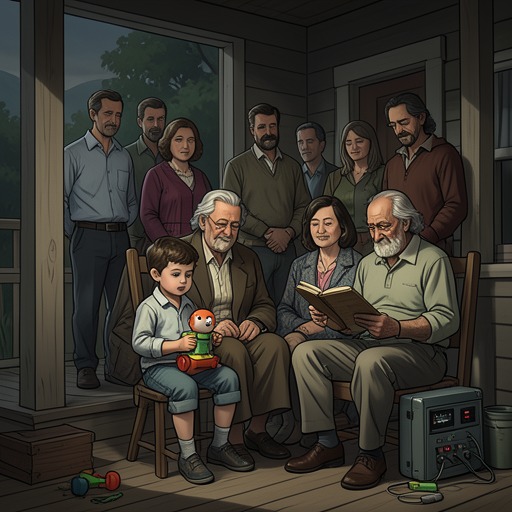
around age five
Kay’s Childhood Ambition
[Kay Willis](entity:character-recall-character-kay-willis-6be9efcd0eff) grows up in [Passaic, New Jersey](entity:location-recall-location-passaic-new-jersey-472bccc01a2a), as one of five children in a family that values education and confidence. Her mother, [Ellen Burns Rubacky](entity:character-recall-character-ellen-burns-rubacky-4dbb612abbca), never finishes high school but becomes Kay’s model of wisdom, humor, self-worth, and practical love.
When her kindergarten principal asks what she wants to become, Kay answers that she wants to be a mother. Pressed to name an occupation before motherhood, she insists that she wants motherhood as soon as possible, establishing the vocation that will shape her entire life.
1950
The Willis Marriage
Kay marries [Benedict Patrick Willis Jr.](entity:character-recall-character-benedict-patrick-wi-77cce252ecf2), known as Bub, and begins the partnership that will support her future family. Their marriage becomes a central source of emotional and practical strength, especially as parenthood expands beyond what most families could imagine.
Kay later recalls that Bub is thoughtful, affectionate, and generous with praise. His willingness to bathe babies, share family life, and protect Kay’s time helps make their enormous household joyful rather than merely survivable.
April 1951
JoEllen’s Arrival
Kay and Bub welcome their first child, [JoEllen Willis](entity:character-recall-character-joellen-willis-3132c0363c13), nine months and twenty-three days after their wedding. The birth transforms Kay’s idealized image of motherhood into the demanding daily reality of caring for another human being.
The experience begins Kay’s long education in the secret society of motherhood: exhaustion, uncertainty, responsibility, and unexpected joy. It also starts the family chronology that will eventually include ten children.
April 1951 to February 1958
Six Daughters in Seven Years
Kay gives birth to JoEllen, Kim, Patty, Maureen, Fran, and Jeane in rapid succession. Six girls arrive in seven years, filling the household with work, noise, illness, humor, and an unusually dense web of sibling relationships.
Kay remains busy but generally enjoys the children, aided by her mother and Bub. Their insistence that she rest and receive support becomes the practical foundation for the later principle of [Refuel, Restore, Renew](entity:expression-recall-expression-refuel-restore-ren-01bb62b2027b).
March 1960
Ben’s Birth
After six daughters, Kay and Bub welcome [Benedict Patrick Willis III](entity:character-recall-character-benedict-patrick-wi-94bf904a8d85), their first son. The family celebrates the arrival of a boy, while Kay worries about raising him as the only brother among many sisters.
Ben’s birth changes the family’s balance and encourages Kay and Bub to imagine yet another child. Their decision reflects the faith, confidence, and willingness to accept uncertainty that mark their approach to family life.
December 1961 to July 1966
Four Boys in a Row
[Timothy Willis](entity:character-recall-character-timothy-willis-777f67f16321), [Jerry Willis](entity:character-recall-character-jerry-willis-b642781d31e9), and [Danny Willis](entity:character-recall-character-danny-willis-728cfb63352d) follow Ben, giving the family four boys after six girls. Kay jokes that the family is on a roll, while the children’s births create a household with its own rhythm, traditions, and collective identity.
The family now numbers twelve people, and Kay treats the abundance as a blessing rather than a burden. Birthdays, shared jokes, family prayers, and crowded meals become the raw material for the memories she later considers the true measure of parental success.
during Kay’s later pregnancies
Emergency Morning Sickness
During pregnancy, Kay suffers intense morning sickness and invents a family game called “Emergency.” When she calls the word, her young daughters stop moving and sit quietly while she recovers.
The children initially associate emergency vehicles with their mother’s nausea, turning a difficult physical condition into a shared family joke. The episode illustrates Kay’s habit of meeting hardship with humor rather than allowing it to define the household atmosphere.
during the early years of the ten-child household
The Thursday Rule
[Ellen Burns Rubacky](entity:character-recall-character-ellen-burns-rubacky-4dbb612abbca) insists that Kay take every Thursday afternoon away from the children. She argues that Kay’s importance makes regular maintenance essential: if Kay collapses, an entire squad would be needed to replace her.
Kay walks away each Thursday to rest, talk with friends, and refuel. The family comes to expect her absence, and the rule becomes a concrete expression of the principle that caring for oneself is part of caring for children.
during the children’s early years
Bub’s Evening Care
Bub takes responsibility for bathing the babies and follows a personal rule that he will not sit down until Kay can sit down. His actions make his love tangible rather than merely verbal.
The household does not finish every chore, but Kay feels valued and protected. Their partnership demonstrates the book’s argument that fathers are not assistants or babysitters but essential participants in family life.
before the birth of the sixth child
The Big House Move
The [Willis family](entity:character-recall-character-willis-family-c4ebabc4105c) moves from a tiny two-bedroom home into a large house in [Rutherford, New Jersey](entity:location-recall-location-rutherford-new-jerse-67d4eeda573f). Kay is excited by the extra bedrooms, while Ellen worries about the stairs and the labor required to maintain the building.
The move expands the physical stage of family life and eventually supports the traditions, dinners, games, and gatherings that make the house an emotional center for the children and their future families.
after the move to Rutherford
The Five O’Clock Sitter
Ellen pays for a weekday sitter, Jane Elin, to arrive at five o’clock each evening. Kay is initially puzzled about what she could do at that hour, but her mother explains that the purpose is simply to let her rest, freshen up, and recover before the evening routine.
Jane Elin stays with the family for years, giving the children energetic companionship and giving Kay a daily transition out of exhaustion. The arrangement teaches Kay that children also sometimes need time away from their mother.
during Bub’s business trips
Play Days Begin
When Bub must travel for more than two days, Kay abandons routine chores and declares a [Play Days](entity:concept-recall-concept-play-days-b63335303a95) household. The children and Kay play with dolls, make tents, rearrange furniture, and eat from paper plates.
On the second day, everyone helps restore the house before Bub returns. The tradition converts absence and extra work into communal pleasure, later inspiring Kay’s broader argument that unfinished chores are acceptable when play preserves family vitality.
during the children’s childhood
The Family Birthday Trick
When a child wants birthday candles on an ordinary cake, Kay allows the celebration and improvises a reason: the family is marking her ninetieth month of pregnancy. Her father is so moved by the absurdity and affection of the scene that he cries.
The episode captures Kay’s instinct to turn ordinary domestic moments into occasions. In her household, humor and ritual create belonging without requiring money or elaborate planning.
1975
The First Mothers Matter Group
A neighbor, Diane Jones, asks Kay for support while raising three preschoolers. Kay invites other mothers to join their conversations, and seven women gather in Kay’s living room to exchange concerns, failures, humor, and practical ideas.
The group decides to meet again, discovering that honest conversation reduces isolation and restores confidence. This informal beginning becomes [Mothers Matter](entity:organization-recall-organization-mothers-matter-7fa3ff17aed8), the program through which Kay will reach thousands of parents.
after the first living-room meetings
The Name Mothers Matter
As the support meetings spread, [Patty Willis](entity:character-recall-character-patty-willis-a900d8e761f3) helps coin the name [Mothers Matter](entity:organization-recall-organization-mothers-matter-7fa3ff17aed8). [JoEllen Willis](entity:character-recall-character-joellen-willis-3132c0363c13) proofreads Kay’s brochure and jokes about the intimidating phrase “mother of ten children.”
Kay nevertheless treats her experience and enjoyment of motherhood as credentials. The name crystallizes the program’s central claim: parenting is important work, and mothers deserve preparation, respect, and support.
1978
The First Fathers Workshop
Kay offers her first workshop specifically for fathers. Sixteen men attend, most having been persuaded or bribed by their wives, but the evening succeeds well enough that a fathers’ session becomes a permanent part of [Mothers Matter](entity:organization-recall-organization-mothers-matter-7fa3ff17aed8).
The workshop expands the program beyond mothers and establishes fatherhood as an active discipline requiring reflection, practice, and emotional presence. It also prepares the book’s argument that dads are Most Valuable Players.
late 1977
The Rejected Grant
Kay applies for county funding to establish a mothers’ center but is rejected because her proposal lacks “maintenance of effort.” Rather than accept the bureaucratic dismissal, she repeatedly calls county offices until she learns how to revise the application.
Kay resubmits the same proposal with the required phrase added and wins a $51,000 one-year grant. Her persistence turns a technical rejection into the first major institutional breakthrough for [Mothers Matter](entity:organization-recall-organization-mothers-matter-7fa3ff17aed8).
weeks after the grant award
The Professor of Motherhood
A county official doubts Kay’s qualifications because she lacks a degree or teaching certificate. Kay argues that she can serve as a recognized facilitator, securing permission to operate the program.
When the media cover the opening of the mothers’ center, they call Kay a “Professor of [Motherhood](entity:state-recall-state-motherhood-6b70eccb4fd4).” The humorous title marks her transition from neighborhood organizer to public advocate and confirms that lived parenting experience can carry public authority.
1978
The Mothers Center Opens
With county funding and institutional monitoring from [Fairleigh Dickinson University](entity:location-recall-location-fairleigh-dickinson-5f460caea053), Kay opens a dedicated mothers’ center. [Mothers Matter](entity:organization-recall-organization-mothers-matter-7fa3ff17aed8) now has a physical base for educational and support work rather than relying only on living-room gatherings.
The center formalizes Kay’s belief that parents need continuing education, peer exchange, and relief from isolation. It becomes the platform for workshops serving mothers, fathers, single parents, working parents, adolescents’ parents, new mothers, and grandparents.
early 1980s
The Fisher-Price Interview
[Maryann Bucknum Brinley](entity:character-recall-character-maryann-bucknum-bri-d819f59fcc48) recommends Kay to [Fisher-Price](entity:organization-recall-organization-fisher-price-9f8f127709c2) as a possible spokesperson for a preschool camera. The company initially wants a camera expert and dismisses Kay because she is not a psychologist, author, or toy specialist.
During a phone interview, Kay learns that the company is seeking someone who can speak about the toy across the country. She sends a dollar and a note betting that she can sell more cameras than a technical expert unless that expert is also a mother.
two days after the interview
Kay Wins the Spokesperson Job
[Fisher-Price](entity:organization-recall-organization-fisher-price-9f8f127709c2) invites Kay to meet its president. She wins him over by joking that she spends so much annually on toys that she has been putting Fisher-Price on her tax return for years.
Kay becomes one of the company’s most successful spokespeople, traveling to twenty-two cities to discuss toys and play. The work gives her a national platform for her parenting message and introduces her to the pleasures of professional travel, including a chauffeur-driven limousine.
during Kay’s Fisher-Price tour
The Limousine Ride
Accustomed to traveling in a station wagon with ten children, Kay enjoys sitting alone in the back of a limousine. She asks the driver to circle the streets of [Rutherford, New Jersey](entity:location-recall-location-rutherford-new-jerse-67d4eeda573f), so people can see her new status.
The moment is both comic and meaningful: Kay allows herself to relish success without apology. Her delight becomes evidence for her conviction that fun is not a luxury but a parenting skill.
1984
The Convention for Mothers
Kay organizes what the national press calls the first convention for mothers. Despite having only two months to prepare and initially offering an $84 deposit, she secures a hotel, sponsors, donated gifts, workshops, meals, and media attention.
More than one hundred mothers from five states attend, with companies sponsoring “motherships” for mothers who could not afford the fee. The convention becomes a giant sleepover where mothers laugh, share ideas, and experience themselves as professionals deserving of a convention.
summer after Danny begins school
The First College Course
With free tuition connected to [Mothers Matter](entity:organization-recall-organization-mothers-matter-7fa3ff17aed8), Kay enrolls at [Fairleigh Dickinson University](entity:location-recall-location-fairleigh-dickinson-5f460caea053) in a graduate-level course called “Women in Transition.” She worries that returning to college after more than twenty-five years as a full-time mother will expose her inadequacy.
The unconventional class meets in a living room, votes on its own rules, and conducts imaginative exercises. Kay earns an A and discovers that her mind has not atrophied; the experience reinforces her belief that good parents never stop growing.
when Danny is about nine
The Catering Career
Seeking income while two children are in college, Kay takes a part-time job overseeing luncheons at [United Nations Plaza](entity:location-recall-location-united-nations-plaza-c26d98ab33ad). She trades homemade cakes for an expensive pie, then gradually begins preparing full lunches for the private dining room.
Kay carries salads, cakes, and other food through [New York City](entity:location-recall-location-new-york-city-65df0a129d4c) in plastic shopping bags and eventually caters a [Christmas](entity:time-recall-time-christmas-a573265d0167) dinner for one hundred foreign exchange students. The work succeeds financially but begins interfering with motherhood, forcing Kay to search for a better use of her abilities.
mid-1970s
The Baking Enterprise
After catering, Kay sells homemade breads and cakes at craft fairs. She bakes through the week, produces dozens of loaves, and often sells out by noon, earning several hundred dollars.
The business proves that Kay can transform domestic skills into income, but its physical and emotional demands remain heavy. Her repeated search for a sustainable vocation eventually leads her to realize that helping mothers enjoy parenting is the work she most wants to do.
1975
The Dried Flower Business
Kay turns to dried flower arrangements as another home-based income source and wins a substantial [Christmas](entity:time-recall-time-christmas-a573265d0167) order from an agency. The work removes immediate gift-buying anxiety but requires long nights in a basement storage room.
The strain clarifies a career principle from What Color Is Your Parachute?: meaningful work should use abilities one enjoys. Kay recognizes that her enduring strength is not merely baking or crafting but helping other mothers value their own parenting.
after the dried-flower career
The Mothers Matter Conception
Kay realizes that she cannot continue adding babies or exhausting home businesses, but she can help other mothers enjoy parenthood as she has. She conceives [Mothers Matter](entity:organization-recall-organization-mothers-matter-7fa3ff17aed8) as a program built around shared experience rather than expert commandments.
This decision gives her a career that grows directly from family life. The personal and professional strands of her identity become inseparable: raising ten children becomes the source of her public mission.
1980s to 1990s
The National Media Profile
Kay’s work attracts coverage from newspapers and consumer magazines and leads to appearances on Oprah, [Good Morning America](entity:organization-recall-organization-good-morning-ame-f8e23f1436a3), The Today Show, [CNN](entity:organization-recall-organization-cnn-fc1d8abce1ee), and other programs. Her national profile turns her local philosophy into a widely circulated message.
[Maryann Bucknum Brinley](entity:character-recall-character-maryann-bucknum-bri-d819f59fcc48), a professional editor and writer, repeatedly turns to Kay for practical and personal counsel. Their collaboration eventually produces this book, combining Kay’s stories with other parents’ voices and remembered family scenes.
January 1995
The Book Collaboration
Kay and Maryann begin seriously working on a book about parenting secrets. They meet across Maryann’s kitchen table, with Kay bringing fat-free muffins, and frame the project as a conversation rather than a conventional manual.
The book will present sixteen lessons through Kay’s stories, advice from [Mothers Matter](entity:organization-recall-organization-mothers-matter-7fa3ff17aed8) groups, family snapshots, quotations, and parental testimony. Its central purpose is to replace guilt and silence with humor, support, and permission to enjoy family life.
early in the book’s program
The Enjoyment Principle
Kay argues that parents should enjoy each developmental stage rather than continually wishing for the next one. Diapers, school, vacations, driving, adolescence, and sibling conflict each bring challenges but also unrepeatable pleasures.
She warns that parents who endure the present in anticipation of a rosier future miss the childhood actually unfolding. Enjoyment becomes not a mood but a practical parenting skill that shapes the emotional climate children inhabit.
first Mothers Matter session
The Two-Hour Question
Kay asks mothers whether they have two hours each week that belong entirely to them, with someone else responsible for the children. Most answer with embarrassed silence or say they cannot remember what they enjoy.
The exercise exposes how thoroughly mothers erase their own needs. Kay reframes time away as preventive mental-health care and urges mothers to schedule it, trade childcare, hire sitters, or form cooperative rotations.
during a Mothers Matter session’s working-mother story
Allison and Mr. Brown
A rushed working mother repeatedly tells her preschooler Allison that there is no time to stop, talk, or be kind. One morning, while dragging Allison toward the car, she passes their elderly neighbor Mr. Brown.
When Mr. Brown greets her, Allison replies, “We don’t have time to be nice today.” The child’s words reveal that the mother’s frantic priorities have become the family’s moral atmosphere, forcing her to recognize the cost of constant rushing.
during an early Mothers Matter session
The Maintenance-Man Confession
A father tells Kay that he is a professional person at work but only a maintenance man at home. He and his wife spend their evenings cleaning, organizing, and preparing for the next cycle of cleanup rather than living together.
Kay uses his confession to challenge the belief that every chore must be completed daily. Parents cannot do everything, and they do not need to; preserving emotional energy and shared pleasure matters more than maintaining a perfect status quo.
after Kay’s maintenance lesson
The What the Hell Club
Kay urges parents to let laundry wait, ignore cereal on the floor, and get down on the children’s level to play. She jokingly invites them to join the What the Hell Club, where fun outranks a completed to-do list.
The rule is not simple neglect but a deliberate reprioritization. By removing low-value chores, parents create a reserve of silliness, relaxation, and attention that children experience as evidence of love.
early parenting years and throughout the program
The Three Rs
Kay develops the principle of [Refuel, Restore, Renew](entity:expression-recall-expression-refuel-restore-ren-01bb62b2027b), adding related ideas such as rest, revival, relaxation, and rejuvenation. She compares parenting to airplane emergency instructions: adults must put on their own oxygen masks before helping children.
The principle answers the exhaustion, isolation, and inadequacy that often accompany new parenthood. Kay insists that no child deserves a martyr for a mother and that self-care is a prerequisite for patient, joyful care.
during Kay’s years with young children
The Illness Play Day
When a communicable childhood illness forces Kay and the children to stay home while the rest of the family celebrates elsewhere, she feels trapped and disappointed. Ellen advises her to abandon routine chores and spend the day on an activity she has been longing to do.
Kay organizes her photo album and enjoys the work as play. The experience teaches her that restoration does not always require leaving home; a personally meaningful day can renew a parent even inside unavoidable confinement.
during the children’s preschool years
The Bath and Candlelight Dinner
Kay recommends placing restless preschoolers in a warm bath around late afternoon, then following it with a candlelight family dinner, pizza, or breakfast food. The water calms the children and the unusual atmosphere slows the household.
She extends the advice to exhausted parents, urging them to take a warm bath even when bedtime is late. The scene embodies her larger method: small sensory changes can restore intimacy without money or elaborate planning.
during the Mothers Matter program
The Coffee Break Rule
Kay tells mothers to borrow the corporate coffee break and actually sit down each morning. Carrying a mug while making beds or answering phones does not count; the break must interrupt work and give the parent a chance to collect her thoughts.
She argues that rested workers are more rational and productive, and that parents deserve the same protection. The rule challenges the assumption that unpaid domestic labor has no legitimate stopping point.
during the business-practices lesson
The Quitting-Time Rule
Kay borrows corporate quitting time and tells parents to close their home “office” before bedtime. They should stop chores early enough to share the day, listen, laugh, and exchange affection.
The practice acknowledges that parenting has no literal nine-to-five boundary but still needs limits. Without a stopping point, family members become maintenance workers rather than companions.
during the Mothers Matter years
The Mothers’ Hotel Escape
Kay proposes that mothers hold a fund-raiser for themselves and spend a night at a nearby hotel, perhaps sharing a room and a massage. Four mothers eventually split the cost of a hotel room for a sleepover.
Another mother borrows her grandmother’s beach house and invites the group for a day without children or domestic obligations. The escape restores the women’s energy and demonstrates that friendship can be an efficient form of preventive care.
during the business-practices lesson
Personal Days for Parents
Kay asks when mothers last took a personal day that was not caused by illness. She encourages mothers to trade childcare days, ask for help, or plan a full day devoted to something they actually enjoy.
The idea extends the corporate benefit of personal leave into domestic life. Kay insists that parents should rejuvenate before they reach the point where recuperation becomes necessary.
during Kay’s return to adult teaching
The Breadmaking Fraud
When the local adult school’s breadmaking teacher becomes ill, Kay agrees to substitute despite being only a recipe follower. A student asks what caused holes in his bread, and Kay confidently suggests that he may have used too much of an unspecified ingredient.
She later researches the problem and learns from the student that her guess was correct. The episode becomes a comic admission that parenting and teaching both involve uncertainty, improvisation, and the willingness to learn after speaking.
after Kay and Maryann begin discussing the book
The AA of Parenting
Kay identifies the two A’s of parenting as Attitude and Atmosphere. She argues that a parent’s feelings about the work and the emotional climate created at home often matter more than specialized techniques.
The concept becomes the book’s organizing philosophy. A parent who respects her own importance and creates emotional comfort gives children a stronger foundation than one who follows every rule while radiating exhaustion or fear.
during the attitude lesson
The Marathon Metaphor
Kay compares motherhood to a marathon. Mothers work predawn hours, endure fatigue and pain, and continue despite extraordinary demands, but unlike runners they rarely receive crowds, water stations, applause, or media recognition.
The comparison leads Kay to demand that mothers grant themselves the credit given to athletes. [Motherhood](entity:state-recall-state-motherhood-6b70eccb4fd4) is a sustained physical and emotional race, and its participants need encouragement, recovery, and respect.
during Kay’s seventh pregnancy
The Measles Week
Kay is pregnant with her seventh child while five children contract measles, her husband is away, her mother is in Florida, and the clothes dryer breaks. She feels frightened by medical warnings and imagines appearing on Queen for a Day to win a new dryer.
She survives the exhausting week without public applause, later comparing herself with runners crossing the finish line of the [New York City Marathon](entity:event-recall-event-dbfc1889eeb8). The memory becomes her private gold medal and a lesson in recognizing maternal endurance.
during Kay’s full-time motherhood
The Human Development Specialist
Kay sees a university advertisement seeking a [Human Development Specialist](entity:expression-recall-expression-human-development-2ddf6ab7eff1) able to relate to, inspire, and motivate young people toward their potential. She realizes that the description fits mothers precisely.
She adopts the title for herself and encourages other mothers to do the same. The reclassification gives domestic labor professional dignity and reframes parenting as developmental work rather than invisible service.
before Kim’s graduation from Tufts University
The Kim Laude Graduation
When [Kim Willis](entity:character-recall-character-kim-willis-45403d9b4cba) graduates cum laude from [Tufts University](entity:location-recall-location-tufts-university-1cedb80dfb7a), Kay dresses the entire family in yellow shirts labeled “Kim Laude,” while the parents wear “Manager” and “Coach.” The family arrives as a coordinated comic spectacle.
The stunt embarrasses the children but expresses Kay’s way of celebrating achievement through family participation and humor. Years later, Jerry remembers the incident as a delayed but genuine family joke.
during Kay’s full-time motherhood
The Public-Motherhood Identity
Kay struggles with the social question “What do you do?” and invents professional descriptions such as domestic engineer, household executive, set designer, wardrobe coordinator, and recreation director. Another mother jokes that she drives an eight-wheel rig to attract attention at parties.
These stories expose the cultural tendency to diminish stay-at-home mothers. Kay insists that the work of developing children is a serious vocation and that mothers should not describe themselves as people who merely “used to be” professionals.
after the AA lesson
The Cozy Home Principle
Kay distinguishes atmosphere from decoration and housekeeping. A home can be cluttered yet emotionally secure, while a perfectly ordered house can feel cold, controlled, and hostile.
She defines a cozy home through listening, unconditional love, welcome, and the ability to return from difficulty without fear. The principle shifts parental attention from surfaces and chores to the feelings children carry through the doorway.
during the home-atmosphere lesson
The Dinner Dilemma
Kay asks mothers what their homes feel like at dinnertime and hears that many are madhouses. She argues that if parents hate being in the house at supper, children may also experience home as a place of stress and hurry.
She encourages families to slow meals, use special dishes when possible, sit together even when one parent is absent, and choose emotional connection over culinary perfection. Dinner becomes a test of the household atmosphere.
throughout the children’s upbringing
The Family-Dinner Tradition
Bub insists on gathering the entire family for dinner, even when the children are noisy and milk is spilled. Each person takes a turn describing the day, with Bub often speaking first because Kay and the children have already spent the day together.
The table becomes the central forum for family decisions, opinions, humor, and mutual listening. Years later, Kay credits the daily ritual with helping the ten children remain connected and enjoy one another’s company.
during the children’s adolescence
The Dinner-Table Performance
Kay and Bub perform a comic imitation of the Willis dinner hour at a school talent show, using enormous platters, oversized containers, and exaggerated noise. Their teenagers object because they are mortified by the family spectacle.
Kay hears the objections but does not fully listen to the children’s feelings. The memory becomes one of her clearest examples of parental imperfection: even a loving family ritual can be mishandled when humor overrides a child’s dignity.
spring 1978 and after
The Fatherhood Workshop
At a [Mothers Matter](entity:organization-recall-organization-mothers-matter-7fa3ff17aed8) fathers’ session, Kay asks men to recall happy memories of their own fathers. The room becomes quiet as the men remember walks, praise, work, shared news, and small physical gestures.
The exercise reveals that children remember presence more than income. Fathers who participate in ordinary life leave enduring impressions, while financial provision alone cannot create a lasting relationship.
throughout the children’s upbringing
Bub’s Active Fatherhood
Bub reads newspapers with children beneath the paper, discusses sports, bathes babies, and protects the family dinner. His interest in news and athletics reaches all ten children, including the daughters.
His example shows that a father enriches family life by sharing his own interests rather than imitating a mother. The children learn that their father’s presence, attention, and confidence are among their greatest advantages.
when the first child enters college
The Father’s Unemployment
As JoEllen begins college, Bub, a senior executive, loses his job after a corporate takeover and managerial shake-up. Months of job searching consume the family’s resources, while college tuition becomes a critical concern.
The crisis tests the family’s faith in education and cooperation. Kay later concludes that the children’s willingness to help was strengthened by the time and confidence Bub had invested in them, proving that active fatherhood mattered as much as earning power.
during Bub’s unemployment and its aftermath
The College-Education Effort
Despite unemployment, debt, and financial strain, all ten Willis children eventually attend college. The children and parents search creatively for ways around obstacles, treating education as a shared family project rather than a private luxury.
Kay interprets the outcome as evidence that confidence and family participation can empower children beyond material circumstances. The episode deepens the book’s definition of success as contentment, contribution, and enduring family connection.
during Mothers Matter sessions
The Listening Lesson
Kay identifies “crowded brain syndrome” as a common parental failure: mothers listen while mentally tracking chores, errands, meals, and obligations. She urges parents to put their minds in the same place as their bodies and to make eye contact.
Listening becomes a form of self-esteem offered to children. A parent’s undivided attention communicates that the child’s inner life matters, while distracted instruction and correction can make children feel alone even when adults are physically present.
a mother’s childhood and later motherhood
The Pink Curler Conversations
A mother recalls that her own mother invited her into the bedroom for “girl talk” while setting her hair. The child handed over large pink curlers, held them in a shoebox, and gradually learned that she could discuss almost anything.
The ritual demonstrates how ordinary routines can create durable channels of communication. Kay uses the memory to urge parents to establish recurring, comfortable settings where children know they will be heard.
during the children’s adolescence
The Willis Dinner Conversations
At the Willis dinner table, the children discuss sex, religion, politics, school, sports, and family matters. Visitors are fascinated by the scale and candor of the conversations, while the children learn both to speak in a crowd and to hear other perspectives.
The practice makes the table more than a place for food. It becomes a training ground for confidence, tolerance, argument, and belonging—skills that later help the children enter adult life.
during Kay’s working years
The Telephone Appointment
A working mother arranges an afternoon coffee break at three o’clock to talk with her children by telephone. The children look forward to the call, and the parent uses it as a bright point in an otherwise stressful day.
Kay presents the practice as an example of intentional but ordinary contact. Long work hours do not eliminate connection when parents build reliable moments in which children know attention is available.
when Kay is eleven or twelve
The Fear of Kidnapping
After a mysterious illness and hospitalization, Kay develops an overwhelming fear that she will be kidnapped and used to force her doctor father to remove a criminal’s bullet. She spends weeks terrified whenever her parents leave the house.
Ellen responds by acknowledging that she cannot guarantee safety but asking whether wasting the present on an unlikely disaster is worthwhile. Kay feels immediate relief, and her mother’s lesson becomes a lifelong defense against imaginary fear.
during Kay’s parenting years
The Say-Yes Principle
Kay argues that children develop judgment through experience rather than restraint alone. Parents should say yes whenever an activity will not cause serious illness or danger, while making the environment as safe as possible.
Her approach becomes cautiously permissive parenting: parents stand ready to catch children but do not automatically stop them. Trust, praise, and supervised experimentation help children internalize judgment instead of merely obeying commands.
during one child’s early school years
The Rain-Gear Lesson
A mother sends her first-grader to school in heavy rain wearing a raincoat, hat, boots, and carrying an umbrella. When the sun returns, the child comes home wearing every item because the mother told him to use them.
The child receives an A in obedience but needs improvement in judgment. Kay uses the story to show that repeated commands can produce compliance without understanding, while carefully allowed experience teaches children how to interpret changing conditions.
during Kay’s early parenting years
The Warm-Stove Lesson
Kay questions warnings that toddlers should never touch a hot stove because young children may not understand the word or distinguish hot from cool. She prefers a safe demonstration of warmth that gives the concept a basis in experience.
The example embodies her argument that parents should teach reality rather than rely on empty prohibitions. Experience can be carefully structured, and the resulting judgment lasts longer than fear-based commands.
during the children’s childhood
The Baseball-Bat Injury
A neighbor boy, Paul, strikes [Jerry Willis](entity:character-recall-character-jerry-willis-b642781d31e9) in the head with a baseball bat. Kay follows Paul to the neighboring home, where a woman in crisp white clothing treats Jerry’s bleeding wound as Kay initially assumes she is a nurse.
Kay later learns that the woman actually owns the local bakery. The episode becomes a family story about panic, mistaken assumptions, and the calm competence that can emerge when adults act before fully understanding a situation.
during the parenting lessons
The Discipline Distinction
Kay distinguishes discipline from punishment. Discipline is a positive structure that helps children learn, while punishment is a negative force often driven by adult anger or fear.
She argues that children respond more deeply to trust, praise, and encouragement than to threats. Clear limits remain necessary, but their purpose should be growth and responsibility rather than intimidation.
during the parenting lessons
The Imperfect-Parent Principle
Kay rejects the fantasy of the perfect parent and insists that children need consistently normal adults rather than flawless ones. Parents will be angry, tired, disorganized, and occasionally wrong.
Imperfection can prepare children for real life by showing them how to cope with disappointment, conflict, and recovery. The important measure is whether parents enjoy family life more often than not and repair the damage caused by mistakes.
during the home-atmosphere discussions
The Perfect House Visit
A mother with an immaculate, controlled home invites a [Mothers Matter](entity:organization-recall-organization-mothers-matter-7fa3ff17aed8) group to meet in her house. Despite the polished surfaces, the rooms contain almost no signs of children and feel cold rather than welcoming.
Kay uses the visit to distinguish order from coziness. A home should support relationships, not display parental control; an atmosphere of stress can undermine children even when every room appears perfectly maintained.
during Kay’s years with young children
The Failed To-Do List
Kay once buys a “Today” pad listing twenty chores per page, only to discover that the same impossible list remains unfinished every day. The pad transforms ordinary demands into a permanent record of failure.
She later scales her lists down to one room, two windows, and planned interruptions. By recording what can realistically be accomplished, she replaces stress and inadequacy with a sense of completion.
during a working mother’s pregnancy
The Admission of Not Coping
Elizabeth Webbink faces a transfer, pregnancy, a threatened miscarriage, a new job, a housekeeper’s resignation, and a bus strike. She repeats that she can cope until she finally admits that she cannot.
The admission releases help from her mother and friends, who had been ready to assist but had not known she needed it. The story establishes that not coping can be healthier than performing strength and that vulnerability can restore relationships.
throughout contemporary parenthood
The Guilt Doctrine
Kay identifies parental guilt as nearly universal. Mothers feel judged by children, relatives, neighbors, teachers, spouses, and experts, often because no parenting decision can be proven absolutely right.
Ellen teaches Kay that if a person has done wrong, she should apologize, correct what she can, promise not to repeat it, and move on. Guilt does not improve parenting; it only consumes energy that could be used for repair and love.
during Kay’s children’s upbringing
The Blame-and-Credit Pact
Kay makes a humorous pact with her children: she will accept all blame for their mistakes if she receives all credit for their accomplishments. The arrangement lets her acknowledge parental responsibility without turning mistakes into lifelong accusations.
The joke captures her larger refusal to be manipulated by guilt. She accepts accountability, but she rejects the idea that remorse must become a permanent identity or substitute for constructive action.
after the guilt lesson
The Resentment Warning
Kay distinguishes guilt from resentment: guilt arises when parents fail their own expectations, while resentment arises when others fail theirs. She calls resentment the more dangerous emotion because it poisons every interaction.
[Resentment](entity:state-recall-state-resentment-ab32c9af76ba) appears in clenched teeth, silent suffering, complaints, and the demand that others intuit invisible labor. Kay urges parents to identify the feeling before it spreads through the household atmosphere.
during the resentment discussions
The Help Request
Kay argues that silent suffering and constant complaining both fail to solve the unequal burdens of family life. Parents should ask directly for help before reaching physical or emotional collapse.
One useful exercise is to ask a partner which household job he or she hates most and trade responsibilities. The method turns resentment into negotiation and makes family labor visible rather than assumed.
during a pregnancy near Christmas
The Paper-Plate Strategy
Kay wants to make homemade [Christmas](entity:time-recall-time-christmas-a573265d0167) gifts while pregnant and already responsible for a large family. Ellen warns her not to add new work without giving something else up.
Kay chooses to use paper plates for several weeks before the holiday, preserving the craft projects that bring her joy. The strategy becomes a permanent lesson: eliminate a low-value task to create room for meaningful pleasure.
during the Mothers Matter fourth session
The Growth Imperative
Kay asks mothers to identify personal short-term and long-term goals, but many initially name only household projects or survival tasks. They struggle to imagine ambitions, adventures, education, or pleasure belonging to themselves.
Kay insists that mothers cannot postpone growth until children are grown. With an average life extending far beyond the child-rearing years, parents need goals now, both for their own security and as examples of continuing development.
during the fourth Mothers Matter session
The Personal Goals List
Mothers offer goals ranging from learning ballroom dancing and returning to school to having adult conversation, starting a business, writing, slowing down, and taking a nap. Their answers reveal how completely ordinary needs have been displaced by family obligations.
Kay asks them to write goals down, think big, and think often. A goal cannot be reached if it remains an unspoken wish, and a parent’s visible aspirations teach children that adulthood is not the end of growth.
during Kay’s “Women in Transition” course
The Graduate A
In the unconventional university class, Kay is asked to imagine becoming a member of the opposite sex and answer questions about moving through public and private spaces. She struggles not to laugh but completes the assignment.
Kay receives an A and jokes to Bub that she grew the best genitalia in the class. The comic result dissolves her fear of being an older student and confirms that her curiosity and humor remain active strengths.
1984 and after
The Goal-Driven Convention
Kay reflects that her greatest energy often comes from necessity. Financial pressure drives her baking, catering, dried-flower work, and eventually the promotion of [Mothers Matter](entity:organization-recall-organization-mothers-matter-7fa3ff17aed8).
She concludes that worry can sometimes produce growth when it is converted into action. Setting goals keeps her moving, while the absence of goals would leave her isolated and without a future beyond immediate domestic demands.
during the later parenting lessons
The Quantity-of-Quality Argument
Kay challenges the popular claim that quality time compensates for insufficient quantity. Forced crafts, flash cards, museum trips, or exhausted family rituals can make “quality time” another burden rather than genuine connection.
She argues that children need a quantity of quality time: ordinary participation, shared chores, casual conversation, and the chance to be near a parent who enjoys their company. Presence is more valuable than staged experiences.
after the family moves to Rutherford
The Jungle-Gym Realization
Kay installs a jungle gym, believing it will entertain the children while she completes indoor work. The children enjoy it only while she remains visible, calling her back whenever she leaves the house.
She realizes that her presence, not the equipment, creates the playful atmosphere. Kay begins combining work with companionship by folding laundry or peeling potatoes outdoors, learning that children often want inclusion more than entertainment.
during the children’s adolescence
The Dishwasher Breakdown
When the family dishwasher breaks and cannot be repaired, four children must work together in the kitchen each night instead of the usual two. Kay listens as they discuss school and social life while sharing the enlarged task.
The inconvenience creates an unexpected bond. Kay concludes that children need to be useful and that hardship, when shared, can become a developmental opportunity rather than something parents should always shield them from.
during the children’s childhood and adolescence
The Sibling Rivalry Rules
Kay and Bub do not eliminate fighting among their ten children, but they draw firm boundaries: no punching, hitting, or hair-pulling; argument and disagreement are allowed, while verbal cruelty is forbidden.
Kay tells an offending child that she will not allow anyone, including the child, to hurt someone she loves. The rule recognizes anger as legitimate while protecting family members from physical and emotional abuse.
during the family-size panel
The Rivalry Reframing
At a panel on ideal family size, a psychologist explains that sibling rivalry can prepare children for the real world. Siblings negotiate, compete, trade, bargain, and confront one another without the fairness adults might impose.
Kay adopts the optimistic interpretation that rivalry can contribute to achievement and resilience. The family’s constant conflicts are not romanticized, but they are understood as experiences through which children learn social strength.
after adolescence and during early adulthood
Ben and Tim’s Reconciliation
Ben and Timothy spend years fighting intensely, sometimes requiring Kay to stand physically between them. She fears they may injure one another permanently and hopes distance will eventually protect the brothers.
Their relationship changes through shared football and separate college lives. When Ben’s son is born, Ben asks Timothy to be godfather and publicly praises his brother’s strength and integrity; Timothy answers that he has always admired Ben, transforming rivalry into mutual respect.
during Kay’s religious-education training
The No-Labels Lesson
A nun teaching Kay’s volunteer training warns the class never to classify students. Children may initially appear troublesome, bright, or difficult, but labels can impose expectations that stunt development.
Kay realizes that she has already categorized her own children and begins reconsidering how fixed descriptions shape parental perception. The lesson becomes a central rule: children must be encouraged to grow beyond any current behavior or reputation.
after the teacher-training lesson
The Labeling Warning
Kay observes that labels can be negative or apparently positive: fat, stupid, noisy, funny, brilliant, or perfect. Even accurate descriptions eventually become false as children change, but the expectations attached to them may continue shaping behavior.
She warns that praise can also become a burden if it places children on pedestals where mistakes feel catastrophic. Children flourish when encouraged and inspired, not categorized or stereotyped.
during the children’s childhood
The Family-Sized Memories
The Willis children recall matching clothes, crowded shopping carts, shared birthdays, enormous holiday gatherings, and the lack of separate identities within a ten-child household. Yet many also describe a deep certainty that being a Willis made them special.
The family identity gives them belonging while teaching that privilege carries responsibility. Their parents’ values—family, education, integrity, compassion, and service—become internalized through repeated daily experience rather than formal lectures.
during the children’s school years
The Family-Day Tradition
Kay takes the children to [New York City](entity:location-recall-location-new-york-city-65df0a129d4c) on a religious holiday so they can see [Christmas](entity:time-recall-time-christmas-a573265d0167) sights without school penalties. When crowds and long lines spoil the outing, she invents [Willis Family Day](entity:action-recall-action-willis-family-day-42da7c9d93ed) and excuses the children from school for a shared family matter.
The tradition turns an ordinary absence into a treasured identity marker. Years later, the children remember the permission to celebrate together as evidence that Kay made family belonging an active, joyful choice.
during the children’s childhood Christmases
The Christmas Gift Rule
Kay develops a rule for choosing presents: each child should receive something huggable, musical, readable, and at least one item never advertised on television. She records every purchase in a [Christmas](entity:time-recall-time-christmas-a573265d0167) notebook to keep distribution fair.
The gifts that remain most meaningful are inexpensive shared-play structures—a basement stage, dress-up trunk, cash register, and appliance crates. Their lasting value comes from the imaginative family life they generate rather than their price.
during the children’s childhood
The Family-Stage Christmas
Kay builds a small stage in the basement from plumbers’ piping, plywood, old draperies, a spotlight, and eventually a microphone. She also supplies dress-up clothes, props, and household objects that become boats, shops, theaters, and other imagined worlds.
The structures give the children years of collaborative play and continue to be remembered long after the toys themselves disappear. They embody Kay’s conviction that the best presents create time together.
two nights before his death in 1988
Bub’s Illness
Bub becomes terminally ill, and Kay chooses to keep him at home so all ten children can gather around his bed. The family faces the most dreaded event of its life while knowing that Bub can still hear them.
His approaching death becomes a setting for remembrance rather than only despair. The children assemble to tell their father what they remember, creating a final family ritual grounded in love and gratitude.
thirty-six hours before Bub’s death
The Final Memory Circle
The ten children take turns recalling Christmases, vacations, dinners, accidents, jokes, music, and private moments with Bub. They laugh, cry, play his favorite football songs and hymns, and express gratitude for his life.
Bub dies thirty-six hours later, but his presence remains active in later family occasions because the children have articulated and preserved their memories. The scene becomes the book’s deepest demonstration that memory can sustain love beyond physical presence.
after the parenting lessons on resentment
The Romance Imperative
Kay argues that romance is essential to successful parenting because it feeds the heart and keeps partners connected beyond chores, bills, interruptions, and exhaustion. Anger and love cannot easily coexist when resentment has become habitual.
Romance need not involve expensive restaurants or elaborate escapes. A date is simply an appointment between two people, and protecting that appointment helps parents return to family life refreshed rather than emotionally depleted.
during a Mothers Matter group’s marriage discussion
The Tuesday Date Rule
A couple with almost no money choose Tuesday nights as their date night because the television schedule offers nothing worth watching. The wife turns off the television, lights candles, serves beer and snacks, and asks her exhausted husband how his day was.
The ritual is difficult at first, but persistence restores conversation, listening, affection, and sexual intimacy. Their weekly rule proves that romance can be created through intention and atmosphere rather than financial abundance.
after Kay’s 1950 wedding
The Joy of Sex Joke
Kay recalls receiving The Joy of Cooking as a shower gift and having almost no sex education. After the honeymoon, Ellen tells her never to make love twice in one night because that is how twins are born.
The story exposes the family’s former conspiracy of silence around sex and marriage. Kay uses the humor to argue that parents and couples need honest conversation about difficult realities rather than relying on embarrassed myths.
throughout Kay’s early motherhood
The Parenting Reality Gap
Kay remembers that no one prepared her for the exhaustion, guilt, loneliness, and uncertainty that followed the birth of her first child. Even as sex education and childbirth classes become more available, parents remain unprepared for the emotional reality of raising children.
She argues that parents need to share miserable moments as well as triumphs. Honest discussion breaks the conspiracy of silence and lets parents discover that difficulty does not mean they lack love or competence.
during Mothers Matter session two and afterward
The Happy-Memory Question
Kay asks mothers and fathers to identify their happiest childhood memories. The answers rarely involve expensive possessions; instead, they concern walks, errands, baking, shopping, bedtime talk, holidays, and ordinary time with a trusted adult.
She concludes that memories function as an emotional bank account. Parents can make deposits through attention, care, and shared life, giving children inner resources they can draw on during future loss and hardship.
during one mother’s childhood
The Princess Newspaper Walk
A woman recalls that her father called her Princess and walked with her each evening to buy the newspaper. Sometimes he carried her on his shoulders, and the ritual continued until adolescence interrupted it.
She remembers almost nothing about the newspaper itself, but she remembers holding her father’s hand and having private time with him. The story exemplifies the book’s belief that ordinary repeated presence becomes extraordinary in memory.
during one father’s childhood
The Milk Route Memory
Another parent remembers riding with her father on his early-morning milk route. He places a folded blanket on a milk crate so she can sit beside him, and they end the route with chocolate milk and a doughnut.
The memory is valuable not because of the work itself but because her father includes her in his real life. Participation transforms routine labor into a private family adventure.
during one father’s childhood
The Big-Hill Ride
A father recalls running to the top of a hill each afternoon to meet his father’s arriving car. His father would tousle his hair, ask how he was doing, and drive him down the hill in a ride lasting only seconds.
The small ritual remains his happiest memory because it made him feel anticipated and valued. Kay uses the story to show that emotional significance depends on attention, not duration or expense.
during Kay’s childhood
The New York Memory
Kay remembers traveling from [New Jersey](entity:location-recall-location-new-jersey-25586b9a9d1c) to [New York City](entity:location-recall-location-new-york-city-65df0a129d4c) with Ellen for shopping and prayer at St. Patrick’s Cathedral. Ellen teaches her how to navigate the city and adds humorous rules about identifying genuine nuns.
The trips give Kay a lasting memory of adult companionship, ritual, humor, and trust. They also reveal how Ellen’s influence is carried forward in Kay’s own methods of family travel and storytelling.
during the children’s childhood
The Christmas City Trips
The Willis children make annual holiday trips to [New York City](entity:location-recall-location-new-york-city-65df0a129d4c), visiting FAO Schwarz and [Radio City Music Hall](entity:location-recall-location-radio-city-music-hal-0f5c7ceb9a9a) before returning through crowded streets to the [Port Authority Bus Terminal](entity:location-recall-location-port-authority-bus-t-82ecb53a8da8). The outings involve long lines, gridlock, lost children, and bewildering crowds.
Despite the logistical strain, the children remember the trips as magical because the family was together. Their memories attach [Christmas](entity:time-recall-time-christmas-a573265d0167) not to purchases but to shared wonder, neighborhood belonging, and the emotional security of returning home.
during a New York City Christmas trip
The Lost Children Rescue
While emerging from a dense holiday crowd, Kay notices two lost children. She places them on a station wagon so they can see above the crowd and tells them to signal a passing police officer.
The moment shows Kay’s instinctive command in a crisis and becomes one of the children’s memories of her protective competence. Her actions convert family sightseeing into an unintended lesson in responsibility toward strangers.
October 31, 1984
The Halloween Hotel Stay
While traveling for [Fisher-Price](entity:organization-recall-organization-fisher-price-9f8f127709c2), Kay stays alone at [Hotel Pontchartrain](entity:location-recall-location-hotel-pontchartrain-18baa3de3baa) in [Detroit](entity:location-recall-location-detroit-c63f400ec324). She enjoys the room’s luxury, the harpist, restaurant service, interviews, and freedom from cooking, dishes, interruptions, and cutting anyone’s meat.
Homesickness arrives because it is [Halloween](entity:time-recall-time-halloween-c9b359236295), one of her favorite family celebrations, and she misses the children’s excitement. When a maid offers her a mint, Kay mistakes it for Halloween candy, a comic reminder that she is still carrying her household world into a new professional one.
the night after Kay’s hotel stay
The Mint-on-the-Pillow Joke
Kay initially believes the hotel maid is offering [Halloween](entity:time-recall-time-halloween-c9b359236295) candy, only to discover that the item is an ordinary mint. The following night, she understands that the mint on her pillow is part of the hotel’s turn-down service.
The embarrassment makes her laugh at the contrast between the domestic mother she has been and the luxurious professional traveler she is becoming. She recognizes that she can enter this “other” world without abandoning her humor or family identity.
near the ending
The Family’s Lasting Bond
As adults, the ten Willis children continue returning home, telephoning one another, sharing news, and celebrating [Christmas](entity:time-recall-time-christmas-a573265d0167) together. Their careers and locations differ, but the family remains capable of gathering without constant fighting and of enjoying one another’s company.
Kay defines this as success: not flawless behavior or standardized achievement, but contented human beings who contribute to society and still want to be in the same room. The ending fulfills the book’s equation of [Happy Parents = Successful Kids](entity:expression-recall-expression-happy-parents-succ-1049b7c2d65e).
at the ending
The Final Parenting Message
Kay’s concluding message asks parents to stop enduring family life and begin enjoying it. They should protect time for themselves, listen, accept imperfection, reduce fear and guilt, ask for help, preserve romance, and create a warm atmosphere through ordinary presence.
The book closes by insisting that parents cannot teach happiness through instructions alone. They show it through the way they live, love, laugh, recover, and remain available; their children inherit not perfection but the emotional resources of a joyful home.