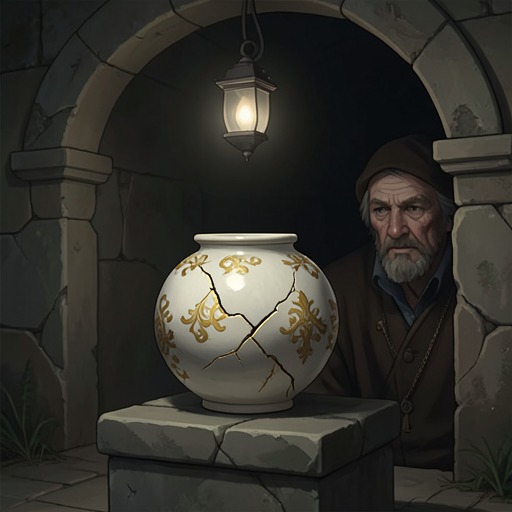
Kintsukuroi (repairing broken things with gold)
BeautifulKintsukuroi (repairing broken things with gold) is a metaphor for carrying damage openly rather than treating it as something to conceal or erase. In Robbie’s conversation with Gideon, it becomes guidance about friendship and vulnerability: Gideon can show Ava his own cracks and accompany her without making her pain a problem he must solve. When the image resurfaces between Ava and Gideon, its hopeful language is tested against the fact that Kelly Waititi is not coming back.
Robbie’s explanation
Gideon first hears about Kintsukuroi while speaking with Robbie about his feelings for Ava. He has admitted that he likes her, but worries that she does not feel the same and that acting on his feelings could jeopardize their friendship. Robbie shifts the conversation from whether Gideon can secure Ava’s affection to how he might meet her honestly. He describes broken porcelain repaired with gold, with the cracks left visible as part of the object’s history. In his account, repair does not mean disguising the break: the visible damage can make what has been mended more beautiful and more valuable.
The metaphor matters partly because Robbie presents it as something he trusts, not as a clever figure of speech invented for the moment. Gideon checks whether it is real and asks whether Robbie has ever lied to him; Robbie’s answer confirms the trust beneath the lesson. That exchange gives the advice an interpersonal basis. The image asks Gideon to believe that acknowledging damage can be more truthful than pretending nothing is wrong, and that doing so need not make a person less worthy of care.
Robbie then extends the image to both Ava and Gideon. Gideon jokingly asks whether Ava is like a Japanese mug, and Robbie answers that Gideon is like one too: everyone has cracks. This response prevents the metaphor from making Ava the sole damaged person in their relationship. Gideon is not an intact helper looking in from the outside. He, too, has a history and vulnerabilities that he may choose to reveal.
Sharing cracks without taking charge
Robbie’s practical advice is that Gideon may show Ava his cracks if he wants to, because they are part of him and might help her. The distinction he draws is crucial: Gideon can help Ava, but he cannot fix her, and fixing her is not his responsibility. Kintsukuroi thus redirects the image of repair away from a rescuer restoring someone else to wholeness. The cracks belong to the person who bears them; revealing them is an act of connection, not a claim of ownership over another person’s recovery.
Gideon understands this as more than a recommendation to be open. He recognizes that pretending everything is all right would also mean denying that he is broken. At the same time, he revises how he sees Ava: she is not a mug he must put back together, handle carefully, or protect from every further break. She is Ava, with serious cracks that, in his understanding, make her more beautiful rather than less. The change is from managing her as a fragile object to recognizing her as a person with whom he can share an imperfect, reciprocal relationship.
His reflection also places their closeness in time. Gideon thinks that Ava might have dismissed him had they met while Kelly was still alive, and that she let him into her life when she did because of what she was experiencing after Kelly’s death. He concludes that she needs him now. That belief carries emotional weight, but Robbie’s warning sets a limit on it: being needed does not make Gideon responsible for repairing Ava. The metaphor supports intimacy only so long as help remains distinct from control.
The metaphor meets grief
Kintsukuroi returns when Ava and Gideon are together and Gideon interrupts her to ask whether she knows what the Japanese do with broken things. He describes pieces being put back together and the gaps filled with gold, so that the breaks become part of the piece’s story and contribute to its beauty. The recurrence links their conversation to Robbie’s earlier counsel, but the exchange changes the emphasis. What had helped Gideon think about how he might support Ava now becomes a shared language for acknowledging pain that neither of them can undo.
Ava answers that Gideon cannot fix it. He says he knows, and recognizes that he cannot fix it either. The pronoun refers to the loss that keeps breaking her heart: Kelly is not coming back. The scene makes the metaphor’s boundary explicit. Gold can give a break a visible place in a mended object’s history; it cannot reverse death or restore the person who is gone. Kintsukuroi offers a way to think about living with damage, not evidence that every grief can be repaired into a resolved state.
Ava’s account of her own response sharpens that limit. She has read blogs and forums and encountered the assurance that time heals all wounds, but rejects it as a false saying. Beside that rejection, the gold-filled crack is not a promise that suffering will disappear with time. Its more modest possibility is that a wound can remain part of a person’s story without being hidden. The cracks may be shown beautifully, as Robbie puts it, but their visibility does not make the loss itself beautiful or make it cease to hurt.
Significance
The image moves between two related but distinct uses. With Robbie, it teaches Gideon how to approach Ava: disclose his own vulnerability, offer support, and resist the urge to fix her. Between Ava and Gideon, it gives them language for damage while exposing the difference between acknowledging grief and repairing its cause. Its recurrence develops the idea rather than simply repeating it; the hopeful counsel is retained, but measured against an irreparable absence.
Kintsukuroi therefore gives the novel a model of care based on recognition rather than restoration. Brokenness is neither denied nor treated as the whole identity of the person who bears it. At the same time, the metaphor does not erase the distinction between damage that can be mended and bereavement that cannot be reversed. The gold is an image for making room for the cracks in a continuing life, not for pretending that the original loss can be made whole again.