Event 1
Fall of Man

The [Fall of Man](entity:event-recall-event-fall-of-man-9f33232da25e) serves as Sartre’s biblical image for original shame: [Adam](entity:character-recall-character-adam-7e6d3c5ddcc8) and Eve’s recognition of their nakedness symbolizes the exposure of human beings as objects in the presence of another subject. The episode gives a concrete form to a general condition, rather than explaining shame as the consequence of a particular wrongdoing.
## The Symbol of Nakedness
Sartre treats modesty, especially the fear of being discovered naked, as a symbolic specification of original shame. The body stands for a defenseless state in which a person is apprehended as an object. In this reading, the Fall’s decisive image is not a detailed account of the biblical event but the moment when Adam and Eve know they are naked.
Clothing becomes the countergesture to this exposure: to dress is to conceal one’s object-state and claim the position of a subject who can see without being seen. The contrast clarifies why nakedness matters in Sartre’s argument. It makes visible the tension between being a free subject and finding oneself fixed as an object for another.
## [Shame](entity:state-recall-state-shame-dd8884546d33) and the Other
The Fall’s symbolic force lies in its connection to the Other’s gaze. Shame is not, in this account, simply guilt over a specific fault. It is the recognition of oneself as an object whose being is exposed, fixed, and dependent on another’s apprehension. The biblical image condenses that broader condition into the discovery of nakedness.
The response to shame is to apprehend as an object the one who has apprehended oneself in that way. Thus the symbol also points toward a reversal: the exposed person attempts to recover subjectivity by objectifying the Other. The Fall of Man figures the vulnerability that initiates this conflict, not a final resolution of it.
Event 2
Founding of Constantinople

The founding of Constantinople is presented as an example of how an intentional act can produce consequences its agent never anticipated. Constantine established a new imperial residence at [Byzantium](entity:location-recall-location-byzantium-4d6e89dc2ec7); the project’s purpose made the act intelligible, while the later growth of a Greek cultural center, a schism in the [Christian Church](entity:organization-recall-organization-christian-church-1587495bf92e), and a weakened [Roman Empire](entity:organization-recall-organization-roman-empire-ecb51fee35ac) exceeded his foresight.
## Purpose and Intention
The account distinguishes an intentional act from an outcome that merely happens. A careless smoker may cause a powder magazine to explode without having acted in the relevant sense; a worker who deliberately dynamites a quarry in obedience to orders does act, because the explosion realizes a conscious project. Constantine’s establishment of a residence in the East belongs to the latter category: he carried out the project of creating a new imperial seat, even though its full consequences were unknown to him.
The founding is therefore not defined by everything that eventually followed. Its sufficient intention was to create a new residence for emperors in the Orient. The act is understood through that aim, rather than by treating every later result as though Constantine had intended it.
## The [Lack](entity:concept-recall-concept-lack-a9bf2909da91) That Organizes the [Project](entity:concept-recall-concept-project-1b64eebd123a)
The purpose of the new residence takes shape through a perceived lack. In the passage’s account, [Rome](entity:location-recall-location-rome-3ec0a741c1f4) needed a counterweight: the existing imperial center could be opposed by a Christian city that did not yet exist. The imagined city was not simply a representation of a possible place. It appeared as something desirable and unrealized, and thus gave direction to the steps that would bring it into being.
This account connects action to a capacity to apprehend what is absent from the present arrangement. The conception of the city organizes the project before its realization; consciousness can thus distance itself from what already exists and orient itself toward what is not yet. Constantinople’s founding illustrates how a perceived deficiency, rather than a motive discoverable among existing facts alone, can make an intentional project possible.
## Unforeseen Consequences
Constantine did not foresee that establishing himself at Byzantium would create a center of Greek culture and language. Nor did he anticipate that its emergence would ultimately provoke a schism in the Christian Church and contribute to the weakening of the Roman Empire. These consequences enlarge the historical significance of the act without changing the account of what Constantine set out to do.
The example separates an agent’s project from the longer chain of effects it sets in motion. The new residence was intentional because it realized Constantine’s stated project; the cultural and political transformations that followed were not thereby shown to have been part of his intention. The founding consequently demonstrates both the purposive structure of action and the distance that can open between a chosen end and the history generated by its achievement.
Event 3
Croix-Rousse工人起义
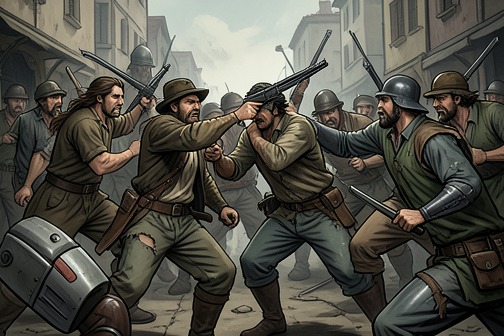
The [Croix-Rousse workers’ revolt](entity:action-recall-action-croix-rousse-workers-r-7a2fa785a387) serves as a compact example of why material suffering does not by itself produce sustained political action. The workers win a riot, yet cannot make sense of their victory; returning home bewildered, they are easily overcome by the regular army. Their defeat follows from a gap between revolt and the capacity to imagine a different social order.
## Victory Without a Plan
After the riot, the workers do not know what to do with their victory. They return home bewildered rather than consolidating it into a next course of action, and the regular army has little difficulty overcoming them. The reversal makes their initial success precarious: an uprising has occurred, but victory alone supplies neither an understanding of what should follow nor the practical direction needed to resist the army.
## Suffering as a Natural Condition
The episode is situated within an argument about how people apprehend historical conditions. The workers’ misfortunes do not seem habitual to them; they seem natural. Their suffering is not detached from their being and considered as a condition that might be otherwise. Instead, it is integrated into the worker’s condition: to suffer and to be are, in this account, one and the same. Because the suffering is lived without being contemplated or valued, it does not yet function as a motive for action.
## Imagining an Alternative
The revolt’s failure is set against a broader claim about social change: a situation becomes unbearable when people can conceive of another state of affairs. A worker in 1830 can revolt when a wage reduction makes a still-worse standard of living imaginable, but the passage distinguishes that immediate response from recognizing existing misery as something that could be abolished. Without the education and reflection needed to envisage a social order in which such suffering would not exist, workers adapt to their condition rather than act to transform it.
Once a different order becomes possible to thought, the present changes meaning. The worker must mentally withdraw from the existing situation, posit a better condition as a possibility not yet realized, and then see the actual situation in contrast to it. Only through that double negation can suffering be recognized as intolerable rather than simply given. The episode thus makes political revolt depend not on suffering alone, but on the emergence of an imagined alternative against which present conditions can be judged.
Event 4
Christmas遭受私刑并死亡
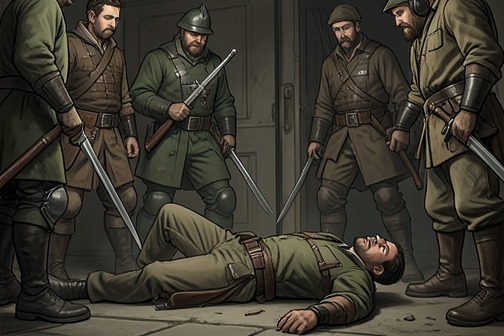
Christmas’s torture and death serve as the culminating example in Sartre’s account of sadism’s failure. Drawing on the closing pages of Faulkner’s *Light in August*, Sartre shows how the victim’s look turns the torturers’ attempt to dominate him into an encounter with a freedom they cannot control; the violence instead fixes their actions in memory and exposes the futility of their project.
## Context and Participants
Sartre introduces the episode while examining the sadist’s effort to appropriate a victim’s transcendent freedom. Treating another person as an instrument cannot deliver that freedom: the sadist can act only on the victim as an object in the world, not possess the victim’s freedom as a subject. The episode from Faulkner’s novel gives this abstract limit a concrete form.
The perpetrators are described as the town’s “good citizens,” who hunt Christmas down and inflict lethal violence on him. Christmas is near death when the scene focuses on his response to them. The passage thus places the victim’s encounter with his torturers, rather than the mechanics of their violence, at the center of Sartre’s argument.
## The Victim’s Look
Christmas lies still, conscious, and looks up at the men. His eyes are described as peaceful, unfathomable, and unbearable. That look reverses the direction of attention: the torturers, who have sought to make Christmas an object of their power, confront themselves as seen by him.
Sartre treats this moment as the victim’s freedom becoming manifest to the sadist. The look makes the torturer experience the alienation of his own being in another person’s freedom. His effort to reduce Christmas to an instrument cannot erase the fact that Christmas remains a subject whose look gives the encounter a meaning the torturer does not command.
## Failure and Consequence
The episode’s consequence extends beyond the immediate encounter. In Faulkner’s scene, Christmas’s image enters the torturers’ memories and remains there. Sartre reads this lasting memory as a reversal: the men who sought to dominate their victim cannot prevent his look from becoming part of their own future experience.
That reversal exposes the failure at the heart of sadism. The sadist wants to enslave freedom, but his attempt can only turn the activity into an objectified property—“sadism”—for the Other. Even humiliation and pleas for mercy cannot make the victim’s freedom something the sadist owns. When Christmas looks at his torturers, the goal of sadism collapses along with the belief that its activity can recover the sadist’s being-for-others.
## Role in Sartre’s Argument
Sartre uses Christmas’s death to return from the apparent position of the one who looks to the condition of being looked at. The sadist’s attempt to control the Other leads back into the same circle: the Other’s freedom can make the sadist an object, just as the sadist has tried to objectify the Other. The scene therefore demonstrates, rather than resolves, the conflict built into being-for-others.
The episode also supports Sartre’s broader claim that sexual attitudes toward the Other cannot be reduced from the outset to physiology. [Desire](entity:concept-recall-concept-desire-b1fd32ef1a7e), love, and related attitudes arise with the body and the Other, while bodily constitution provides their expression under conditions of contingency. Christmas’s look crystallizes the existential limit underlying these attitudes: another person’s freedom can be encountered and affected, but not appropriated as an object.
Event 5
克洛维一世改宗天主教
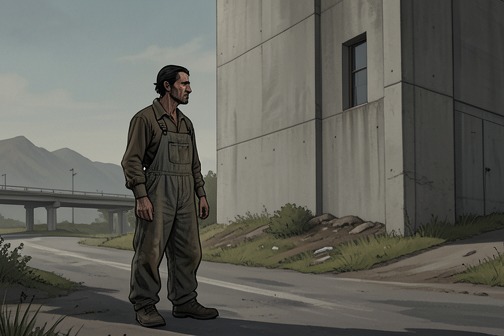
[Clovis](entity:character-recall-character-clovis-92ff17cdbc2a)’s conversion to Catholicism is presented not as an act explained by circumstances alone, but as an example of how a chosen end makes circumstances legible as reasons for action. The political and religious order of [Gaul](entity:location-recall-location-a3505e1f8c28) could count as a cause of conversion only in the light of Clovis’s project of conquering Gaul; with a different end, that same order might support another choice or disclose no reason to act.
## The Historical Example
The discussion begins from the familiar explanatory claim that Clovis converted because many barbarian kings were Arian and he saw an opportunity to win the favor of the episcopate, which held great power in Gaul. This account makes the conversion appear strategically responsive to its setting, rather than a decision detached from political conditions.
The relevant situation is broader than the Church alone. It includes the relative strength of the episcopate, the great landowners, and the common people. These conditions supply the objective circumstances from which a historical explanation can be drawn, but they do not, by themselves, determine what Clovis will do.
## Circumstances and Causes
A cause, in this account, is an objective apprehension of a determined situation as a means capable of serving an end. The situation does not announce its own significance: it becomes a cause only when viewed within a project directed toward a particular goal.
For the episcopate’s power to appear to Clovis as a reason to convert, he must first posit the conquest of Gaul as his end. The relation between circumstance and action is therefore conditional. The political and religious balance can inform a decision, but only through the purpose in whose light its possible consequences are understood.
## Alternative Ends, Alternative Actions
Change the end, and the same Church may point elsewhere. If Clovis pursues another purpose, he might find in the Church’s position a reason to become Arian or to remain pagan. The example thus resists treating the historical setting as a single, fixed cause that mechanically produces conversion.
The circumstances might also yield no cause for action at all. If they are not apprehended in relation to an end, the situation of the episcopate remains unrevealed, in total obscurity. What changes is not the situation itself but its practical disclosure: a project brings certain features forward as relevant, while leaving others without significance for action.
## Significance for the Account of Action
Clovis’s conversion illustrates the distinction between an objective situation and the cause it becomes for an agent. Historical explanation can identify political and religious conditions, but those conditions explain an act only insofar as they are understood within a project. The conversion is therefore neither a mere effect of the balance of power nor an action whose meaning can be read from circumstances in isolation.
The example also makes the agent’s freedom central to explanation. A different end would reorganize the same circumstances into different possible reasons and actions. Clovis’s case shows how a project does not simply select among already self-evident causes; it makes a situation appear as a field of causes at all.
Event 6
君士坦丁大帝改宗基督教
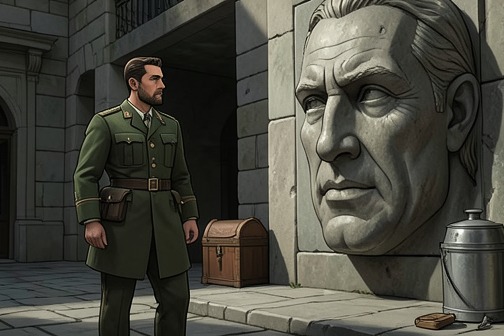
Constantine’s conversion to Christianity serves as an example in an argument about how historical action should be explained. The passage contrasts objective causes, which become intelligible in relation to an agent’s chosen end, with subjective motives, which locate an action in the agent’s psychological state. It treats the conversion not as an event whose explanation can be settled simply by weighing circumstances against an inner impulse, but as a problem that exposes the limits of that division.
## Background and the Problem of Explanation
The discussion introduces the conversion through historian Ferdinand Lot’s assessment that the usual reasons offered for it are insufficient or erroneous. Lot argues that Constantine had everything to lose and apparently nothing to gain by embracing Christianity. Faced with that judgment, he turns from explanation by causes to explanation by motives, proposing a sudden impulse that might be pathological or divine.
The example matters because each explanatory route frames the event differently. A cause-based account would make the conversion intelligible through the objective situation and the ends for which it could serve; Lot’s account instead locates its explanation in the historical agent’s psychic or mental state. The passage presents this shift as a methodological choice rather than as a fact about Constantine’s inner life that the evidence independently establishes.
## Causes and Motives
Causes are objective features of a situation apprehended as useful means toward an end. Motives, by contrast, are the ensemble of desires, emotions, and passions that urge an agent to act. The distinction does not simply place public circumstances on one side and private feelings on the other: circumstances become causes only when a project makes them relevant, while motives describe the subjective pressures associated with action.
The account of Constantine makes the consequence of choosing between these explanations especially clear. If the conversion is attributed to a sudden impulse, the event becomes contingent in a particular sense: another person, with different passions and desires, might have acted differently. The passage contrasts this with the ideal rational act, in which objective appreciation of the situation would guide action and motives would be practically absent. A passionate or irrational act is characterized by the reverse proportion.
## What the Example Establishes
The conversion is not narrated as a scene, and the passage supplies no account of its circumstances beyond Lot’s claim about Constantine’s apparent interests and the inadequacy of customary explanations. Its role is analytic: it demonstrates why historians may fall back on motives when causes seem unable to explain an act, and why that fallback makes the event appear dependent on an individual’s particular psychic state.
The example also prepares a broader challenge to the familiar distinction. Causes and motives may operate together in a single decision, yet they belong to radically different layers of meaning. The passage argues that a theory unable to assign their respective influence when they cooperate will be still less able to explain a conflict in which causes and motives urge different decisions. Constantine’s conversion therefore functions less as a resolved historical case than as a test exposing a problem the discussion says must be reconsidered from the beginning.
Event 7
亚当取食苹果

[Adam](entity:character-recall-character-adam-7e6d3c5ddcc8)’s taking of the apple is treated not as a narrated episode of temptation and punishment but as a test case in the philosophy of freedom. The act engages the whole person who performs it; the decisive dispute is whether that person and the act are already determined by an essence, or whether Adam becomes who he is through a choice that projects him toward ends and possibilities. In this contrast, the apple marks the point where a familiar gesture opens onto a larger question: what it means to be responsible for one’s own existence.
## The act and its possible alternatives
The discussion begins by granting a possibility often associated with freedom: Adam could have refrained from taking the apple. It immediately complicates that claim. The consequences of changing this one gesture are so extensive that a different act would imply not simply a modified episode in Adam’s life, but another Adam. The act is bound up with the person’s character and attributes so thoroughly that its alternative seems to require a different person altogether.
This difficulty gives the example its philosophical force. Adam’s act is not presented as an isolated choice that could be lifted out of his life unchanged. To ask what else he might have done is also to ask who he might have been, and what world that other Adam would inhabit. The comparison therefore tests two accounts of freedom at once: whether an alternative remains genuinely available to the same person, and whether the person’s identity is itself part of what the choice determines.
## [Leibniz](entity:character-recall-character-leibniz-1de558e95c53)’s account of freedom
In the account attributed to Leibniz, freedom brings together rational self-determination, the intelligibility of an act through the nature of its agent, and contingency: other people could have acted differently in the same situation. Adam’s taking of the apple can thus be understood through the person Adam is, while other possible acts belong to other possible Adams. Because those alternatives imply different persons, they also imply other possible worlds, each organized to accommodate its own Adam.
The argument acknowledges the strength of this account: the act engages Adam as a whole, and a different act would make sense only within the compass of a different personality. But Leibniz’s explanation, as presented here, turns that insight into necessity. If Adam’s substance is established first and his act follows from it as a conclusion, then the apparent chronological sequence of person and deed merely expresses a prior logical order. Adam’s essence contains the act in advance, while the alternatives are already located in other possible worlds.
That account also limits Adam’s responsibility. His action may derive from his own essence rather than from an external force, but the essence itself is given to him and chosen by God, not chosen by Adam. He did not choose to be Adam. The passage therefore distinguishes responsibility for an act from responsibility for the being who acts: if Adam’s identity is an unchosen premise, attributing responsibility for the resulting gesture cannot make him responsible for the premise that determines it.
## Existence, ends, and the choice of Adam
The alternative account rejects an essence that precedes Adam’s existence. Adam is defined by the ends he chooses, through an ekstatic temporalization that does not follow the logical sequence Leibniz’s explanation imposes. His contingency is the finitude of that self-choice. Rather than discovering what he is by looking backward to a completed nature, Adam comes to know himself through the future he projects: the organized totality of his tastes, likes, and hates, understood in the light of the ends toward which he moves.
This shift changes the question posed by the apple. It is not only whether Adam chose the gesture, but whether he chose himself in choosing his ends. The argument thus avoids the objection that Adam chose to take the apple without choosing to be Adam: in this account, the problem of freedom lies precisely in the relation between existence and the determination of essence. Adam’s identity is not a settled substance that explains his choice from behind; it takes shape through the project by which he makes himself intelligible.
A different gesture would still imply another Adam and another world, but “another world” no longer means a prearranged collection of possible beings. It means that Adam’s different way of being-in-the-world would disclose a different face of the world. The change is relational as well as personal: the alternative does not merely substitute a new action within an unchanged setting. A changed project would bring another organization of the world into view.
## [Possibility](entity:concept-recall-concept-possibility-7ec8fa91f921) and the order of time
The contrast extends to the status of the possible itself. For Leibniz, the other Adam and his possible gesture pre-exist eternally as possibilities within another possible world. The explanation consequently moves from past to present in a way that reflects an eternal order of essences: Adam is, in the final analysis, a postulate of divine understanding, and contingency is confined to the principle from which the system begins.
Here, by contrast, a possible alternative is not an eternal, fully formed item waiting to be realized. It appears through a new project toward new possibilities: possibility has to be made possible by Adam’s projection. It can then announce to him what he is, rather than simply sit outside time as an abstract alternative. Interpretation accordingly proceeds chronologically and from the standpoint of the future. It does not reduce time to a logical chain of reasons or to a causal-deterministic succession.
The passage qualifies this comparison as a theoretical simplification. At that level, another gesture is possible only with a total overturning of the ends by which Adam chooses himself as Adam; the apparent alternative therefore cannot be treated as a small adjustment made while everything about him remains fixed. Actual reality, the text warns, is more complex. The act’s meaning must be understood through the original ends posited by freedom, but that understanding is not a deduction from a principle to its consequence. The example ends by directing attention away from a ready-made catalogue of alternatives and toward the temporal, future-oriented process through which a person’s act and identity acquire meaning.
Event 8
World War I
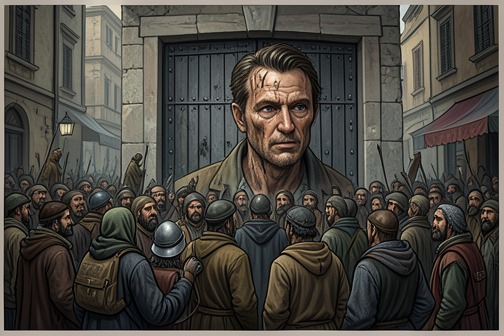
[World War I](entity:event-recall-event-world-war-i-f6ecad7962bb) appears here as an example of how a political project can turn a past event into history: the [United States](entity:location-recall-location-united-states-2f533bc8d0b9)’ entry into the European war of 1914–1918 was initially utilitarian in the account, but its later framing as repayment of a debt of honor to France made the conflict part of a memorialized common past.
## The Event and Its Political Meaning
The account distinguishes participation in the war from the historical meaning assigned to it. When American capitalism chose to enter the European war because it offered opportunities for profitable transactions, that choice was utilitarian rather than historical. The event acquired a different significance when Americans recalled earlier relations with France and interpreted their participation as the repayment of a debt of honor.
## Memory as a Political [Project](entity:concept-recall-concept-project-1b64eebd123a)
The French-American past was not treated as a fixed inheritance that automatically explained the present. A political project selected and illuminated particular elements of that past, giving them a meaning that could justify the present choice and win popular adherence. The phrase “[Lafayette, we are here!](entity:expression-recall-expression-lafayette-we-are-h-7b283bc4c3df)” condensed that interpretation into a public memorial formula: it connected American action in the war to an earlier relationship with France and made economic interests legible as an honorable historical obligation.
## An Alternative [Past](entity:time-recall-time-past-1b203d0e0e2a) and the Meaning of History
The account emphasizes that a different assessment of American interests could have produced another historical narrative. Had the United States sided with [Germany](entity:location-recall-location-germany-2e3723c2f347), advocates might have invoked “blood kinship” and the large proportion of German emigrants to America in the nineteenth century. Such alternatives show that the past offers multiple references that can be reorganized in the service of a present project; the French-American story was constructed, not simply retrieved.
The significance of World War I in this discussion therefore lies partly in the contrast between its immediate economic motive and its retrospective public justification. A society becomes historical not merely because it has a past, but because it reclaims that past as a memorial and arranges it to make present action intelligible. The war becomes a focal point where political interest and collective memory meet, and where the chosen account of earlier relations shapes what the event means.
Event 9
美国参加第一次世界大战

The [United States](entity:location-recall-location-united-states-2f533bc8d0b9)’ entry into [World War I](entity:event-recall-event-world-war-i-f6ecad7962bb) is presented as an example of how political action acquires historical meaning through a society’s chosen interpretation of its past. The decision to enter the European war for profitable transactions is utilitarian; recovering earlier relations with France as a debt of honor turns that decision into a national story, expressed in the declaration “[Lafayette, we are here!](entity:expression-recall-expression-lafayette-we-are-h-7b283bc4c3df)”
## Economic Interest and Historical Meaning
The account distinguishes the United States’ practical motive from its later historical framing. American capitalism enters the war because it sees an opportunity for profitable transactions. That calculation, by itself, is not historical: it treats the conflict as a means to an economic end. The shift comes when the United States connects its present action to earlier relations with France and gives those relations the meaning of an American debt of honor.
This contrast does not deny the economic interests behind the decision. Instead, it shows how a political project can organize the meaning of an action without reducing that meaning to its immediate material motive. The same entry into the war can appear merely utilitarian or become part of a national history, depending on the past invoked to explain and justify it.
## [Lafayette](entity:character-recall-character-lafayette-3d33d4b75550) and the Recovered [Past](entity:time-recall-time-past-1b203d0e0e2a)
The sentence “Lafayette, we are here!” condenses that historical framing. By invoking Lafayette and the earlier connection between the United States and France, the declaration presents American participation not simply as an opportunity for business but as the repayment of a debt of honor. The past is brought forward as a public memorial that helps make the present action intelligible.
The passage stresses that this connection is not the only past the United States might have recovered. Had a different assessment of national interests led it to side with [Germany](entity:location-recall-location-germany-2e3723c2f347), propaganda could have appealed to “blood kinship,” emphasizing the proportion of German immigrants to America in the nineteenth century. The counterfactual makes the selection visible: political circumstances shape which strands of the past are made meaningful in the present.
## A Shared Past Constructed Through Politics
The appeal to France is not dismissed as mere publicity. Such historical references matter because they are necessary to win the masses’ adherence; the masses demand a political project that illuminates and justifies their past. In this account, a society does not become historical simply by having earlier events behind it. It becomes historical by taking them up as a memorial in light of its current project.
The result is the construction of a common French-American past. That story signifies both the Americans’ substantial economic interests and the actual affinities between the two democratic capitalisms. Its coherence comes from gathering those different elements into a shared account of why the present action belongs to a meaningful history. The example therefore portrays national memory not as a neutral storehouse, but as a past organized and given significance by present political choices.
Event 10
妇女向凡尔赛进军

The [October Days](entity:action-recall-action-october-days-7f9bbc435ebd) are presented as a possible consequence and retrospective meaning of the taking of the [Bastille](entity:location-recall-location-bastille-f194d55e095c), not as a settled historical verdict. The passage asks whether the Bastille’s fall was merely a revolt against a partly dismantled fortress or the first display of popular strength that enabled the populace to gain confidence and march on [Versailles](entity:location-recall-location-versailles-b6a47c263b79). Its significance lies in that unresolved choice: later projects continually recast what the past means.
## The Bastille as a Historical Turning Point
The taking of the Bastille in [1789](entity:time-recall-time-1789-4c928437645b) is treated as an immutable fact, but the fact alone does not determine its historical meaning. One reading reduces it to a popular outburst against a fortress already partly dismantled, later elevated into a celebrated deed by the Convention as it fashioned a distinguished past for itself. In that account, the event’s apparent importance is partly the result of subsequent political remembrance.
A contrasting interpretation sees the uprising as the first manifestation of popular strength. On this reading, the populace asserted itself, acquired confidence, and placed itself in a position to undertake the march on Versailles during the [Last Days of October](entity:time-recall-time-last-days-of-october-4403b97b2e6b). The October Days therefore stand in the passage as a possible continuation of the Bastille uprising: an event whose significance depends on whether the earlier revolt is understood as an isolated outburst or as the beginning of popular action.
## Meaning in Suspense
The passage refuses to choose between these accounts as though the answer could be established from the present alone. Someone who decides the Bastille’s meaning today, it argues, risks forgetting that historians are themselves historical: they interpret history in the light of their own projects and those of their society. The Convention’s commemorative use of the event is one example of how political purposes can shape a public past, while the proposed link to the march on Versailles offers another framework for understanding it.
The event’s meaning consequently remains in suspense rather than becoming final. The passage extends this claim from collective history to personal memory: just as societies continually reinterpret their past, a person’s past remains subject to renewed questioning. Such ongoing historicization is described as an affirmation of freedom, because the past’s significance is not fixed once and for all but reconsidered from changing projects in the present.
Event 11
拿破仑远征俄国的撤退
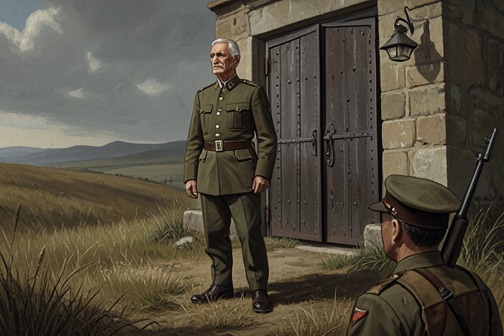
Napoleon’s retreat from [Russia](entity:location-recall-location-russia-8ee8be401081) appears not as a self-explanatory historical memory but as the past a retired soldier makes his own through present choices. By continuing to hope for the Emperor’s return under the Restoration, the old soldier chooses to be a hero of the retreat; he then lives out that identity so uncompromisingly that the past he has claimed helps perpetuate his poverty and failure.
## The [Past](entity:time-recall-time-past-1b203d0e0e2a) Chosen from the [Future](entity:state-recall-state-future-8b0b5d986089)
Sartre presents the soldier’s past as bound to a future-directed project rather than as a force that determines him from behind. The old soldier chooses not to join the government of Louis XVIII or adopt its new customs. He continues to hope for the Emperor’s triumphant return, conspires to hasten it, and prefers life as a retired soldier to service as an active one. Through these choices, he takes the retreat from Russia as his own heroic past.
The contrast with another possible life makes the point explicit: a soldier who had formed the project of joining the new government would not have chosen the same past. The retreat remains the same historical reference, but its meaning in an individual life depends on the end toward which that person acts. The past is not first an independent cause that dictates a present; it becomes this soldier’s past through the future he chooses.
## Conduct and the Burden of a Chosen Identity
The soldier’s commitment is visible in his circumstances and behavior. He lives in almost indecent poverty, is embittered, and longs for the Emperor’s return. Sartre reverses the apparent causal order: the soldier is not simply driven by an already settled heroic past. Rather, his continued longing and refusal to accommodate the Restoration express the past he has chosen to be.
Once claimed, however, that past is not merely an idea he can set aside. His conduct realizes it, and there is no separation between choosing the identity and acting it out. He seeks to make his past glory an intersubjective reality, so that it can exist as an objectivity for others as well as for himself. Officials, for example, react to the danger represented by old soldiers. Their treatment of him places his chosen identity within a public world of judgment and consequence.
## Social Judgment and Consequence
Being treated by others as a representative of the old imperial cause helps shape what the soldier does next. He acts in a way he takes to be worthy of the past he has claimed, becoming intransigent and losing every chance of a pension. His poverty is thus linked not only to his political situation but also to his effort to remain faithful to a self-defined heroic history. He cannot accept conduct that would make him, in his own terms, unworthy of that past.
The example therefore holds freedom and constraint together. The past does not exist as an independent power that mechanically governs the present; yet once the soldier has chosen it, it becomes an integral condition of his project and presses upon his subsequent conduct. The identity is freely assumed, but its public realization and the soldier’s fidelity to it make it increasingly demanding.
## Meaning in the [World](entity:concept-recall-concept-world-37cd00570eef)
Sartre’s example gives historical memory a social as well as personal dimension. A freely chosen past appears in the world, enters relations with other people, and becomes available for their evaluation. The soldier’s heroic self-understanding cannot remain private: his behavior, the officials’ reactions, and his lost pension all give it consequences beyond his own intention.
The retreat from Russia thus illustrates a central tension in Sartre’s account of the past: people choose its meaning in light of what they are trying to become, then encounter that meaning as a concrete obligation embedded in their actions and relations. The soldier chooses the hero of Beresina as his past; in trying to live up to that choice, he is also devoured by it.
Event 12
别列津纳战役
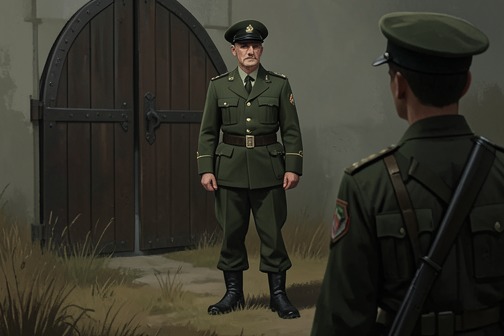
The Battle of [Berezina](entity:location-recall-location-berezina-416dd584c71f) functions in this passage as a past a person chooses and then must live up to. The retired soldier’s identity as a hero of Napoleon’s retreat from [Russia](entity:location-recall-location-russia-8ee8be401081) is neither a deterministic force acting upon him nor a detached memory: it arises through his present commitment to the Emperor’s return, becomes visible to others, and helps govern the choices that keep him impoverished and embittered.
## The Battle as a Chosen [Past](entity:time-recall-time-past-1b203d0e0e2a)
The soldier is retired under the [Bourbon Restoration](entity:time-recall-time-bourbon-restoration-e8f472453621), when Louis XVIII’s government and its new customs offer a political order he refuses to join. He continues to hope for Napoleon’s triumphal return and even conspires to hasten it. In choosing those commitments—and choosing retirement rather than active service—he chooses a past in which he is a hero of the retreat from Russia, associated with the crossing at Berezina.
The example establishes that the past does not act before it is taken up by a present project. A different soldier, choosing to go over to the new government, would not have chosen the same past. Berezina therefore matters here less as a recounted battle than as the historical identity through which the retired soldier understands and directs his life.
## From Identity to Conduct
The soldier’s present circumstances give that identity its force. He lives in almost indecent poverty, is embittered, and longs for the Emperor’s return; the account connects this condition to the past he has chosen. Once he constitutes himself as the soldier of the Empire, his conduct realizes that past. Choosing it and making it real through behavior are not separate stages.
His past also takes on an intersubjective form. He tries to make his former glory an objective reality in the eyes of others, including officials who react to the danger represented by old soldiers. Their treatment of him helps place the imperial identity into the public world, where it is exposed to other people’s evaluation rather than remaining his private recollection.
## The Burden of the Past
The soldier then acts to prove himself worthy of the identity he has claimed. He remains intransigent and thereby loses every chance of receiving a pension: he cannot, within this chosen identity, be unworthy of his past. The commitment that sustains his hope thus also narrows his practical prospects and compounds his present misery and failure.
This is the passage’s reversal: a person freely chooses a past in light of an end, but the past, once embodied in action and exposed to others, imposes itself upon him. It does not possess an independent power that determines him. Rather, it is the materialized form of the end he has made his own, embedded in the shared world and entangled with other people’s judgments. Berezina becomes at once a source of the soldier’s self-understanding and a standard that consumes his freedom of response.
Event 13
第二次世界大战爆发
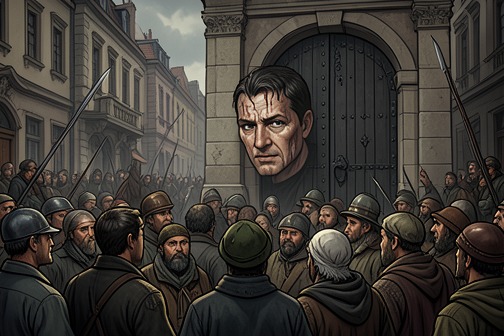
The outbreak of [World](entity:concept-recall-concept-world-37cd00570eef) War II becomes a retrospective hinge: it allows a generation facing the international events of 1938 to recast the years 1918–1938 as the “period between the wars,” turning what had seemed like continuous progress into a bounded and repudiated past. The event illustrates how historical meaning is made through projects that reinterpret what came before.
## The Period Before the Outbreak
For those who had lived through 1918–1938 while projecting themselves toward a future continuous with their present and immediate past, the period had appeared to begin an unlimited progress. Its years were not yet a closed historical block; they belonged to an unfolding continuity.
## Retrospective Reclassification
About 1938, a new generation, preoccupied with international events in preparation, gave those same years a new name: “the period between the wars.” The label anticipated the war that broke out in 1939 and made the interval legible as a period bounded by conflict. In this new light, 1918–1938 was limited, surpassed, and repudiated, rather than understood as the start of an open-ended advance.
## Historical Meaning in Suspense
The contrast is not a change in the dates themselves but in the project through which they are interpreted. A period’s meaning depends on whether it is taken as continuous with the present or held at a distance as a discontinuous fragment from which people are emerging. The outbreak thus supplies the retrospective boundary that makes the label possible, while the later generation’s project determines what that boundary means. The episode exemplifies the broader claim that the meaning of the social past remains perpetually in suspense.