The four horsemen
BelovedThe four horsemen are the party that arrives at 124 Bluestone Road to reclaim Sethe under the Fugitive Slave Law, triggering the infanticide that defines the novel's central trauma. Their arrival is the catastrophic event that shatters Sethe's brief freedom, drives her to kill her crawling-already? daughter, and sets in motion the haunting, the community's shunning, and the long aftermath that structures Beloved.
Composition and Approach
The party consists of four men: schoolteacher, one nephew, a slave catcher, and a sheriff. They ride close together, "bunched-up like, and righteous," carrying the "righteous Look" that every Negro learned to recognize—a flag that telegraphed the faggot, the whip, the fist, the lie long before it went public. Three dismount while one stays in the saddle, rifle ready, eyes trained on the house and the surrounding road, because fugitives often made a dash for it. The men are wary of the quietest ones, who might "roar, like a bull" and grab the rifle; they know a dead nigger could not be skinned for profit. The nephew, who had peeped inside, points his thumb to indicate that what they seek is round back. They move to the left and right of the house, converging on the woodshed.
The Scene in the Shed
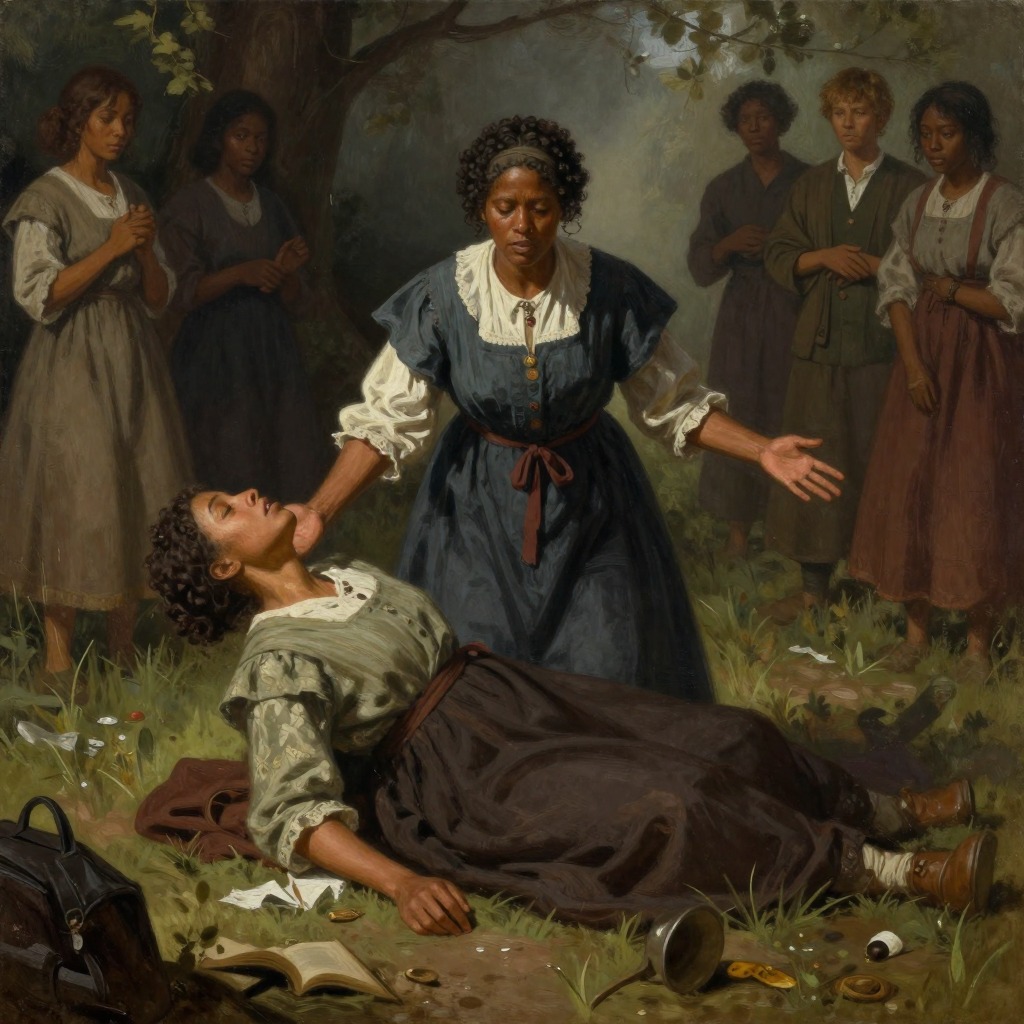
Inside the shed, they find two boys bleeding in the sawdust and dirt at the feet of a nigger woman holding a blood-soaked child to her chest with one hand and an infant by the heels in the other. She does not look at them; she simply swings the baby toward the wall planks, misses, and tries to connect a second time, when the old nigger boy—Stamp Paid, still mewing like a cat—runs through the door and snatches the baby from the arch of its mother's swing. The men stare, amazed. Schoolteacher, especially, realizes there is nothing to claim: the three (now four) pickaninnies they had hoped to take back to Kentucky are not alive and well. Two lie open-eyed in sawdust; a third pumps blood down the dress of the main one—the woman schoolteacher bragged about, the one who made fine ink, damn good soup, pressed his collars the way he liked, and had at least ten breeding years left. But now she'd gone wild, due to the mishandling of the nephew who'd overbeat her and made her cut and run.
The Aftermath and the Sheriff's Response
The nephew, the one who had nursed her while his brother held her down, does not know he is shaking. He asks the sheriff, "What she want to go and do that for?" The sheriff, swallowing hard, tells the other three, "You all better go on. Look like your business is over. Mine's started now." Schoolteacher beats his hat against his thigh and spits before leaving the woodshed. They unhitch the borrowed mule from schoolteacher's horse—the mule that was to carry the fugitive woman back—and tie it to the fence. Then, with the sun straight up, they trot off, leaving the sheriff behind among "the damnedest bunch of coons they'd ever seen," all testimony to the results of a little so-called freedom imposed on people who needed every care and guidance. The sheriff, cold despite the August heat, wants to back out too, but one of the boys on the floor sighs, and that sigh flings him into action. He tells Sethe he'll have to take her in, and when she does not move, he makes up his mind to bind her wet red hands—until Baby Suggs enters and goes straight to the boys, and Stamp Paid trades the living baby for the dead one.
The Significance of the Arrival
The four horsemen's arrival is the novel's central catastrophe, the moment that transforms Sethe's twenty-eight days of unslaved life into eighteen years of haunting and isolation. It is the event that Baby Suggs, standing in the garden, sensed as a "dark and coming thing" behind the scent of disapproval—the high-topped shoes she didn't like the look of. The horsemen's arrival also exposes the community's failure: nobody warned them, and Stamp Paid always believed it wasn't the exhaustion from the feast that dulled them, but some other thing—like meanness—that let them stand aside. The scene is later recalled when Paul D sees the newspaper clipping and when Sethe, in her final breakdown, mistakes Mr. Bodwin's arrival for another horseman, flying at him with an ice pick. The four horsemen thus recur as the archetype of white intrusion, the force that drives Sethe to her most extreme act of motherlove and that the community must ultimately exorcise through the singing women at 124.