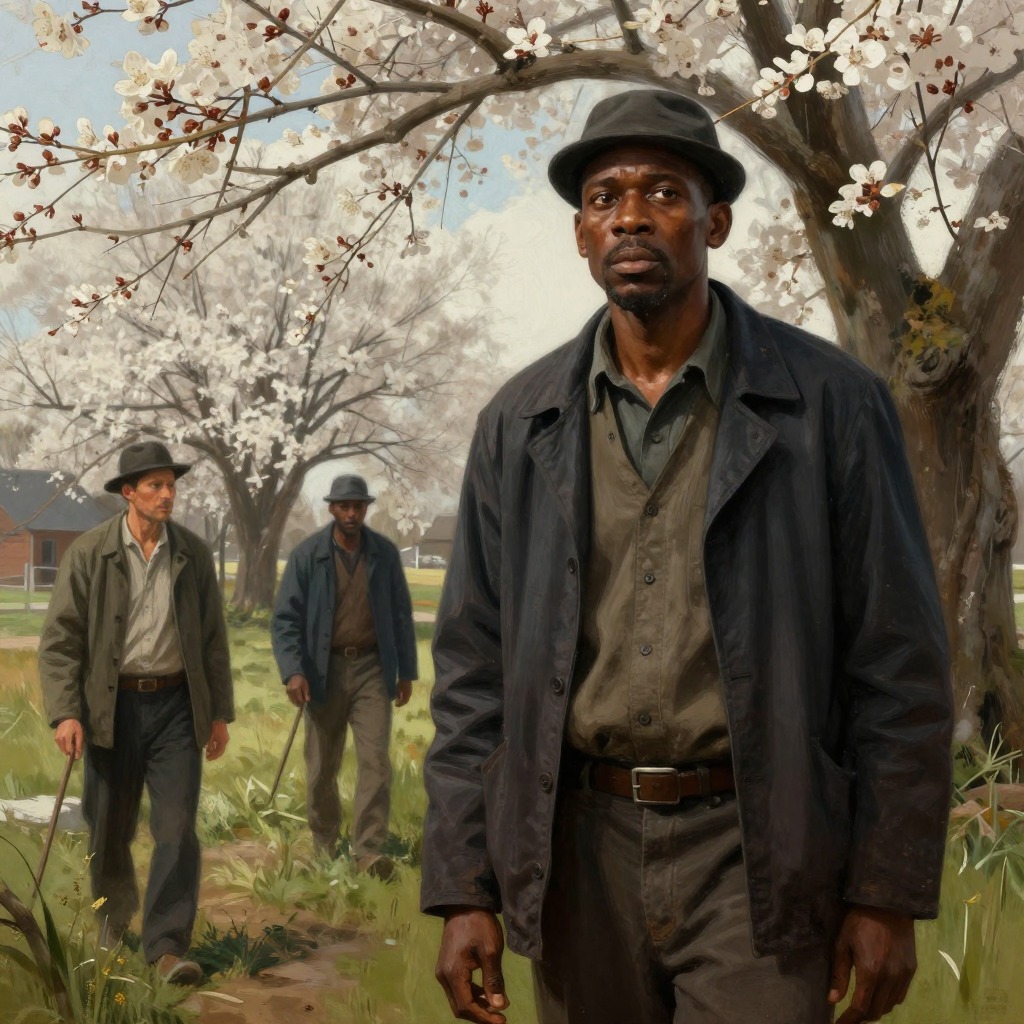
Tree flowers
BelovedTree flowers serve as the natural compass that guides Paul D from the brutal chain gang in Alfred, Georgia, to the relative safety of Delaware, marking his escape as a journey of hope and renewal. After the harrowing flood that nearly drowns the forty-six prisoners, Paul D, the last Buffalo man among the ailing Cherokee, finally asks how to get North. The Cherokee's simple instruction—'Follow the tree flowers'—becomes the organizing principle of his flight, transforming the landscape into a living map that leads him toward freedom.
The Cherokee's Guidance and the Beginning of the Journey
Paul D's escape begins in the aftermath of the catastrophic rain that floods the prison camp, forcing the chain gang to flee through mud and darkness. After weeks with the Cherokee, who call the escaped prisoners 'Buffalo men,' Paul D is the only one left without a plan. He admits his ignorance and asks how to reach the 'Free North. Magical North. Welcoming, benevolent North.' The Cherokee, smiling, points and says, 'That way. Follow the tree flowers. Only the tree flowers. As they go, you go. You will be where you want to be when they are gone.' This cryptic advice sets Paul D on a path that is both physical and spiritual, as he learns to trust the natural world after years of being chained and controlled.
The Race Through Blooming Landscapes
Paul D's journey is a desperate race against time and the changing seasons. He 'raced from dogwood to blossoming peach,' then 'headed for the cherry blossoms, then magnolia, chinaberry, pecan, walnut and prickly pear.' Each tree species marks a stage in his northward progress, and he must move quickly to keep pace with the blossoms that are his only guide. The narrative emphasizes his urgency: 'Spring sauntered north, but he had to run like hell to keep it as his traveling companion.' From February to July, he is 'on the lookout for blossoms,' and when he loses them, he climbs a tree on a hillock to scan the horizon for 'a flash of pink or white in the leaf world that surrounded him.' He does not stop to smell or touch the flowers; he merely follows their wake, a 'dark ragged figure guided by the blossoming plums.'
The Arrival in Delaware and the Symbolic Meaning
The journey culminates in an apple field, where the blossoms are 'just becoming tiny knots of fruit.' This field turns out to be in Delaware, where Paul D meets the weaver lady who takes him in. The apple trees, with their transition from blossom to fruit, symbolize the potential for new life and the end of his ordeal. The tree flowers, ephemeral and beautiful, stand in stark contrast to the ugliness of the prison camp and the dehumanization of slavery. They represent a natural order that is free from human cruelty, and Paul D's ability to follow them signifies his reconnection with a world that is not defined by chains and suffering. The journey also marks a turning point in Paul D's sense of self: he moves from being a man who 'had no idea of what to do' to one who can navigate the world on his own terms, guided by the simple, pure logic of nature.
Narrative Significance and Thematic Resonance
The tree flowers function as a motif of hope and resilience throughout the novel. They are a rare instance of beauty and guidance in a world otherwise marked by violence and loss. Paul D's escape via the blossoms contrasts with the other escapes in the novel—Sethe's desperate flight, Sixo's tragic death—and offers a glimpse of a possible future. The flowers also echo the novel's broader themes of memory and the natural world: just as the blossoms return each spring, so too do the characters' memories and traumas resurface. Yet the tree flowers offer a different kind of recurrence—one that is cyclical, life-affirming, and ultimately redemptive. Paul D's journey, guided by these fragile markers, becomes a testament to the human capacity to find a way forward, even when the path is uncertain and the destination unknown.