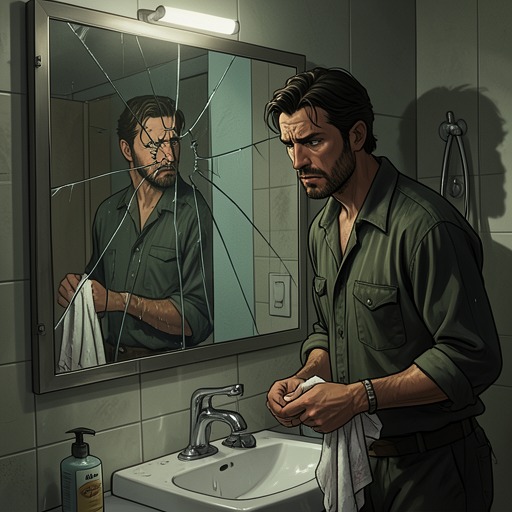
Edison’s overflowing toilet and revelation that he is homeless
Big BrotherEdison’s overflowing toilet and revelation that he is homeless is the turning point at which a humiliating domestic crisis exposes the larger crisis Edison has concealed from his sister, Pandora. The flooded bathroom first makes his distress physically impossible to ignore; then, in the quiet after Pandora helps him clean up, his invented tour and lack of a place to live come into view. The scene shifts the meaning of his visit to Cedar Rapids from an apparently temporary stay to an urgent disclosure of how precarious his life has become.
Background and interruption
The episode begins amid an argument about the cost of Edison’s return to his childhood circle. Fletcher has challenged Pandora to consider whether her brother is taking advantage of her house, family, patience, and money, and what she receives in return. Pandora is still absorbing the question when Edison’s bellow from upstairs interrupts them. The noise registers not as a response to one mishap but as a lament over an entire life, foreshadowing the breadth of what he is about to disclose.
Pandora hurries upstairs and finds the bathroom door shut, water leaking beneath it and spreading across the hallway floorboards toward the stairs. She calls through the door, asking what has happened and urging Edison to unlock it so she can help. His wailing initially leaves him unable to answer. The widening pool turns a private emergency into an immediate threat to the house, but Pandora’s response is to insist on getting in rather than leave him alone behind the locked door.
The bathroom crisis
When Edison finally retracts the bolt, Pandora discovers that he has not evacuated his bowels in quite some time. The toilet is brimming, and waste water has carried feces across the floor: under the sink, beside the shower stall, against the bathtub, and into a dam at the doorway. Two pieces even escape as she closes the door. Edison has pulled up his pants just enough to spare them further embarrassment and sits sobbing on the tub’s edge, his face buried in his hands. Pandora recognizes that the scene might appear comic, but refuses to treat his distress as a joke.
She manages the mess with brisk, practiced efficiency, recalling how their mother changed the children’s wet sheets without turning the accident into a spectacle. Pandora plunges the toilet, which is stopped up with waste and paper, then puts on rubber gloves and moves the scattered feces back into the bowl, flushing at intervals. She uses old towels to soak up the water, retrieves the two pieces that escaped beneath the door, and dries the hall. Her unfazed manner makes the cleanup feel routine even as its circumstances make clear how far Edison’s bodily and emotional distress has overwhelmed him. By the time the spreading mess is under control, his howling has fallen to irregular sobs.
After telling Edison to fasten his fly, Pandora removes her gloves and sits beside him on the rim of the tub, putting an arm around his shoulders. She answers his shame with a childhood memory: as a child, she feared that the water in the toilet bowl would keep rising after she flushed. Her recollection does not erase the humiliation, but it gives her a way to meet it without scolding him. The overflowing bowl has made the fear literal; Pandora’s small gesture of companionship helps move the scene from exposure toward an admission.
The invented future falls away
Edison says that Fletcher is right and that all he does is humiliate himself. Pandora tries to lend the crisis a future in which it will become a funny story they can share over the phone while he is on the road in Portugal. Edison answers that there is no Portugal. Pandora initially keeps up the light tone, joking that this will surprise the people who live in Lisbon, but his next clarification removes the basis for the reassurance: there is no tour.
Pandora lets the disclosure sink in and recognizes that, deep down, she had suspected the tour did not exist. She asks what will happen when Edison flies back to New York on Tuesday and whether he has somewhere to live. He answers no. This is the scene’s decisive reversal: the future journey Pandora had imagined as a comforting prospect is revealed as another fabrication, while the question of his immediate housing has no answer. The toilet’s physical overflow gives way to the underlying fact that Edison has no secure place to return to.
Homelessness and family obligation
Pandora asks what has happened to the gigs Edison had said were coming in the spring; a flick of his head indicates that they, too, are gone. His account of work and travel has concealed both the absence of the promised engagements and his lack of housing. When Pandora asks why he felt compelled to invent these things, Edison explains that he could hardly show up in Cedar Rapids and announce that he had come to stay for the rest of his life. The fabrication is thus tied directly to the difficulty of asking his family for an indefinite place to stay.
Pandora names the eating as an attempt to compensate, forget, hide, or otherwise endure what is happening, while acknowledging that she does not know exactly what is driving it. She tells him he cannot continue this way. Edison replies that perhaps he does not want to. The exchange does not provide a solution to his homelessness or establish what he will do next. Instead, it brings his concealment to an end and leaves Pandora facing both the immediate need beneath his stay and the limits of what can be repaired through one act of care.
Narrative significance
The scene links bodily disorder, economic insecurity, and family obligation without making them interchangeable. The toilet is a concrete emergency that demands work: Pandora must open the door, clear the blockage, and dry the floor. Yet cleaning the bathroom does not resolve what the conversation uncovers. Edison’s lack of a home, vanished gigs, and invented tour remain after the water has been mopped up, so the domestic cleanup becomes the threshold to a more consequential truth.
Its tonal movement is equally important. The scene begins with Fletcher’s sharply phrased suspicion that Edison is using Pandora, passes through a spectacle that could invite ridicule, and settles into the intimate image of Pandora sitting beside her brother with an arm around his shoulders. Her childhood memory and attempts at humor offer tenderness, but neither cancels the material facts he reveals. By the end, the family question posed before the interruption has become harder rather than simpler: Pandora knows what Edison has been hiding, but the disclosure itself does not settle how long she can house him or what help will change his circumstances.