Tuber
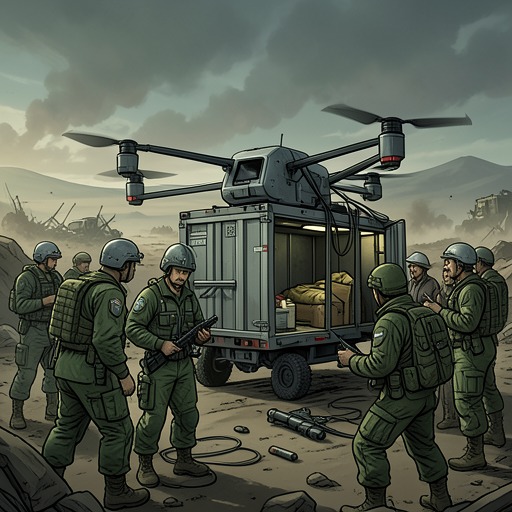
BlackwaterTuber are artificially created humans grown in large numbers and tailored for specific duties, from combat to manual labor. The concept joins engineered capability to legal exclusion: Tuber are forcibly sterilized and barred from public office, although combat templates may hold officer ranks. In the military, they are valued as highly trained specialists—and treated as replaceable lives.
Creation and Legal Status
Tuber are not simply people who choose a military or industrial occupation; they are made for assigned kinds of work. Their production at scale and tailoring to particular duties establish a social order in which human beings are classified by intended function. The account of their status makes that ordering explicit: they are forcibly sterilized and prohibited from holding public office. The narrow exception for combat templates, who may attain officer rank, grants some of them authority within the armed forces without removing the broader political restriction.
That combination—military responsibility alongside civic exclusion—makes their position contradictory rather than straightforwardly empowered. A Tuber may be trusted with command in combat, but Tuber as a group remain denied reproductive autonomy and ordinary access to public office. The distinction is built into the rules governing them, not presented as a consequence of any individual failure.
Military Use and the Logic of Replaceability
The military rationale is clearest in torpedo attacks. A torpedo must approach a ship at a precise right angle to its hull for its vacuum-bomb warhead to achieve the intended yield. That straight course makes the attacker easier for point defenses to track, so the pilots delivering the weapon need exceptional reflexes and anticipation. Tuber are engineered as superior pilots, with peak human reflexes and instincts developed through a lifetime of training; the expectation is that they can evade fire while holding the attack line and speed.
The same passage lays bare the cost of this design. The reasoning treats a Tuber killed in the attack as readily replaceable because more can be grown, and contrasts that assumed replaceability with the value assigned to Rocco Swift himself. Rocco would not say this to the Tuber’s faces, but the unspoken restraint does not alter the military calculation: their training is prized precisely where it can be spent in missions expected to be lethal. Their skill and their disposability are not opposing features of the system; the latter helps make the former militarily useful.
Social Difference and Everyday Treatment
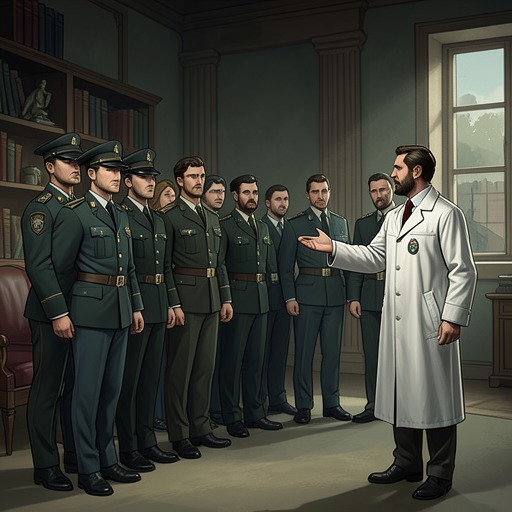
Tuber embodiment is also made visible in ordinary encounters. After a briefing aboard the PFSS Grain & Steel, Rocco Swift notices the white-haired leader of 4th Squadron, whose gold eyes mark him as physically unfamiliar to Rocco. Rocco reflects that Tuber appearance can be unpredictable when people are grown to express particular traits, while acknowledging that he rarely considers this. The moment registers both designed variation and the distance between an engineered person and the assumptions of someone who has not often thought about that difference.
The scene does not reduce the other commander to his appearance: he stops Rocco’s casual address and insists that he has a name. That small correction sits alongside the larger institutional definition of Tuber as a category of people grown for functions. Individual identity is present, but it has to assert itself within a world inclined to notice the designed body first.
Institutions and Narrative Significance
Tuber status intersects with military hierarchy and political administration in ways that shape practical decisions. When a Union personnel officer says that pilots’ leave has already been approved, the officer distinguishes the pilot away responding to an SOS from those who would have to be recalled individually. Henri Marcell then demands complete personnel files and qualifications and orders the SOS pilot transferred to his ship as soon as the pilot’s duty day ends. The exchange concerns staffing, not a debate over Tuber rights; it nonetheless places personnel availability, leave, and assignment within the machinery that directs military labor.
In a separate operation, political officer Ewart reports that an IRS agent aboard the ship is telling Admiral Gray about a hidden Tharcian carrier in the lower shoal zone. Captain Kain wants the agent removed and proposes sending him to lead a search party. Because 3rd Squadron has lost its commander, Agent Raven is to fill in, but an actual squadron commander must accompany the mission in case something goes wrong. Rocco Swift is told to deploy with 2nd Squadron so the arrangement will look credible to Admiral Gray. His question about why they are not using Tuber pilots points to their place in the available military workforce, while the deception and command requirements show that their use is governed by operational needs rather than a simple rule that they always take the riskiest assignment.
The concept also sharpens the story’s broader contrast between formal structures and wartime improvisation. Commander Anna explains that her ship is meant to attack the Union in a way it is unprepared for, so its mismatched crew is part of its unconventional purpose. Within that setting, Tuber appear as capable people whose engineered bodies and skills are recruited into flexible military plans, while legal restrictions and assumptions of replaceability constrain how the institution values them. Their presence makes military efficiency inseparable from the question of whose lives the system is prepared to spend.