Mad Macka’s abalone boat
BluebackMad Macka’s abalone boat is both the vessel on which Mad Macka’s solitary diving operation depends and, after his death, the boat given to Abel Jackson. Its story turns on a change of purpose: first a working platform tied to a dangerous underwater routine, then a vessel Abel learns to handle and takes along the coast. The compressor, airhose, dive flag, and later removal of the hookah make that change visible in the boat’s equipment as well as in its use.
The working boat and Mad Macka’s final dive
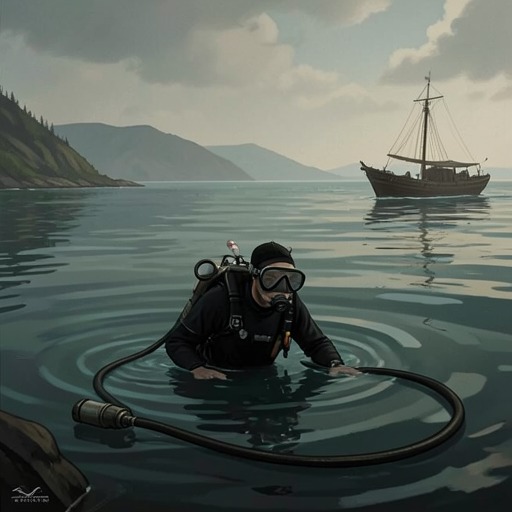
Mad Macka’s abalone boat is introduced as a lonely yellow vessel drifting on Longboat Bay, pulled along by the unseen diver at the end of an airhose. A blue-and-white diver’s flag flaps on deck, the only movement in the scene. The compressor has been thrumming through the morning, but when it falls silent, Abel Jackson sees that the orange hose is still out and understands that something has gone wrong below. The boat’s quiet is not merely a pause in its work: it signals the danger of a diver who has chosen to work alone.
The boat’s association with risk is sharpened by the history of diving along the coast. A few years earlier, a great white shark had bitten another abalone diver in half, and divers usually worked in pairs for safety. Mad Macka preferred to work alone. Every season Dora Jackson welcomed him into the bay, yet the sight of his isolated yellow boat made her shudder apprehensively. The vessel therefore stands at the intersection of ordinary seasonal labour and a known, persistent danger: its equipment keeps Mad Macka connected to the surface, but it cannot guarantee his return.
When the compressor stops, Abel and Dora Jackson race across the bay in their dinghy and tie up alongside the abalone boat. Dora strips off her jeans, boards it, takes Mad Macka’s spear gun, and opens his toolbox. Her hands shake slightly as she fits a powerhead to the spear. She orders Abel to stay in the boat and enters the water, following the airhose down. After a few seconds she surfaces, unscrews the powerhead, passes the speargun up, and climbs the ladder onto Mad Macka’s boat. She begins pulling in the hose and concludes that Mad Macka has had a heart attack: there is no mark on him, and he may have been unable to swim back before the compressor ran out of fuel. She asks Abel to get a grapple. The boat is the point from which Dora must act, and the equipment around it makes the limits of rescue plain: she can reach Mad Macka and bring him up, but cannot undo the fatal failure below.
A gift and a change of purpose
Before the summer holidays, Dora writes to Abel with news that Mad Macka’s family has decided to give him the boat, its trailer, and everything with it. The gift arrives after the boat has become inseparable in Abel’s memory from the silent compressor and his mother’s dangerous descent. He counts the days until he can return home. The transfer does not erase that history, but gives the vessel a future beyond Mad Macka’s solitary diving.
On Abel’s return, he finds the boat on the beach. It is a five-metre catamaran, wide and stable as a house. Dora has worked on its motors: four-stroke fifties that she considers good outboards. Abel climbs aboard and tries not to think about his last time in it; the dive flag hangs limp. The still flag recalls the earlier emergency, when the boat’s work had stopped because Mad Macka was in trouble underwater. Now Dora tells Abel to clean the vessel himself, and says they will take the compressor off that day because they will not need the hookah. The practical alteration is also a decisive break with the boat’s former role: it will no longer depend on the surface-air system that defined Mad Macka’s work.
Learning to take the boat out
Abel does not immediately command the boat on his own. Dora teaches him how to handle it, use the echo sounder and radios, and trim the outboards for different sea conditions. They spend several days in the bay before moving out to Robbers Head and then taking the boat onto the dark open sea. Abel steers across the sloping backs of ocean swells as the land diminishes behind them. The sequence makes his growing competence a practical process, acquired through instruction and increasingly demanding journeys rather than bestowed with the gift itself.
The boat also carries Abel into a different kind of work. On one outing he and Dora drift all afternoon with heavy handlines baited with squid. Snapper and morwong rise flashing from the deep, and Abel lays the catch on ice while feeling the wind in his hair. The boat is now a place for fishing and shared time with his mother, not a solitary diver’s base. Its stability and equipment support Abel’s movement from sheltered water toward the open sea, while his mother remains beside him as teacher and companion.
As Abel’s skill and confidence grow, he takes the boat up and down the coast. He pulls into small sheltered coves, swims with Dora beneath cliffs and trees loud with birds, speeds near long beaches, and stays just behind the breakers. Dolphins rise in the bow wave; huge schools of tuna feed around the boat on baitfish. These journeys widen the scale of Abel’s experience: from the close, repetitive work of picking abalone to coastlines and waters that make him feel small. Later, curiosity again takes him out in the boat, this time to watch a tiger shark swimming painfully up and down the beach. The vessel gives him a way to approach the scene, but not a way to save the shark; he watches from the boat and later from the jetty as its suffering continues.
Significance
The boat’s changing equipment and uses give its inheritance a concrete shape. Under Mad Macka, it is a solitary work platform marked by the compressor, airhose, and flag; after the fatal dive, the family’s gift allows Abel to learn the motors, sounder, radios, and demands of open water. Removing the hookah is a clear practical separation from the work that ended in disaster, while retaining the vessel itself carries Mad Macka’s legacy forward in altered form.
For Abel, the boat becomes a means of learning through movement: he first practices in the bay, then steers beyond the coast, fishes, explores, and observes marine life. It does not make the sea safe or fully knowable. The earlier emergency and the later sight of the injured tiger shark make the limits of human control persist even after the boat has changed hands. Its inheritance is therefore neither a simple replacement for Mad Macka’s loss nor a guarantee of mastery. It gives Abel the means to go farther, with Dora’s teaching, while leaving the sea’s risks and scale intact.