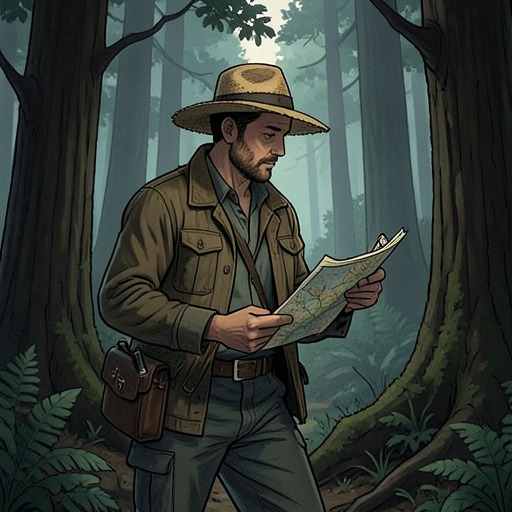
Candide's capture and escape among the Oreillons
CandideCandide's capture and escape among the Oreillons turns a mistaken act of rescue into a perilous encounter, then reverses the danger through Cacambo's quick reasoning. Candide first believes he has saved two women from attack; only afterward does he discover that the monkeys were their companions. When the Oreillons seize the travelers, they take Candide for a Jesuit and prepare to punish him. His escape depends on proof that he has killed a Jesuit himself, leaving him to recognize how much his safety rests on a chain of misunderstandings.
From the Meadow to Capture
The episode begins after Candide and Cacambo have crossed a barrier before the camp learns that the German Jesuit is dead. Cacambo has prepared for the journey with bread, chocolate, bacon, fruit, and wine, and they travel on Andalusian horses into country without a beaten track. They stop in a meadow to feed the horses and eat. Candide, still distressed by the thought that he has killed Cunegonde's brother and may never see Cunegonde again, questions the point of continuing his life far from her. Yet, even as he laments his fate, he goes on eating.
At sunset, cries lead the travelers to two women pursued by two monkeys. Candide interprets the scene as an assault. Having learned to shoot during his service in the Bulgarian army, he takes up his double-barrelled Spanish fusil and kills both animals, believing he has rescued the women from danger. He imagines that they may be young women of rank and that the act could bring him favor in the country. The confidence of this conclusion makes the reversal sharper: the women rush to the monkeys, embrace them, and mourn them. Candide's intervention has killed their companions, not rescued them from attackers.
The Oreillons' Mistaken Accusation
Cacambo recognizes the danger in the women's response and warns Candide that they may retaliate. The two men leave the meadow, take supper in a wood, and fall asleep on moss. During the night the women report them to the Oreillons, who bind the travelers with cords made from tree bark. Candide and Cacambo wake unable to move, surrounded by fifty armed Oreillons. Some prepare a cauldron and others spits; the group identifies Candide as a Jesuit and announces its intention to avenge itself on one.
The accusation rests on what Candide appears to be, rather than on what he has done. He is wearing the spoils of the Jesuit officer he killed, and the Oreillons take that clothing as evidence that he belongs to the Jesuits. The mistake places him under threat precisely because of the earlier killing that had already caused his grief. Candide asks Cacambo to explain why their captors should not eat them, but Cacambo understands that a direct appeal to Christian mercy is unlikely to settle the matter.
Cacambo's Case and Their Release
Cacambo speaks to the Oreillons in their language and makes a practical argument. He acknowledges that they are about to take an enemy's life, then distinguishes an enemy from a friend: Candide, he says, is their master and ally, not a Jesuit. Cacambo explains that Candide has killed a Jesuit officer and wears the man's clothes; the clothing, rather than proving Jesuit identity, is the consequence of Candide's attack on one. He offers a test rather than asking the Oreillons to accept his assertion. They can carry the clothing to the nearest Jesuit barrier and verify the claim; if Cacambo has lied, they can still punish the prisoners afterward.
The Oreillons find this account reasonable and send two leading members to investigate. When the delegates return with confirmation, the Oreillons untie Candide and Cacambo. They treat the travelers courteously, offer refreshments, and escort them to the boundary of their territory. Their public rejoicing that Candide is not a Jesuit completes the change in his status: the same man who had been bound for supposed membership in an enemy group is released because the evidence establishes that he killed one of its members.
Reversal and Significance
Candide is astonished by the grounds of his escape. He concludes that if he had not run Cunegonde's brother through the body, the Oreillons would have eaten him; he then reasons that nature must be good because the Oreillons showed him kindness once they knew he was not a Jesuit. The episode makes his conclusion deliberately unstable. Their hospitality is real, but it follows a specific distinction between friend and enemy, tested through investigation. Candide's relief turns on that distinction rather than on any general guarantee that events are just or safe.
The scene also compresses the tale's recurring collision between abstract explanations and particular circumstances. Candide's first judgment of the monkeys is overturned by what he sees next; the Oreillons' judgment of Candide is overturned by the evidence Cacambo supplies. Both reversals arise because appearances and assumptions misidentify the relationships at stake. Against Pangloss's confidence that events fit an orderly best, survival here depends on a contingent history: Candide has killed a Jesuit, Cacambo can explain the killing, and the Oreillons agree to check his account. The travelers then continue into an unknown country, where their astonishment at unfamiliar customs prepares the next stage of their journey toward El Dorado.