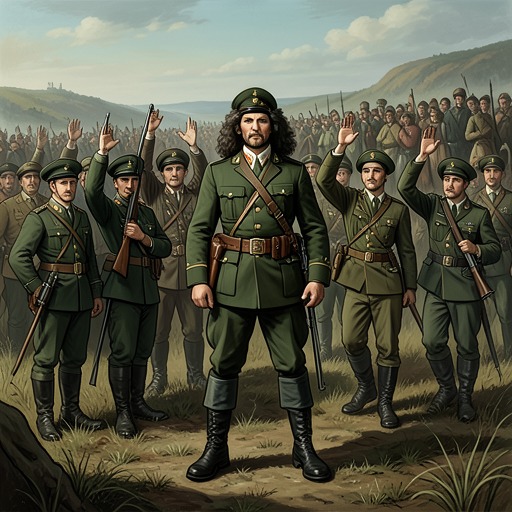
The Bulgarian-Abarian war and village massacres
CandideThe Bulgarian-Abarian war and village massacres are a turning point in Candide’s flight from military service: a battle staged with the instruments and ceremonies of public honor becomes an encounter with mass death and reciprocal destruction of civilian villages. Candide’s decision to leave the battlefield carries him beyond the armies’ claims of glory and toward the next stage of his journey.
Battle and its public spectacle
The two armies are introduced as polished and splendid, accompanied by trumpets, fifes, hautboys, drums, and cannon. That ceremonial soundscape stands in sharp contrast to the scale of the killing. The narrator estimates that cannon fire killed about six thousand men on each side; muskets killed another nine or ten thousand, and bayonets accounted for several thousand more. The total, given approximately, may have reached thirty thousand.
Candide does not join the fighting. Trembling, he hides as best he can while the battle unfolds. The contrast between the armies’ outward brilliance and his fear punctures the language of military heroism: the conflict’s pageantry accompanies a catastrophe measured in tens of thousands of lives.
Candide leaves the battlefield
When the two kings have a Te Deum sung in their respective camps, Candide resolves to go elsewhere to consider effects and causes. The religious ceremony follows the battle without undoing its human cost; the rulers’ celebration and Candide’s flight occupy sharply opposed responses to the same violence.
Candide crosses the battlefield’s aftermath and reaches a nearby village that the Bulgarians have burned. The village belongs to the Abares, and its destruction is described as being carried out according to the laws of war. Candide then flees to a Bulgarian village, which the Abares have treated in the same way. The sequence makes the devastation reciprocal: each army’s violence against a settlement is answered by the other’s destruction of a settlement belonging to its opponent.
Flight and immediate aftermath
Moving through the ruined villages and beyond the seat of war, Candide carries only a few provisions in his knapsack. His thoughts remain with Cunegonde as he escapes. The battle therefore does not resolve his personal purpose or give him safety by itself; it displaces him, leaving him to continue with limited supplies and the hope of finding her.
His provisions run out when he reaches Holland. Having heard that the country is wealthy and Christian, Candide expects to receive the kind of welcome he once experienced at the Baron’s castle, before his love for Cunegonde led to his expulsion. The expectation links his flight from the war to the next test of his faith in social and religious claims: survival beyond the battlefield still depends on how other people treat him.