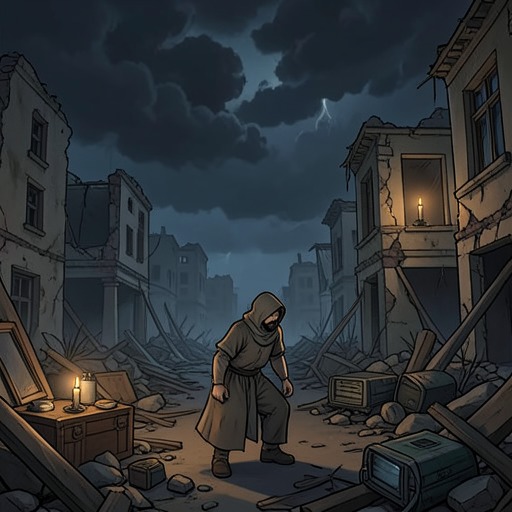
Lisbon's earthquake-ravaged ruins
CandideLisbon's earthquake-ravaged ruins turn a catastrophe into a test of competing explanations: the earth convulses, people try to survive and assist one another, and authorities answer devastation with a ritual they believe can stop further shocks. In the aftermath of the 1755 Lisbon earthquake, the city's destruction exposes the distance between Pangloss’s theory that everything is for the best and the suffering it must explain away.
The earthquake and the ruined city
The disaster begins at sea, within sight of Lisbon, when a violent tempest assails the ship carrying Candide and Pangloss. After the vessel founders, they reach shore on a plank; their benefactor, James the Anabaptist, has drowned, and the sailor who helped bring about his death survives. The earthquake follows as Candide and Pangloss approach the city, making the journey from shipwreck to urban catastrophe a sequence of losses rather than a rescue from danger. The ground shakes, the harbour surges against vessels at anchor, and fires, ash, and collapsing buildings devastate streets and public places. The narrative reports that thirty thousand inhabitants, of all ages and sexes, are crushed beneath the ruins. The episode is anchored to a historical date: a footnote identifies the 1755 Lisbon earthquake as occurring on November 1, 1755. By bringing a large-scale calamity into the same account as the loss of an individual benefactor, the narrative sets collective destruction alongside the particular lives already endangered on the voyage.
Explanations, need, and relief
Pangloss tries to incorporate the Lisbon shock into an account of connected causes, comparing it with earthquakes in Lima in America and proposing a subterranean chain of sulphur between the two cities. Candide accepts that explanation as possible but asks instead for oil and wine while wounded and in need of immediate help. His request shifts attention from abstract demonstration to the practical requirements of survival; Pangloss, however, insists that the idea can be proved. After Candide faints, Pangloss brings him water from a nearby fountain. The following day, they search the ruins for provisions and regain some strength. They then join others in helping inhabitants who survived. Those they assist share what food they can, and the meal is marked by grief: people moisten their bread with tears. Pangloss consoles them by maintaining that events could not have happened otherwise. The ruins thus hold two responses at once: concrete mutual aid among survivors and a philosophical explanation that turns suffering into part of an allegedly necessary order.
The auto-da-fé and renewed disaster
After the earthquake has destroyed three-fourths of Lisbon, the authorities’ proposed remedy is a public auto-da-fé. A decree identified as the Coimbra University’s Anti-Earthquake Auto-da-fé Decree declares that burning people alive slowly and ceremonially will prevent the earth from shaking. The measure converts disaster response into punishment, treating ritual execution as protection rather than addressing the destruction and people’s needs. Pangloss and Candide are arrested: Pangloss for speaking his mind, and Candide for listening with apparent approval. Eight days later they are dressed for the procession in san-benitos and paper mitres, with different images painted on their garments. Candide is whipped, several other prisoners are burned, and Pangloss is hanged, although the narration notes that hanging is not the usual custom. On that same day, the earth shakes violently again. The renewed tremor does not validate the ceremony’s promise; instead, its close timing with the punishment exposes the failure of the supposed preventive measure.
Significance in the wider narrative
The ruined city places Pangloss’s optimism under pressure without bringing it to an end. The theory already appears in his account of the Baron's castle as the finest of castles in the best of all possible worlds; at Lisbon, the scale of death and destruction gives that claim a devastating setting. Candide’s questions and requests for help register needs that Pangloss’s explanations cannot meet, while the effort to assist survivors offers a more immediate response than either speculation or ritual. The catastrophe also remains part of the novel’s chain of causes after the characters leave the ruins. Much later, when Candide asks Pangloss whether he still believed everything happened for the best after being hanged, dissected, whipped, and sent to the oar, Pangloss refuses to retract his position. At the end, he again folds Candide’s expulsion, punishment by the Inquisition, travels, and other reversals into a single account of events leading to their present meal. Candide answers by turning away from the argument toward cultivating the garden. In that larger pattern, Lisbon’s ruins are not a self-contained illustration of disaster: they are a decisive instance of catastrophe being explained, punished, endured, and eventually set beside practical work.