Baron Vordenburg's papers
Baron Vordenburg's papers are the crucial archival key that unlocks the mystery of the vampire Mircalla, Countess Karnstein, and makes possible her final destruction. Without the documents—a collection of journals, tracings, and a confession left by the Baron's ancestor—the party searching for the vampire's tomb would have remained helpless, and the plague that had scourged the region for more than a century would have continued unchecked. The papers not only pinpoint the exact location of the grave but also reveal the ancestor's own anguished history with the vampire, his original decision to conceal her remains, and his eventual, belated repentance.
Contents and Origin
The papers are the work of the Baron's ancestor, a man who in his very early youth had been a passionate and favored lover of the beautiful Mircalla, Countess Karnstein. Her early death plunged him into inconsolable grief. When he discovered that Mircalla had become a vampire—haunted by one of those demons after her own suicide—he conceived a horror of her remains being profaned by the outrage of a posthumous execution. He therefore adopted a stratagem: he journeyed to Karnstein, pretended to remove her remains, and obliterated her monument so thoroughly that its site was quite forgotten. The papers he left behind include the tracings and notes that would later guide his descendant to the very spot, as well as a confession of the deception he had practiced. The collection also contains a curious paper arguing that the vampire, on its expulsion from its amphibious existence, is projected into a far more horrible life—a belief that had originally motivated his concealment of the grave.
Discovery and Use
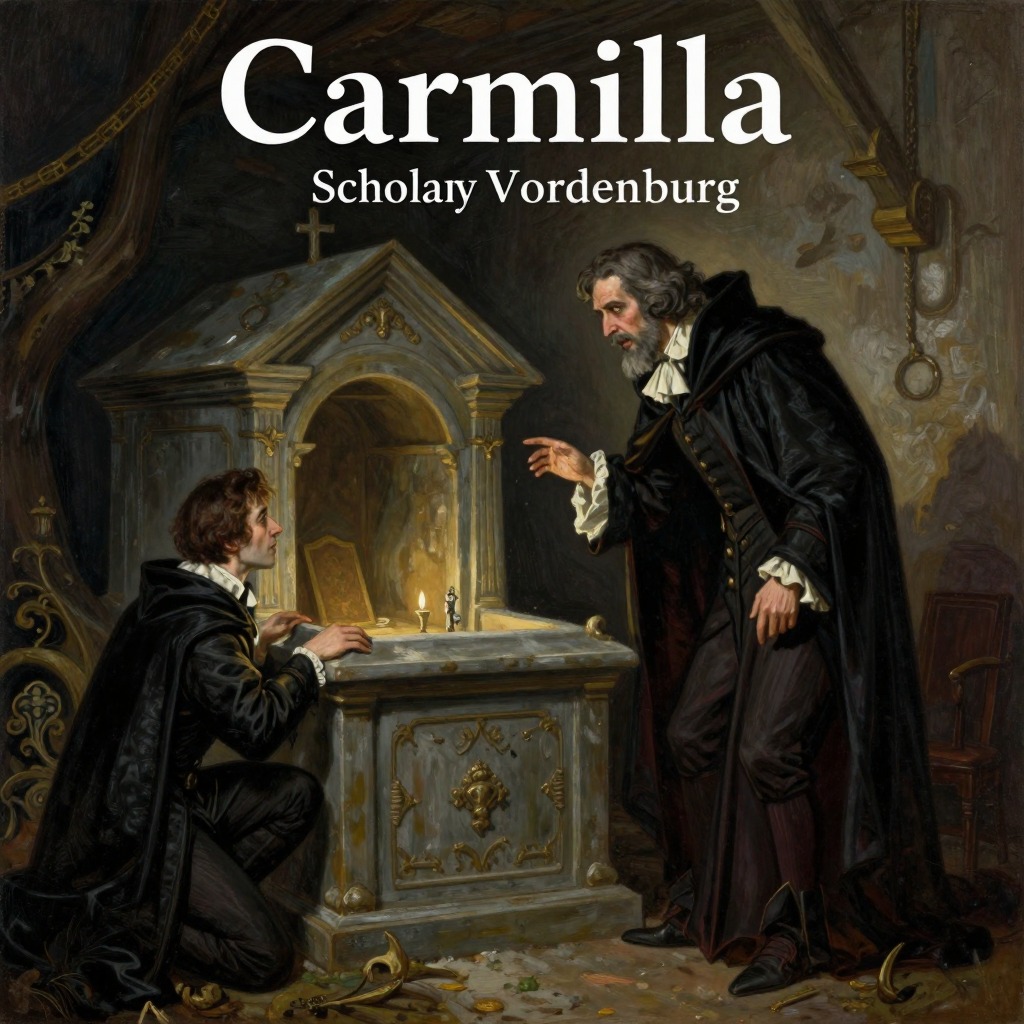
When the party—Laura, her father, and General Spielsdorf—arrived at the ruined Chapel of Karnstein, the General was already in despair of finding the tomb. The woodman they consulted could tell them nothing of the monuments, and the local forester confirmed that not a soul living could point out where the Countess's grave had stood. It was at this moment that Baron Vordenburg himself appeared, a tall, narrow-chested, stooping man in black with gold spectacles and a perpetual smile, carrying a roll of paper and a dirty little book with closely written yellow leaves. He spread the paper on the worn surface of a tomb and traced imaginary lines from point to point, occasionally reading from his book. Together with the General and Laura's father, he began measuring distances by paces, examining a piece of the side wall with great minuteness, pulling off the ivy, and rapping the plaster. At length they ascertained the existence of a broad marble tablet with letters carved in relief—the long-lost monument of Mircalla, Countess Karnstein.
Significance and Legacy
The discovery of the tomb led directly to the formal proceedings the next day, in which the grave was opened and the body of the Countess was found exhibiting all the admitted signs of vampirism: a faint but appreciable respiration, a corresponding action of the heart, perfectly flexible limbs, elastic flesh, and a leaden coffin floating with blood to a depth of seven inches. The body was raised, a sharp stake driven through the heart, the head struck off, and the remains reduced to ashes and thrown upon the river. The territory has never since been plagued by the visits of a vampire. Baron Vordenburg, who remained with the family for two or three weeks after the expulsion of Carmilla, explained to Laura's father that his ancestor, when age had stolen upon him, looked back on what he had done in a different spirit. A horror took possession of him, and he drew up the confession of his deception. If he had intended any further action, death prevented him, and the hand of a remote descendant has, too late for many, directed the pursuit to the lair of the beast.