Charm against the oupire
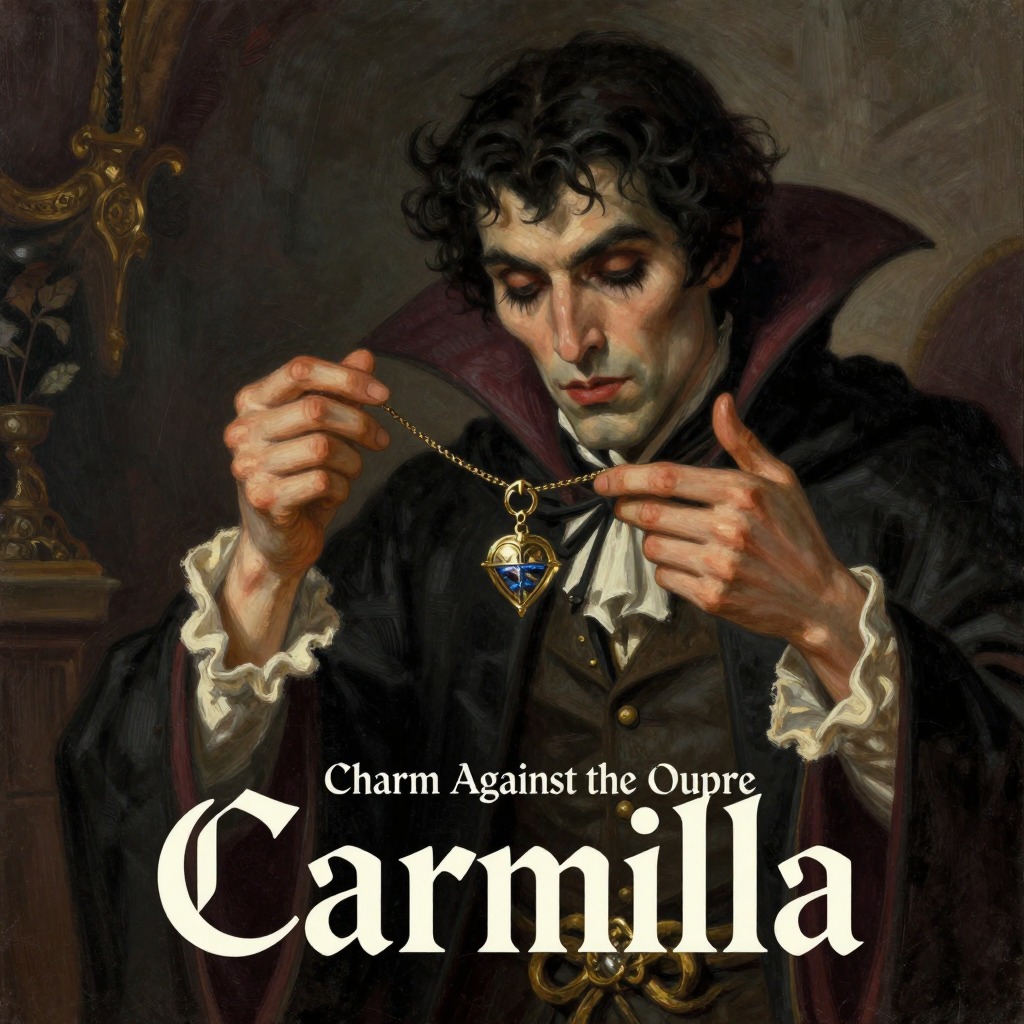
The Charm against the oupire is a small, oblong slip of vellum inscribed with cabalistic ciphers and diagrams, sold by a hunchbacked mountebank who visited the schloss during a wave of mysterious deaths in the surrounding Styrian forest. It is the only physical object in the narrative that the characters explicitly treat as a prophylactic against the vampire, yet its actual efficacy remains ambiguous, serving more as a psychological prop and a rhetorical device for Carmilla than as a genuine supernatural deterrent.
Origin and Purchase
The charm entered the story on the same afternoon that the mountebank arrived in the courtyard, carrying a magic lantern, a fiddle, and boxes containing a salamander and a mandrake. After performing a lively tune and dancing with ludicrous airs, he addressed Laura and Carmilla at the drawing-room window, dropping his hat on the pavement and offering "an amulet against the oupire, which is going like the wolf, I hear, through these woods." He claimed that the charm, when pinned to the pillow, would allow the user to "laugh in his face." The charms he displayed were oblong slips of vellum covered with cabalistic ciphers and diagrams. Carmilla instantly purchased one, and Laura did the same.
Carmilla's Use and Interpretation
After Laura suffered her first dream-attack—the vision of a sooty-black, catlike creature that sprang onto her bed and pierced her breast with a stinging pain like two large needles—Carmilla reported that she too had been frightened by a dream of "something black coming round my bed." She claimed that she awoke in horror and thought she saw a dark figure near the chimneypiece, but that the moment her fingers touched the charm she kept under her pillow, the figure disappeared. She insisted that without the charm, "something frightful would have made its appearance, and, perhaps, throttled me, as it did those poor people we heard of." Laura, who had left her own charm in a china vase in the drawing room, retrieved it and pinned it to her pillow the following night, after which she slept "delightfully deep and dreamless." Carmilla later pinned her charm to the breast of her nightdress, claiming that the previous night it had been "too far away." When Laura asked what she thought the charm was, Carmilla answered that it had been "fumigated or immersed in some drug, and is an antidote against the malaria," acting only on the body, not on evil spirits. She insisted that the complaints "wandering in the air" begin by trying the nerves and infecting the brain, but that the antidote repels them before they can seize the victim. This rationalizing explanation—that the charm is "simply natural" and "nothing magical"—is entirely consistent with Carmilla's broader strategy of deflecting suspicion by offering pseudo-scientific, materialist interpretations of the supernatural events unfolding around her.
Narrative Significance
The charm functions as a double-edged narrative device. On one level, it provides Laura with a temporary sense of security, allowing her to sleep through the nights when Carmilla is most likely feeding on her. On another level, it gives Carmilla a plausible, non-supernatural vocabulary with which to discuss the attacks, thereby reinforcing the ambiguity that pervades the first half of the story. The charm's apparent success—Laura sleeps soundly after using it—masks the fact that her condition continues to deteriorate: she grows pale, her eyes become dilated and darkened underneath, and a strange melancholy steals over her. The charm never prevents the progressive weakening that the vampire's nightly visits cause; it only obscures the cause. In the end, the charm is abandoned as a plot device once the narrative shifts from psychological horror to the explicit, judicial destruction of the vampire. It remains, however, a potent symbol of the characters' desperate, and ultimately futile, attempts to protect themselves through folk remedies against a predator whose nature they cannot yet name.