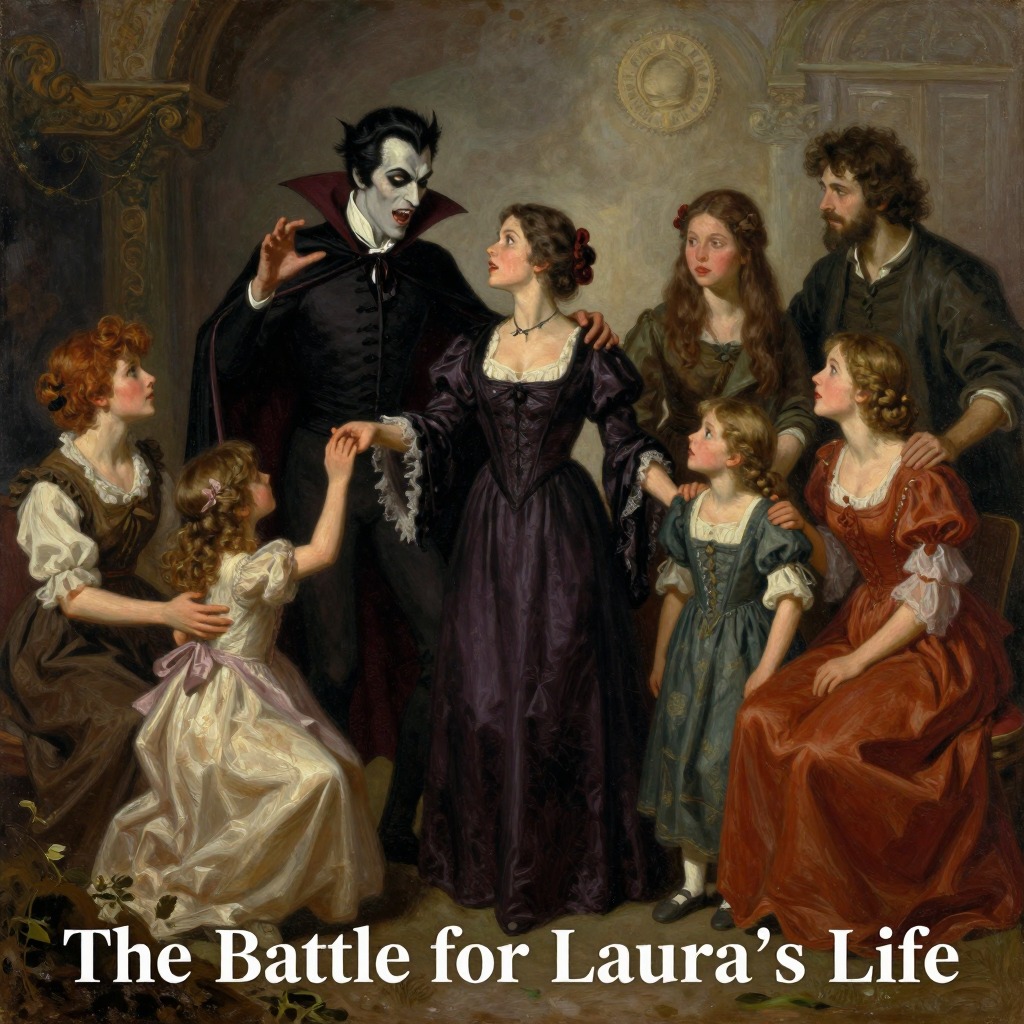
The carriage accident and arrival of Carmilla
CarmillaThe carriage accident and arrival of Carmilla is the pivotal event that introduces the vampire into the secluded world of Laura and her father, transforming a quiet summer evening into the threshold of a supernatural ordeal. What begins as a spectacular and terrifying accident on the road before the schloss quickly becomes the means by which Carmilla, under the guise of a helpless young lady, insinuates herself into the household, her arrival orchestrated with such theatrical precision that it immediately raises questions of design and fate. The scene establishes the key figures, the atmosphere of foreboding, and the central deception that will drive the narrative forward.
The Approach and the Crash
It was a sweet summer evening, and Laura and her father were returning from a walk, their mood shadowed by the disturbing letter from General Spielsdorf announcing the death of his ward, Bertha Rheinfeldt. As they stood with Madame Perrodon and Mademoiselle De Lafontaine admiring the moonlight, the unwonted sound of carriage wheels and many hoofs on the road arrested their attention. The equipage emerged from the high ground overlooking the steep Gothic bridge: two horsemen first, then a carriage drawn by four horses, with two men riding behind. It seemed the traveling carriage of a person of rank, and the party was immediately absorbed in watching this unusual spectacle. The scene became greatly more interesting when, just as the carriage passed the summit of the bridge, one of the leaders took fright, communicated his panic to the rest, and after a plunge or two, the whole team broke into a wild gallop, dashing between the horsemen and thundering along the road towards the schloss with the speed of a hurricane. The excitement was made more painful by the clear, long-drawn screams of a female voice from the carriage window. Laura, in curiosity and horror, covered her eyes, unable to see it out, but curiosity opened them again to a scene of utter confusion: two horses on the ground, the carriage lying upon its side with two wheels in the air, and men busy removing the traces.
The Lady in Black Velvet and Her Daughter
From the wreckage, a lady with a commanding air and figure emerged, standing with clasped hands and raising a handkerchief to her eyes. Through the carriage door was lifted a young lady who appeared to be lifeless. Laura's father, who piqued himself on being something of a physician, felt her pulse and assured the elder lady, who declared herself her mother, that her pulse, though faint and irregular, was still distinguishable. The lady was tall, not thin, dressed in black velvet, and looked rather pale, with a proud and commanding countenance, though now agitated strangely. She spoke in a theatrical manner, lamenting that she was on a journey of life and death, and that to lose an hour was possibly to lose all. She declared she must leave her daughter, who would not recover sufficiently to resume her route for who could say how long, and asked for the nearest village. Laura, eager for a companion, plucked her father by the coat and whispered earnestly for him to ask the lady to let her stay with them. Laura's father, with characteristic kindness, offered to take the young lady into his care, assuring the mother that his daughter and her good gouvernante, Madame Perrodon, would treat her with all the care and devotion so sacred a trust deserved. The lady, after a brief, stern, and earnest conversation with Laura's father out of hearing, consented. She then knelt beside her daughter, whispered a benediction, hastily kissed her, and stepped into her carriage, which whirled away at a furious canter, followed by the two horsemen in the rear.
First Impressions and the Mystery of the Guest
As the carriage disappeared into the misty wood, the young lady opened her eyes and asked in a very sweet voice, "Where is mamma?" Learning that her mother had left her for about three months, she wept. She was conducted to her room, and soon sank into a deep sleep. The ladies of the household were immediately charmed: Madame Perrodon declared her the prettiest creature she ever saw, about Laura's age, and so gentle and nice; Mademoiselle De Lafontaine pronounced her absolutely beautiful. Yet details emerged that hinted at something sinister. Mademoiselle described a hideous black woman with a colored turban who had remained in the carriage, gazing from the window, nodding and grinning derisively with gleaming eyes and large white eyeballs. Laura's father remarked on the ill-looking pack of servants, describing them as ugly, hang-dog looking fellows, though clever rogues for getting everything to rights in a minute. He then revealed the strange conversation he had had with the lady in black velvet: she had expressed reluctance to trouble them, saying her daughter was in delicate health and nervous, but not subject to any kind of seizure or illusion, being perfectly sane—a declaration Laura found very odd and unnecessary. The lady had also emphasized that her journey was of vital importance, rapid and secret, and that her daughter would be silent as to who they were, whence they came, and whither they were traveling. This injunction of secrecy, combined with the mother's theatrical distress and the sinister appearance of the servants, planted the first seeds of unease, even as Laura herself was delighted at the prospect of a new friend in her solitude.
The Recognition and the Bond
When the physician pronounced the young lady well enough for a visit, Laura hastened to her room. There, she was struck dumb and recoiled, for she saw the very face that had visited her in her childhood at night, the face that had remained so fixed in her memory and on which she had for so many years ruminated with horror. The face was pretty, even beautiful, and wore the same melancholy expression, but this almost instantly lighted into a strange fixed smile of recognition. The young lady, who now gave her name as Carmilla, exclaimed that twelve years ago she had seen Laura's face in a dream, and it had haunted her ever since. Laura, overcoming her horror, confirmed that she too had seen Carmilla in a vision or reality twelve years before. Carmilla described her own childhood vision: she had woken in a strange room, crept under a bed, and seen Laura, a beautiful young lady with golden hair and large blue eyes. She climbed on the bed and put her arms about Laura, and they both fell asleep, until Laura screamed and Carmilla slipped down to the ground. This mutual recognition, which both girls found wonderful, forged an immediate and intense bond. Carmilla declared it seemed as if they were destined from their earliest childhood to be friends, and asked Laura if she felt as strangely drawn towards her as she did towards Laura. Laura admitted she felt drawn towards Carmilla, but also something of repulsion, though the sense of attraction immensely prevailed. Carmilla, with a languid and passionate gaze, held Laura close and whispered, "Good night, darling, it is very hard to part with you, but good night; tomorrow, but not early, I shall see you again." The arrival, then, was not merely the introduction of a guest but the reenactment of a childhood trauma and the beginning of a relationship that was both a longed-for friendship and a source of inexplicable dread.