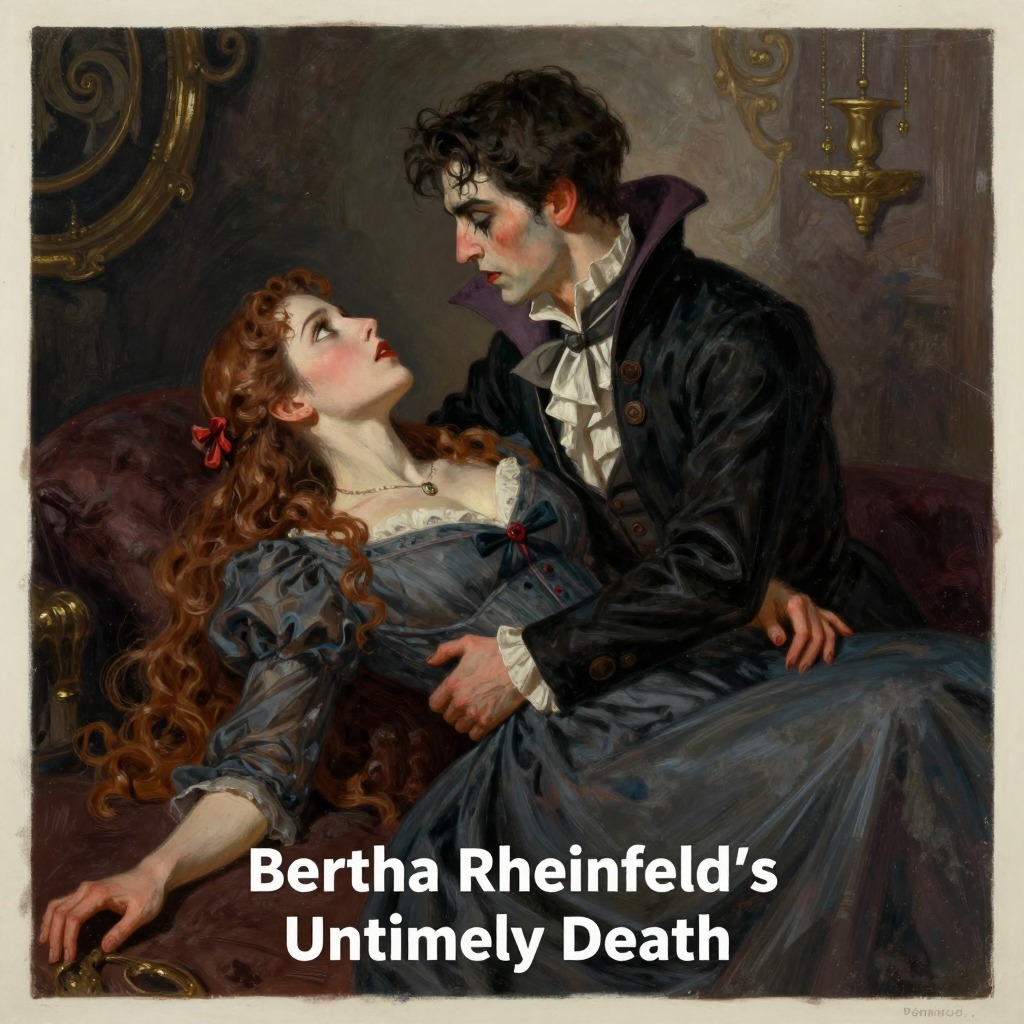
vampire-victim (Carmilla and Bertha)
CarmillaThe vampire-victim relationship between Carmilla and Bertha Rheinfeldt constitutes the hidden precedent that structures the entire plot of Sheridan Le Fanu's novella. Though Bertha dies before the main narrative begins, her story—recounted in harrowing detail by her guardian, General Spielsdorf—reveals the predatory pattern that Carmilla will repeat with Laura. Bertha's fate establishes the vampire's characteristic methods: a masquerade of friendship, nocturnal attacks that leave puncture wounds on the throat, progressive weakness and languor, and a death that mimics natural illness while concealing a supernatural cause.
The Masked Ball and Infiltration
Carmilla's approach to Bertha began at a magnificent masquerade held at Count Carlsfeld's schloss, a festival so lavish that General Spielsdorf described it as princely, with fireworks Paris itself had never witnessed and ravishing music from the finest instrumental band in the world. During the ball, Carmilla—wearing a mask and calling herself Millarca—was accompanied by a richly dressed older woman who acted as her chaperon and whom the General later understood to be her mother. The younger woman observed Bertha with extraordinary interest throughout the evening, first in the great hall, then on the terrace under the castle windows. When she finally approached and lowered her mask, displaying a remarkably beautiful face, Bertha was immediately captivated. The General noted that he had never seen anyone more taken with another at first sight, unless it was the stranger herself, who seemed quite to have lost her heart to Bertha. The elder lady, meanwhile, engaged the General in a conversation that piqued his curiosity by referring to scenes at Court and distinguished houses, demonstrating a knowledge of his past that seemed all but unaccountable.
The Petition and the Fatal Trust
The elder lady, claiming to be an old acquaintance of the General, made a strange and audacious request: that he take charge of her daughter during her absence on a mission of life and death. She disarmingly admitted everything that could be urged against the arrangement and threw herself entirely upon his chivalry. At the same moment, Bertha came to the General's side and besought him to invite her new friend Millarca to pay them a visit. Overpowered by the combined entreaties of both ladies, and struck by the refined and beautiful face of the young woman, the General consented. The elder lady imposed strict secrecy, forbidding any attempt to learn more about her identity until her return. The General, reflecting on the folly of his act, soon found himself bound by promises he did not fully understand, unable even to inquire after the missing young lady's name when she later became separated from them at the ball. She reappeared the next day with a story of having fallen into a deep sleep in the housekeeper's bedroom, and the General, relieved, brought her home.
The Symptoms and the Doctor's Diagnosis
Once installed in the General's schloss, Carmilla—still using the name Millarca—exhibited the same habits that would later characterize her stay with Laura. She complained of extreme languor and never emerged from her room until late afternoon. She was repeatedly seen from the windows in the first faint grey of morning, walking through the trees in an easterly direction, looking like a person in a trance, though her door was always found locked from the inside. The General initially believed she walked in her sleep, but this hypothesis could not explain how she passed through locked doors. Bertha began to lose her looks and health in a manner so mysterious and horrible that the General became thoroughly frightened. She was first visited by appalling dreams, then by a specter sometimes resembling Millarca, sometimes in the shape of a beast indistinctly seen walking round the foot of her bed. She experienced a sensation like the flow of an icy stream against her breast, then felt something like a pair of large needles pierce her a little below the throat with a very sharp pain. A few nights later followed a gradual and convulsive sense of strangulation, then unconsciousness. A physician from Gratz, called in for consultation, wrote a letter that the General was instructed to open only in the presence of a clergyman. The letter stated that Bertha was suffering from the visits of a vampire, that the punctures near her throat were the insertion of two long, thin, sharp teeth peculiar to vampires, and that the small livid mark described by the sufferer was induced by the demon's lips. Every symptom, the doctor insisted, was in exact conformity with those recorded in every case of a similar visitation.
The Confrontation and Bertha's Death
Acting on the doctor's instructions, the General concealed himself in the dark dressing room that opened onto Bertha's chamber, his sword laid on the table beside him. A little after one o'clock, he saw a large black object, very ill-defined, crawl over the foot of the bed and swiftly spread itself up to the girl's throat, where it swelled into a great, palpitating mass. The General sprang forward with his sword, and the black creature contracted toward the foot of the bed, glided over it, and stood on the floor—revealing Millarca. He struck at her instantly, but she stood near the door unscathed; he pursued and struck again, but she was gone, and his sword flew to shivers against the door. The specter had vanished, but her victim was sinking fast, and before the morning dawned, Bertha died. The General, now a man consumed by grief and vengeance, devoted his remaining days to tracking and extinguishing the monster, whom he later identified as the same Carmilla who had taken refuge at Laura's schloss. The pattern of seduction, secrecy, nocturnal attack, and gradual depletion that destroyed Bertha would be repeated with Laura, who recognized her own symptoms in the General's narrative with a shock of horrified recognition.