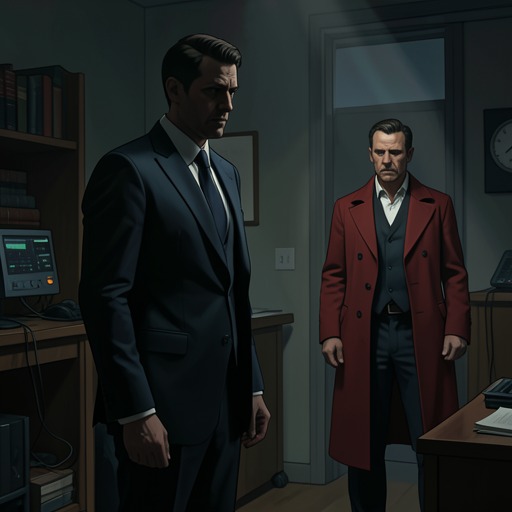
SMERSH Execution of Le Chiffre
Casino RoyaleSMERSH Execution of Le Chiffre ends the confrontation in which Le Chiffre has been torturing James Bond, but it does not deliver Bond a straightforward rescue. A masked SMERSH agent enters, identifies Le Chiffre as a thief and traitor, and shoots him; then, explaining that Bond survives only because the agent lacks orders to kill him, the intruder marks Bond’s hand as a spy before leaving. The execution removes Le Chiffre from the story while making clear that Bond remains exposed to the organization behind the killing.
Causes and Background
Le Chiffre’s downfall is rooted in the financial crisis that brought him into conflict with Bond. At the baccarat table, Bond explains that Le Chiffre has bought the bank for one million francs, leaving him with twenty-four million in capital. Bond’s own funds are about equal, and he intends to attack the bank repeatedly until either he or Le Chiffre is financially broken. The contest is therefore not merely a game: Le Chiffre needs to recover his position, while Bond’s continuing challenge threatens to frustrate that objective.
The play depends on visible actions and incomplete information. The banker has a slight advantage because he can use the player’s decision to stand or draw to help determine his own play, but the players still have to act under uncertainty. Bond says that he will accept Le Chiffre’s bets whenever possible and relies on intuition in the difficult decision of whether to draw on a five. That strategic contest becomes a contest of endurance as well: after losing twelve million francs in two coups, Bond has sixteen million left, exactly enough to meet the next bank.
When Le Chiffre’s bank reaches thirty-two million francs, Bond considers the possibility that a further win will give Le Chiffre the fifty million francs he needs and let him leave the table. Bond decides that the best chance to stop him is to attack the entire bank rather than share it with the other players. He believes Le Chiffre will not expect anyone to cover the whole amount and cannot know about the reserve in Bond’s envelope. The analysis proves right: Le Chiffre needs only another eight million. The earlier gambling battle thus supplies the financial stakes behind the later judgment that Le Chiffre has caused trouble beyond what his Soviet superiors can tolerate.
The Interruption
During the torture, Bond is reduced to dim awareness of the room. A third voice breaks the established exchange between him and Le Chiffre. Bond gradually regains enough consciousness to hear the silence after the voice speaks and to see Le Chiffre’s expression change from astonishment to fear. The interruption shifts the scene’s balance before Bond can understand who has arrived: Le Chiffre, formerly the person controlling the room, is suddenly the one responding to an unseen threat.
The newcomer names SMERSH. Le Chiffre attempts to answer, but the agent tells him that his two men are dead and condemns him as a fool, thief, and traitor. The agent says that he has been sent from the Soviet Union to eliminate Le Chiffre, and that an order to make him die more painfully could not be carried out because there is only time to shoot him. The stated reason for the killing is the trouble Le Chiffre has caused. His fate is not decided at the baccarat table or by Bond, but by the organization whose interests his actions have damaged.
Le Chiffre answers with a single affirmative word. The agent shoots him, and he falls still in his chair. The scene presents the execution as sudden and conclusive: the prolonged struggle in the room is ended not by Bond’s escape or victory over his captor, but by an intervention from the Soviet organization that Le Chiffre has betrayed.
Bond’s Survival and the Mark
The agent turns to Bond after killing Le Chiffre. He says Bond is fortunate because there are no orders to kill him, and makes the contingency explicit: Bond has been saved twice in one day, first by chance and now by mistake. The agent says that he should have had orders to kill foreign spies lingering around the traitor. Bond’s survival is therefore not evidence that SMERSH intends to spare him; it results from an exception in the orders the agent received.
The agent warns Bond that SMERSH is merciful only by chance or mistake, then connects the warning to Bond’s profession as a gambler. Bond may one day play against one of the organization’s people, the agent says, and should be recognizable as a spy. He then cuts a mark into the back of Bond’s right hand in the form of an inverted M. Bond is already in no condition to resist; the new mark sends him back into unconsciousness. The act does not alter the outcome of the execution, but it carries the encounter beyond the room by making Bond’s identity as a spy visible on his body.
Consequences and Significance
The execution resolves one immediate threat while leaving Bond’s larger danger intact. Le Chiffre is dead, but the agent’s words replace him with the wider menace of SMERSH. The killing also clarifies the political meaning of Le Chiffre’s fate: he is not merely a losing banker or a defeated opponent, but a Soviet operative judged to have betrayed his own side and caused intolerable trouble.
The scene’s reversal is sharply unequal. Le Chiffre is killed at the height of his apparent control over Bond, while Bond remains bound, unable to intervene, and survives for reasons outside his control. The agent’s final message makes that survival precarious rather than reassuring. He leaves Bond with a warning and a permanent sign of the encounter, so that the end of the torture does not amount to freedom from the conflict. The execution closes the immediate confrontation and establishes the danger that Bond’s future opposition to SMERSH will entail.