Wendy Tynes—Charlie
CaughtWendy Tynes—Charlie is a mother-and-son relationship defined by years of shared life and tested by an ordinary but decisive threshold: Charlie is about to leave home for college. Wendy has raised her only child alone for twelve years, and his approaching departure unsettles her more deeply than it unsettles him. Their scenes place everyday teenage distance—short answers, earbuds, an eye roll—beside Wendy’s intense awareness that their life as a two-person household is changing.
A Family of Two
Wendy and Charlie have been alone together for twelve years, a fact that gives their closeness its particular weight. Charlie is Wendy’s only child, and she experiences the years of raising him as having passed with the speed familiar to parents watching a child grow up. Their bond is not presented as uninterrupted tenderness: Charlie is seventeen, a high-school senior, moody, and, in Wendy’s rueful view, a pain. But that exasperation sits alongside unmistakable affection. She sees him as beautiful and perfect even while acknowledging the friction of living with an adolescent.
The relationship’s central tension is therefore not a rupture between mother and son but the approaching end of their shared household routine. Wendy’s attachment is sharpened by the fact that, for so long, the two of them have been the family unit. She does not want Charlie to go; the prospect of his departure means facing a life in which the companionship that has structured her days will no longer be present in the same way.
Everyday Distance and Contact
Their daily communication carries the familiar bluntness of a teenager and the persistence of a concerned parent. When Wendy calls Charlie’s cell phone at school’s end, he answers only on the fourth ring and greets her curtly. She asks whether he is home, and he confirms that he is. The exchange is brief, but it establishes a pattern: Wendy checks in, while Charlie responds with minimal ceremony. His terseness does not establish estrangement; it is part of the ordinary, sometimes irritating texture of their closeness.
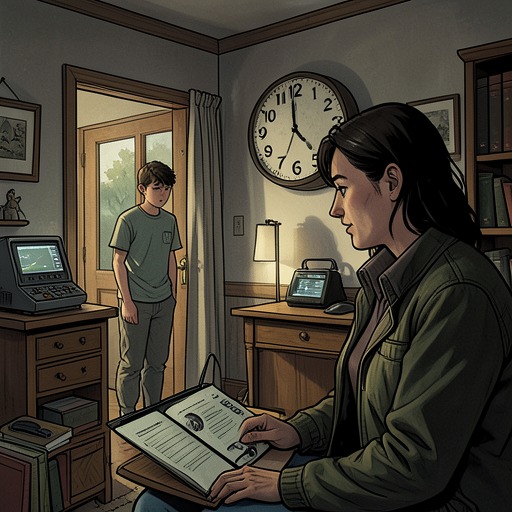
At home, Wendy calls out for him even though she expects no answer. She imagines him at the computer with earbuds in, absorbed enough that even a fire might escape his notice. She has not received an answer to her calls in at least three years. The detail turns a small household habit into a measure of time: Charlie’s withdrawal into headphones and his mother’s unanswered calls have become routine, while Wendy continues calling anyway. Her imagined picture of him is affectionate as well as comic, and it underscores how closely she still attends to his whereabouts even when he appears not to hear her.
College and the Coming Separation
The search for a college has ended with Charlie’s acceptance to Franklin & Marshall in Lancaster, Pennsylvania. He is a senior at Kasselton High School, and the transition from the familiar suburban life of home to college is now concrete rather than hypothetical. Wendy recognizes that Charlie is scared and nervous about the change, as teenagers commonly are, but believes her own anxiety is greater. His unease and hers are not identical: he faces a new stage of life, while she anticipates the absence of the child who has been her constant companion.
Wendy privately wishes she could freeze Charlie at exactly his present age—not younger or older—and keep him with her for a few more days. The wish expresses her resistance to time passing, not a plan to stop his future. Its force comes from the contrast between the approaching college departure and the intimate scale of what she wants: only a little longer with the son she knows now. She then recognizes the implication plainly: soon she will be alone. The thought gives the college decision its emotional significance for her, beyond the practical milestone of a school acceptance.
Bad News at Home
Wendy’s work crisis enters the relationship during an ordinary domestic moment. She has forgotten dinner, and Charlie rolls his eyes in imitation of her. Although she had decided not to tell him yet that she had been fired, hoping to wait for the right time, she tells him anyway. The disclosure shows how the pressures of her day break through her plan to manage what Charlie knows and when he knows it.
Charlie initially only looks at her. Wendy asks whether he heard, but the scene, as presented, does not establish what he thinks or how he will respond. That pause matters precisely because it remains unresolved: after Wendy has spent the day facing trouble at work and contemplating a future without Charlie at home, she brings the news into their shared domestic space and waits for acknowledgment. Their relationship is shown through this mixture of routine friction, practical reliance, and impending change, rather than through a dramatic declaration of affection.