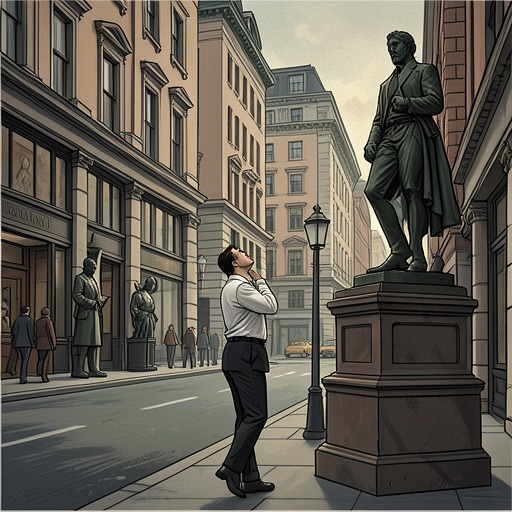
Sir Hariram Goenka statue
ChowringheeThe bronze Sir Hariram Goenka statue in Curzon Park is at once a civic memorial and a recurring point of address for the narrator. Its fixed place in the city gives him somewhere to bring his changing fortunes: first, the shame of having compromised his honesty while struggling to survive; later, the recognition that he has found a home and work. Around the statue, the novel sets individual memory against the city’s habit of sweeping lives into oblivion.
Memorial and Setting
The statue commemorates Sir Hariram Goenka, whose dates are recorded in an inscription: born on June 3, 1862, and died on February 28, 1935. It stands in Curzon Park, where the narrator rests when exhaustion stops him from going farther. The park is also a refuge for people without offices to attend or shelter to return to; under the trees, the narrator sees homeless people sleeping on the grass. The monument thus occupies a public space used not only for remembrance but also for rest by those with little security of their own.
The statue’s bronze material and civic position give it a prominence denied to most of the people who pass through the city. The narrator recalls that it stands before the Governor’s house, and later finds it at the western end of the park, facing Raj Bhavan. In his imagining, it seems to challenge the balance between a merchant’s scales and a ruler’s scepter. That silent orientation makes the monument a meeting point for questions of commerce, political authority, and who endures in public memory.
An Image of Hope and Shame
Before the narrator finds work at the Hotel Shahjahan, a doorman at the Clive Building offers him tea, places a hand on his shoulder, and compares the fire he sees in the young man’s eyes to Sir Hariram Goenka’s. The encouragement makes the statue a standard of hoped-for achievement: the doorman imagines that the impoverished narrator might one day become as great as the man memorialized in bronze. The narrator, however, cannot accept the comparison without misgiving. He has asked four annas for each wastepaper basket and believes that he has betrayed the doorman’s trust. His sense of guilt turns the comparison into an accusation against himself.
He goes from Dalhousie Square to Curzon Park and sits at the statue’s feet, where he apologizes to Sir Hariram Goenka and insists that he has no intention of insulting him. The act is both intimate and self-conscious: the narrator addresses a monument as if it could judge him, while recognizing that the doorman’s generous belief in him may exceed what he deserves. The pause stretches until the sun, like an employee finishing the day, seems to gather its papers and leave. The narrator remains alone, with nowhere else to go. The statue does not answer, but its presence gives form to the contrast between the kindness he has received and the compromised act that troubles him.
Return to the Statue
Later, when Byron encounters the narrator in the park, the narrator refers to people who have found peace by hanging themselves from the branches of the tree that shelters the statue. The allusion frames the monument as part of a landscape where despair is not abstract: people in torment have sought death nearby. The narrator rejects Byron’s concern that he might do the same, but the exchange recalls how precarious his earlier situation had been. The statue remains at the center of the scene, an enduring landmark beside both the possibility of refuge and the evidence of suffering.
After securing work at the Hotel Shahjahan, the narrator returns to the western end of Curzon Park and speaks to Sir Hariram Goenka again. He tells the statue that his circumstances have changed: he now has a job at the hotel. He imagines the Shahjahan’s nights in the days when Sir Hariram Goenka presided over the city’s commercial empire, then catches himself. He does not know whether the man ever visited a hotel and recognizes that he has been speaking to the statue with an immature familiarity. This self-correction preserves the gap between the historical person and the figure the narrator has made into a confidant. Yet the address matters precisely because it is not based on personal knowledge: the statue has become a surface onto which the narrator brings memory and change.
Public Memory and Personal Measure
The novel places the statue within a broader reflection on Calcutta’s history. Thousands have arrived with different origins, languages, customs, and cultures; some have accumulated wealth and glory, but time has repeatedly erased the boundaries between rich and poor, native and foreigner, familiar and unknown. Only a few, the narrator observes, escape that forgetting in the form of statues. The monument therefore marks both remembrance and its inequality: Sir Hariram Goenka remains visible, while countless other lives disappear from the city’s record.
For the narrator, however, the statue’s meaning is not simply a tribute to commercial success. He first approaches it as a poor, ashamed man who cannot see a way forward; later he returns as a hotel employee with a home, loved ones, and a job. The bronze figure does not change, but the narrator’s relation to it does. That return measures a modest, concrete transformation without erasing the earlier hardship. Set against a city that forgets most of its inhabitants, the statue becomes a witness the narrator can revisit—and a reminder that a life’s apparent direction may change even when its public landmarks stay fixed.