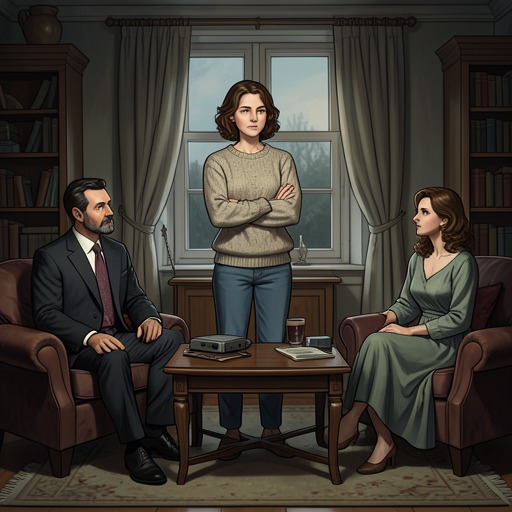
Ella wears her mother's yellow dress to the family dinner
Cinder & EllaElla wears her mother’s yellow dress to the family dinner in a confrontation that turns a choice of clothing into a test of family belonging. The dress is both a treasured remnant of her mother and a way for Ella to enter the gathering as herself, scars visible; when her relatives treat those scars as something to hide, she refuses to exchange that connection for their comfort and returns to her room instead.
Finding and choosing the dress
After Ella’s father clears the room so she can change, she searches her closet knowing that nothing she owns will make her feel as though she fits in with the Colemans. The family is dressed up for dinner: her father and Jennifer look polished, while Anastasia and Juliette resemble pampered heiresses. Against that display, Ella’s uncertainty is not simply about finding a suitable outfit; she anticipates being measured against a family image that leaves little room for her.
Among the hangers she finds her mother’s small, canary-yellow cocktail dress. It carries a specific history: when Ella was about thirteen, her mother dated a professional salsa dancer for several months, and, delighted that he liked taking her out dancing, she splurged on the dress. Ella and her mother had not often had the means to dress up. They were never truly poor, but they watched their spending and saved when they wanted something special. The dress therefore recalls a rare moment of pleasure her mother chose for herself.
Ella presses the dress to her face and breathes in, though it no longer smells of her mother. It remains her favorite of her mother’s clothes, and she remembers how beautiful her mother looked in it. Finding it among boxes her father had packed had brought Ella to tears of relief. The garment cannot restore her mother’s presence, but it gives grief a tangible object to hold onto as Ella prepares for a difficult evening.
Wearing her mother’s memory
Before she has fully considered the decision, Ella pulls the dress over her head. It fits perfectly, a fit that feels to her like fate. The spaghetti-strap dress reaches her knees, leaving her scars visible. That prospect causes her physical pain, but she reasons that people will stare at her anyway; she would rather take part of her mother with her to face the dinner.
Ella adds the pearl necklace her mother always wore with the dress and pins up her hair in the same style. Looking at herself for a long time, she can almost feel human again if she sets the scars aside. In the mirror she recognizes her mother looking back at her; apart from the eyes, Ella sees a likeness. The dress and its accompanying details briefly let her encounter herself through that resemblance, rather than only through the injuries that have altered how others see her.
She takes her cane and makes her way slowly toward the entrance, where the family is waiting. Their collective stare stops her. The moment makes the dress’s double meaning unavoidable: to Ella it is a keepsake and a source of courage; to the family members who object, it exposes the scars they would prefer not to confront.
The family’s objection
Anastasia immediately protests that Ella cannot wear the dress. Ella instinctively defends it: she loves it, and the others are wearing dresses too. Jennifer calls it beautiful, but asks whether Ella is sure she wants to wear it, speaking with a patronizing sweetness that makes Ella feel treated like a small child. When Ella asks why she should not wear it, Jennifer hesitates and then says it is a little revealing.
Ella challenges that explanation by pointing out that Anastasia’s and Juliette’s dresses are shorter and that her own neckline is not particularly low. Jennifer tries to retract the implication, insisting that she did not mean the dress was indecent. Ella then identifies what the exchange has left unsaid: she believes Jennifer wants her to change because the dress reveals her scars, and that Jennifer is ashamed of her just as Anastasia and Juliette are. What began as a dispute over dress standards becomes an explicit conflict over whether Ella’s injured body is acceptable at the family table.
Jennifer shakes her head, her eyes filling with tears, and sobs against Ella’s father’s shoulder. He embraces Jennifer and rebukes Ella for trampling on the feelings of the other family members, telling her to stop being stubborn and change. His response takes the conflict beyond the stepsisters’ open rejection: Ella hears her own father siding with the demand that her scars be covered. The dress, which had made her feel briefly connected to her mother and almost restored to herself, now exposes the distance between her and the household gathered to welcome her.
Refusal and retreat
Ella tells her father that she did not put on the dress to prove anything. She wanted the dress because it belonged to her mother, and she wanted her family beside her at dinner. She rejects the idea that she should have to change simply because her scars embarrass them, and says that she cannot help making them feel repulsed by her. Her father’s face turns pale when he realizes the harm in what he has said; he begins to apologize, but Ella considers the apology too late.
She contrasts the family’s repeated claim that the four Colemans are her family with the response she imagines her mother would have given. Her mother, Ella believes, would have embraced her in the dress and been proud of her courage, never asked her to change. She insists that her mother would not have been ashamed of the scars because she loved Ella. In that contrast, the dress marks not just bereavement but Ella’s own understanding of what loving acceptance should look like.
Ella turns and slowly makes her way back to her room. She wishes she could run, and concludes that she will not go anywhere with the others. Her father would have to throw her over his shoulder to make her leave the house. The family dinner does not proceed with Ella joining them in her mother’s dress: she withdraws rather than conceal her scars to satisfy the family. Her choice preserves her connection to her mother, but the scene ends with that private bond standing in painful opposition to the family unity the dinner was meant to enact.