Scars, disability, and body image
Cinder & EllaScars, disability, and body image are not a single obstacle for Ella to overcome, but a changing set of bodily realities and social encounters that govern how she moves, dresses, is seen, and makes choices. Her severe burns leave raised scars, pain, a pronounced limp, and a lasting need for a cane; the people around her respond with everything from care to recoiling attention and open humiliation. The story’s treatment of disability thus holds physical injury alongside the barriers and judgments imposed by others, while Ella’s growing insistence on autonomy challenges the idea that care should mean control.
Injury, Recovery, and Everyday Mobility
After a difficult recovery, Ella can walk again without another person’s physical assistance. Her doctors had not initially expected this outcome, and she takes pride in having fought through pain and regained much of her mobility. The progress is real but incomplete: the scars remain severe, and she fears spending the rest of her life dependent on a wheelchair. Walking with a cane marks both what she has recovered and what the accident continues to cost her.
That cost appears in ordinary logistics, not only in dramatic moments. At school, Anastasia moves the passenger seat forward and tells Ella to climb into the back; when Ella explains that she physically cannot, Anastasia shrugs and tells her to walk. Ella has to state plainly that she is not being difficult: her body cannot perform the requested movement. The exchange exposes how a seemingly routine arrangement becomes exclusionary when nobody accounts for her mobility.
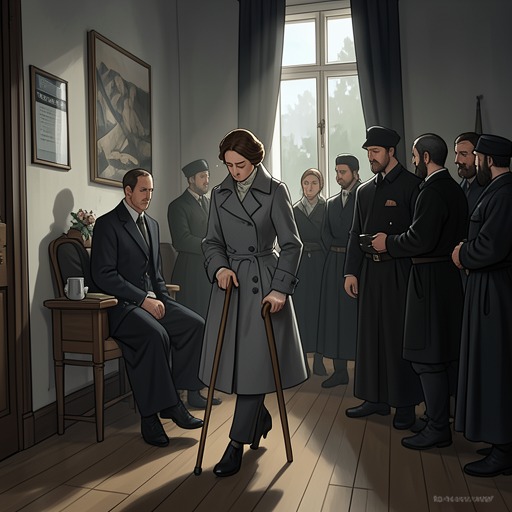
Her clothing likewise becomes a practical strategy for managing other people’s attention. On the flight from Boston to Los Angeles, she covers herself in shoes, trousers, and long sleeves; even with only the scars on her right hand visible, she notices people staring, whispering, pointing, and recoiling. At Beverly Hills Prep Academy, she wears the winter uniform despite the heat, hoping to hide her skin. Concealment does not stop the scrutiny: classmates recognize her, watch her cane and covered limbs, and make her body conspicuous even when they cannot see its scars.
Being Seen: Stigma at Home and School
The language used around Ella’s body can wound before anyone addresses her directly. When Juliette describes photographs of burn survivors as disgusting and Jennifer cautions the twins against calling other people disfigured, Ella flinches at the word. Her face escaped the burns, but her right side from the shoulder down and the area below her waist are covered in thick, rough, red scar tissue that stands out against her usual skin tone. Jennifer’s rebuke does not erase the implication Ella hears: that her own body might be regarded as disfigured.
Jennifer’s first sight of Ella’s uncovered scars brings a different but still painful response. She gasps, tears fill her eyes, and she has to put down the lemonade glasses and sit; after apologizing, she retreats upstairs. Daniel, by contrast, treats Ella matter-of-factly when he prepares a massage table, as if nothing about her body makes her less ordinary. Ella remembers the burn-clinic staff similarly: their treatment helped her imagine a future that would not be unbearable. The contrast shows why well-intentioned sympathy can feel exposing, while ordinary, respectful interaction can help her feel like a person rather than an injury.
At school, the social response becomes sustained exclusion. On her first day, some students force politeness or repeatedly look back at her; others stare openly, laugh, point, and tease her for an audience. No one befriends her or stands up for her, and even students who seem sorry for her appear afraid of becoming targets themselves. Later, classmates deface her locker with insults including “Psycho,” “Stalkerin,” “Hure,” “Loser,” “Hackfresse,” “Freak,” and “Krüppel.” Ella tries to tell herself that the words are untrue and that her three friends matter more, but the vandalism still hurts. The episode makes clear that injury and disability are not the same as the stigma attached to them: her classmates turn her body and presumed mental state into tools of public degradation.
Concealment, Disclosure, and Intimacy
Ella’s efforts to hide her body are closely tied to fear of rejection. When Rob’s interest in her is raised, she cannot imagine being ready for a relationship: she struggles to go outside in short sleeves, doubts that she could bear a boy seeing or touching her scars, and worries that even holding hands would be difficult when her good hand is occupied with her cane. Her concern is both physical and intimate. She fears not only pain or practical awkwardness but the possibility that a partner will see her as damaged.
That fear reaches its sharpest form in her feelings for Cinder, who is Brian Oliver. Ella has told herself she does not want to meet him, although she longs for them to meet and fall in love. She worries that he will not want her because her body is scarred, or that he will treat her as broken in the way she feels her father and Jennifer sometimes do. At the same time, her experience with Vivian, who does not handle her as if she were fragile, and the possibility that Rob could like her as she is offer a counterexample. Ella begins to consider that affection need not depend on concealing her body.
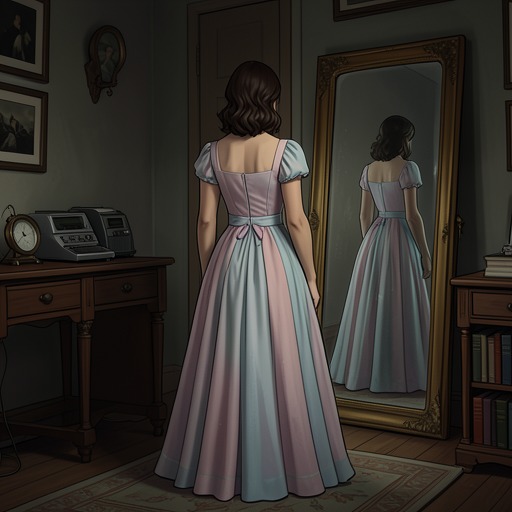
Disclosure remains frightening, but the story also gives Ella occasions to choose how she is seen. While being fitted for a sleeveless, backless dress, she struggles to explain that an accident left her with scars. Vivian interrupts her hesitation with a firm assurance that the scars do not matter to the people there; Glen, one of Vivian’s fathers, praises Ella’s face and eyes rather than treating the gown as spoiled by her body. When Ella emerges in the dress, her back, shoulders, and right arm exposed, Glen and Stefan assess the whole look without staring at the scars for long. Glen arranges her dark hair around her face, and Ella sees herself in a full-length mirror: for the first time since the accident, she feels beautiful. The scene does not erase her scars; it changes the terms of the encounter, letting admiration and self-recognition occupy the same room as visible injury.
Public Appearance, Assistive Objects, and Self-Definition
At FantasyCon, clothing lets Ella negotiate exposure rather than simply accept or refuse it. The family gives her tickets to the convention, and Vivian helps arrange an Ellamara costume: a sleeveless, backless dress that recalls the character Ella loves. Because so many scars would show, Ella doubts she can wear it in public. Vivian supplies a white cloak and long white satin gloves, which are not officially part of the costume but coordinate with it and cover the scars. The outfit creates a compromise: Ella can participate in the convention’s imaginative world while retaining some control over what strangers see.
The costume’s staff also serves a practical function. Vivian has it made so Ella can leave her ordinary cane at home, and Ella later has to explain to Brian that the staff is not merely a prop but also a walking aid. She walks slowly, with a pronounced and painful limp, and the distance from the fan gathering to their meeting place has taken long enough that she arrives nearly late. Her disclosure is direct: she tells Brian that she is disabled. The scene links mobility, time, and public self-presentation; an object that fits the costume makes movement possible, but it does not make the impairment disappear.
Ella eventually describes the extent of the injury herself. Her scars cover her entire right side and everything from the hips down; the burns to her feet have deformed her toes. She tells Brian that, apart from her doctors and Vivian, she has never shown anyone the scars, and explains that people stare, laugh, and say cruel things even when they have seen only her hand and her limp at school. She then turns her wrists to reveal different scars, making visible a painful history beyond the injuries she usually conceals. The disclosure is an act of trust, but it also gathers together the different kinds of hurt that other people’s attention has often blurred or judged from the outside.
Autonomy and the Meaning of Care
The conflict over Ella’s body extends into decisions made on her behalf. Her father and others try to protect her, but protection can become another limit when it assumes that disability means she cannot direct her own life. During a conversation with her father and Dr. Parish, Ella asks for freedom: when she is ready to leave the clinic, she wants her father’s guardianship lifted. She is an adult, she says, but cannot make her own decisions; the person making them is nearly a stranger, and what seems best for him and his family may not be best for her. What she needs is people who trust her.
That request reframes the story’s recurring question of what support should look like. A cane, adapted clothing, friends who stand beside her, or a costume that accommodates her movement can help Ella participate without denying her needs. By contrast, inaccessible assumptions, classmates’ abuse, and care that overrides her judgment restrict her life. Her recovery matters, but it is not presented as the sole measure of her future: alongside the regained ability to walk, Ella seeks recognition, intimacy on terms she can accept, and the authority to make her own choices.