Alternate narrator's car
CrashThe narrator's replacement car is not merely a means of transport but a deliberate reconstruction of the vehicle in which he survived the collision with the Hamiltons. Its exact resemblance makes it the most concrete object in the narrator's effort to return to, repeat, and reinterpret the crash, while its eventual seizure by Vaughan converts private trauma into a public and lethal spectacle.
Selection and Exact Repetition
The car arrives after the narrator's accident, during the period when his obsessive ideas about Vaughan and the motorway landscape have begun to dominate his life. Paul Waring restricts his visits to the studio offices because he is easily tired and excited, yet the narrator treats the delivery of the new vehicle from the local distributors as far more important than his quarrel with Waring's secretary. Recovery is therefore organized around an object that reproduces the conditions of injury rather than distancing him from them.
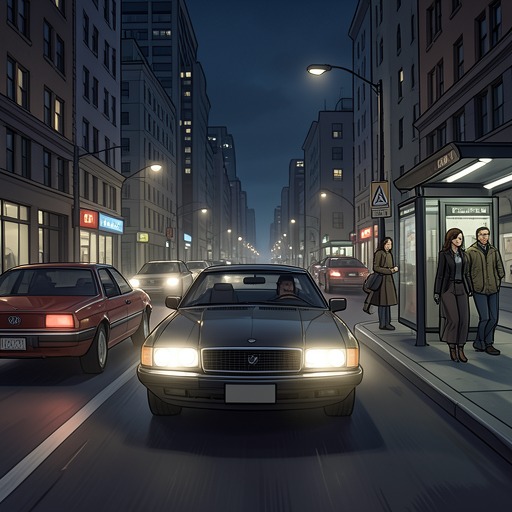
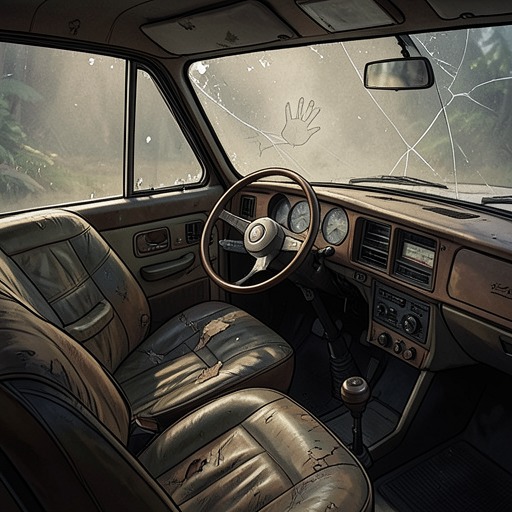
The narrator chooses the same make and model as the crashed car. He also orders the same make of wing mirror and mudguard spat, turning replacement into exact replication. Catherine regards the decision with profound suspicion, and her response exposes the car's disturbing status: it is outwardly new, but it carries the former wreck into the present as a portable duplicate. When she and her secretary watch him from the forecourt of the airfreight offices, the scene places the reconstructed vehicle under social scrutiny before it has even entered ordinary use.
The Car as a Rehearsal of the Crash
Catherine asks why they have been summoned and says that neither of them wants to look at a car again. The narrator denies that he is thinking about the crash, but his behavior contradicts the denial. Sitting in the exact replica of the vehicle in which he nearly killed himself, he visualizes the crushed fenders and radiator grille, the deformation of the hood trim, and the altered angle of the windshield pillars. The new car thus functions as a three-dimensional memory device: its intact surfaces call up the precise forms of their earlier destruction.
The vehicle also joins the narrator's recollection of injury to his developing erotic fixation. Catherine sits in the front passenger seat while he compares her formalized posture with the glass curtain-walling of the airport buildings and the glitter of the showroom. The sexual act he imagines has not yet occurred inside this car, but the thought is already structured by the crash's geometry. The replacement vehicle becomes a chamber in which accident, bodily damage, and sexual possibility are rehearsed together, rather than a neutral instrument that carries the narrator back to normal life.
Social and Legal Consequences of Its History
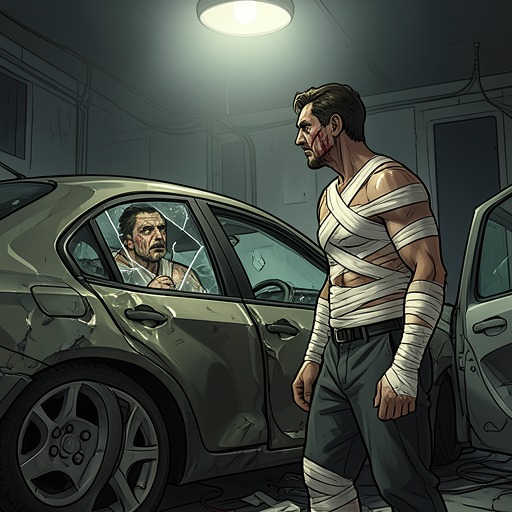
The car remains surrounded by the institutional aftermath of the original collision. The narrator has been told that the damaged vehicle was a complete wreck, dragged by the police to the pound behind the station, and that the sergeant had doubted he could have escaped alive. The other man, Dr Hamilton's husband, died. Later, the coroner's inquest returns a verdict of accidental death, and the police bring no charge of manslaughter or negligent driving against the narrator. The replacement car therefore exists beside an official account that classifies the first crash as an accident, even as the narrator experiences it as an event that continues to organize his body, sexuality, and imagination.
His visits to the police pound make the contrast between the new car and the wrecked vehicles explicit. The pound resembles a museum of crashes, containing roughly twenty damaged cars behind an abandoned cinema. A blue taxi has one front wheel forced back into the passenger compartment, while a white saloon has been compressed by the tyres of a larger vehicle. Against these visible deformations, the replacement car appears immaculate, but the narrator reads its surfaces through the remembered shapes of impact. Its newness cannot erase the material vocabulary of crushed metal that he has learned to see everywhere.
Transfer to Vaughan and Final Use
The replacement car ultimately leaves the narrator's control. After Vaughan has been living in his own Lincoln for several days, the narrator discovers that Vaughan has taken the narrator's car from the garage. The stolen vehicle then becomes part of Vaughan's pursuit of the film actress. Vera Seagrave reports that Vaughan is following her and that the police are searching for him after an American serviceman has been killed on the Northolt overpass. The car's significance shifts at this point: what began as the narrator's private repetition of a formative accident becomes Vaughan's instrument for manufacturing another one.
Ten days after the narrator last sees him, Vaughan dies on the flyover while trying to crash the replacement car into the limousine carrying the film actress whom he has pursued for so long. The car jumps the rails of the flyover, and its impact with the airline coach disfigures Vaughan's body so severely that the police initially identify the corpse as the narrator's. The mistaken identification gives the replicated vehicle a final and terrible power: it makes the narrator's possible death materially indistinguishable from Vaughan's actual one.
At the crash site, the narrator sees his car beside the coach under the high deck of the flyover. Its wheels remain inflated, but the rest of the body is unrecognizable, as if the vehicle has been struck from every direction. Vaughan has driven along the open deck at maximum speed, trying to launch himself into the sky. The replacement car therefore ends where the original car's logic began, in total deformation, but with repetition transformed into deliberate attack and death.
Object, Trauma, and Spectacle
After Vaughan disappears, the narrator becomes increasingly convinced that Vaughan may have been a projection of his own fantasies and obsessions, and that he has somehow failed Vaughan. The replacement car makes this uncertainty tangible. It is simultaneously the narrator's chosen copy, Vaughan's stolen weapon, and the object through which the two men's identities become confused by the police and by the narrator himself.
Its final destruction occurs before a large public audience. At least five hundred spectators gather along the verges and parapets, while police cars, ambulances, and the crushed airline coach form the center of attention. The crowd looks less at the human victims than at the deformed vehicles, as though the wrecks were models of future lives. The replacement car has thus become a stage prop in the culture of automotive catastrophe: first a private memorial to the narrator's wound, then a device of pursuit, and finally the visible architecture of Vaughan's death.