motor-car
CrashThe motor-car is the central material object of Crash, at once vehicle, enclosure, sexual image, instrument of violence, and medium through which the characters imagine their own deaths. Its decisive significance lies in the way it ceases to appear as a transparent tool: after the narrator’s accident, its chromium, glass, controls, scars, and traffic systems become intensely visible, exerting a pressure that joins human bodies to an increasingly autonomous technological landscape.
Definition and Material Presence
The motor-car appears first as a machine of movement, but the narrative repeatedly exposes its physical substance. At the Road Research Laboratory, the narrator and Robert Vaughan watch calibrated vehicles strike concrete target blocks, then view the impacts again in silent slow motion. The repeated collisions initially calm and then arouse the narrator, who begins to imagine himself at the controls of the vehicles. The car is therefore not passive scenery. Its metal, glass, steering mechanisms, and crushed compartments produce sensations and fantasies that feed back into the people who handle or observe them.
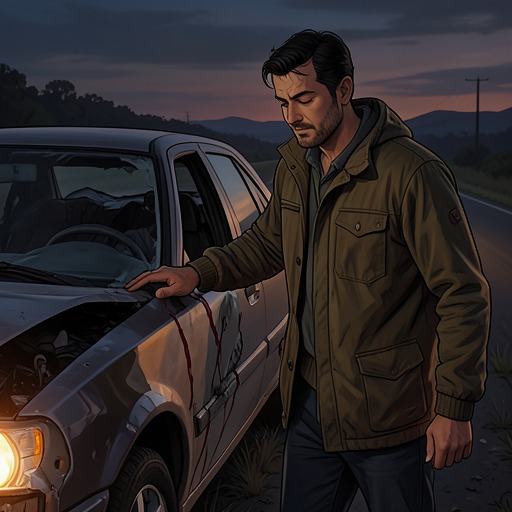
In Vaughan’s interpretation, a crash preserves a human life inside the material arrangement of the vehicle. A dented fender, crushed radiator grille, blood-soaked instrument panel, contaminated seat-belt, or instrument panel driven into a driver’s crotch becomes a permanent record of intimate time and space. The car fossilizes the person who occupied it, converting the vanished identity of a body into the geometry of chromium, plastic, and glass. This process makes the motor-car both archive and anatomical diagram: it stores bodily violence while translating it into an arrangement of surfaces and mechanisms.
The Car and the Changed Landscape
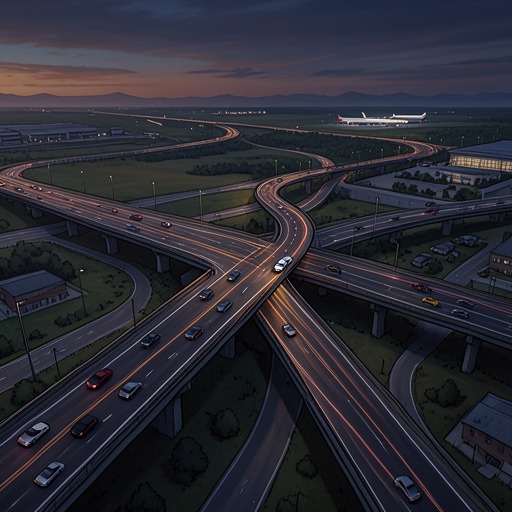
After the narrator’s accident, the motor-car changes in his perception. Travelling home from the hospital with Catherine Ballard, he sees traffic on the Western Avenue interchanges as an assault of reflected light, radiator grilles, chromium trim, route indicators, and accelerating bodies. The familiar suburban world loses its authority beside the motorway embankments, car parks, access roads, and interchanges. The automobile landscape becomes more solid and more legible than the human neighbourhood around it.
The motor-car also participates in the landscape’s strange alternation between speed and stasis. A rare silence leaves drivers trapped behind their steering wheels while the motorway queues extend toward the horizon, enclosed by raised decks and embankments like vehicles inside a vast crater. The narrator imagines his wounds as signals capable of unlocking this immobilized system and releasing the drivers toward the destinations of the electric highway. When traffic later accelerates from one jam to another, the memory of the motionless world remains as an invitation to explore the mental structures produced by the motorway.
The highways impose a new scale on human existence. Cars, airline coaches, and aircraft form a technological horizon that seems to encircle the characters’ lives. Their movement is not simply freedom of passage: it is organized by ramps, lanes, lights, queues, collisions, and detours. At moments the car moves with tidal force through traffic; at others it becomes part of an immense motionless pause. This contrast makes mobility itself unstable, revealing the driver as both operator and captive of the transport system.
Sexualization and the Human Body
The motor-car becomes erotic because its interiors appear to reproduce the bodies of the women Vaughan undresses while driving along the expressways. Colour-keyed upholstery simulates skin; bare thighs modulate pastel vinyl panels; speakers repeat the contours of breasts. The narrator sees the interior as a kaleidoscope of wrists, elbows, thighs, and pubic forms entering shifting combinations with automobile contours. Human anatomy and industrial design are no longer separate categories but interchangeable surfaces in a single visual and tactile system.
This equivalence is acted out through driving. While the narrator holds a car on the curved surface of the perimeter highway, he and Vaughan isolate the geometry of a schoolgirl’s exposed breast as it is framed by the moving vehicle and the road. The car does not merely transport the gaze toward the body; its speed, curvature, windows, panels, and controlled trajectory help compose the body as an image. Vaughan’s own scarred physique is likewise absorbed into the motorway’s design. The angular concrete buttresses of the Western Avenue overpass seem to align with sections of his mutilated body, giving him a hard, mechanical beauty.
The car’s erotic power is inseparable from its capacity for injury. Vaughan describes crash wounds with the tenderness of a lover, and his sexual display in the car holds the narrator within the relationship. The vehicle becomes the shared scene in which arousal, aggression, voyeurism, and anticipated death exchange places. Its controls and cavities provide the vocabulary through which the narrator imagines Vaughan’s body, just as the car’s wounds provide the formal pattern through which Vaughan imagines sexual violence.
Driving, Conflict, and Agency
The motor-car intensifies the unstable relationship between control and helplessness. Vaughan’s Lincoln Continental has lost its second gear after a road race with Seagrave. He sometimes drags it through the fast lane at ten miles an hour, then approaches a stationary taxi with his feet apparently useless before jerking the car to a halt. His driving is simultaneously clumsy, aggressive, distracted, and theatrical. The damaged transmission does not simply limit him; it becomes part of his performance and his method of unsettling the narrator.
The narrator’s own return to driving follows a similar transformation. He hires successive cars, from a heavy American convertible to a high-performance saloon and an Italian micro-car, ostensibly to provoke Catherine and Renata. Soon, however, each vehicle becomes a device for imagining a different death, victim, and arrangement of wounds. The interiors retain traces of previous users: heel marks below the pedals, a lipstick-stained cigarette stub, scratches suggesting struggle, cigarette burns, scuffing, and the grease of hundreds of hands on the steering wheel. These residues make each rented car a layered social object, already occupied by other bodies, assignations, escapes, and boredoms before the narrator offers his own body to its steering columns and windscreen structures.
The car can therefore carry the marks of actions that are no longer recoverable while still directing later actions. It is an archive of anonymous use and a machine that invites repetition. Its worn surfaces link the narrator to absent drivers, while its pedals and steering wheel demand that he enter the chain of gestures established by them. The apparent agency of driving is continually compromised by inherited traces, mechanical limits, traffic rules, and the imagined intentions of other motorists.
The Motorway Machine and Vaughan’s Legacy
For Vaughan, automobile design forms an erotic system of proportions and correspondences. He positions his Lincoln so that the roofline of a passing coupe catches the sunlight in a profile he finds perfect, and he treats spoilers, fenders, rear decks, and interiors as if they were organic forms. The motor-car’s styling becomes a script for his gestures toward women, while women’s bodies become a way of reading the machine. His desire does not move from a human subject toward an inert object; it circulates through an assemblage of bodies, cameras, roads, traffic, and vehicles.
The same machine landscape enables Vaughan’s pursuit of Catherine Ballard. He follows her through traffic, cuts across lanes, advances until abreast of her sports car, then drops behind before resuming the watchful position. His driving begins to mimic her gestures and braking, so that their synchronized brake-lights resemble the dialogue of a long-married couple. The motor-car converts pursuit into a grotesque courtship, giving mechanical form to a relationship in which proximity, imitation, threat, and desire are indistinguishable.
After Vaughan’s death, the car continues to carry his presence. The narrator imagines that Vaughan cannot truly die in a crash because he will be reborn through twisted radiator grilles and cascading windscreen glass. Later, while driving with Catherine along the expressways, the narrator sees every car leaving the flyover as carrying a fragment of the sun. The vehicles remain charged with the dead man’s erotic and destructive logic, but they also contain what the narrator calls formulas for an infinity of sexual bliss. The motor-car thus survives its human users as a recurring technological form, preserving their wounds, fantasies, and unfinished relations in motion.