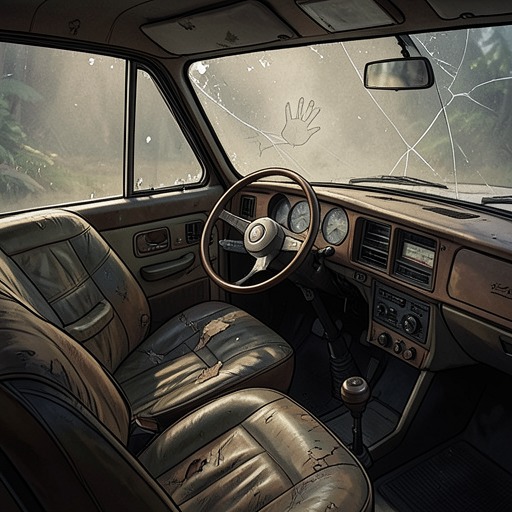
Catherine's sports car
CrashCatherine's sports car is the principal vehicle through which Catherine's body, driving, and sexual relationship with James Ballard become entangled with Robert Vaughan's crash fantasies. It carries the injured narrator along Western Avenue, becomes the object of Vaughan's pursuit, and survives that pursuit with a visible imprint in its body panels. Its decisive significance lies in this transformation: the sports car is not merely transport but a moving enclosure, erotic surface, and rehearsal space for a death that has not yet occurred.
Appearance and Ordinary Use
Catherine's sports car is small, fast, and sufficiently exposed to make its driver's movements conspicuous. On Western Avenue, Catherine drives it at more than seventy miles an hour while fighting her blonde hair away from her eyes; her slim hands move repeatedly between the leopard-skin glove of the miniature steering wheel and the controls. The vehicle's leaping bucket seat places James Ballard close to the physical instability of her driving, while the surrounding clearway turns an ordinary journey into a high-speed negotiation with trucks, airport roads, and concrete avenues.
The car also establishes Catherine's altered relation to James after his accident. She drives him despite his damaged legs, and her erratic passage seems to him no longer simply dangerous: it is as though she trusts unseen powers to guarantee the car's progress. When a refrigerated truck looms ahead, Catherine brakes and pulls around it into the slow lane, making the sports car a precise instrument of improvised survival even as the scene presents driving as a form of risk. The car therefore holds two contrary meanings at once: it is a domestic convenience used to move a married couple, and a machine whose speed and vulnerability intensify their fascination with injury.
Catherine's Body and the Car's Interior
The sports car gives James a new way of perceiving Catherine. At traffic lights on the access road to the northbound motorway lanes, he watches her hands rest on the steering wheel, her right index finger picking at an old adhesive label on the windshield, while her thighs move against each other as she presses the foot-brake. The small gestures are mechanically ordinary, but the car frames them as a choreography of body, pedal, glass, and road.
James's fantasies extend that choreography into a total merger between Catherine and the vehicle. He imagines her vulva pressed against exposed panels and fascias, her breasts against door pillars and quarter windows, her anus moving against the vinyl seat covers, and her hands placed against the instrument dials and window-sills. In this reverie, the car is no longer a container for sexuality; its metal body and Catherine's body become parts of one perverse technological composition. Passing cars appear to celebrate that junction, so traffic itself becomes the public audience and kinetic context for an act that remains inwardly imagined.
The car's erotic charge is inseparable from the narrator's altered marriage. Since James's accident, Catherine has become more at ease with him, and his scars have revived her fascination with his body. The sports car carries this renewed intimacy through the landscape: its acceleration, braking, and confined interior translate marital changes into mechanical action. Catherine's driving is thus neither a neutral background detail nor simply a sign of recklessness. It is the medium through which physical injury gives the marriage a new, troubling form of contact.
Vaughan's Pursuit
The sports car becomes a target when Vaughan's battered Lincoln appears behind it on Western Avenue. Almost mesmerized by his fantasy of Catherine's body and the car's interior, James suddenly sees Vaughan only a few feet behind her. Vaughan surges past, crowds the roadway as if waiting for Catherine to make a mistake, uses his horn and spotlights to force an airline bus away, and then cuts back behind the sports car, pumping his headlamps at its rear fender.
Catherine responds by pulling into the courtyard of a filling station, forcing Vaughan into a heavy U-turn around an ornamental flower-bed. The sports car's smallness and manoeuvrability allow it to escape the immediate line of attack, but the retreat does not end the encounter. James blocks Vaughan's way with his own car, while Catherine remains among the scarlet fuel pumps, watching Vaughan with excitement. The sports car has shifted from private possession to contested territory: Vaughan's aggression, Catherine's apparent exhilaration, and James's protective intervention all converge around its vulnerable body.
The pursuit later becomes more elaborate. Vaughan waits at the junction of Western Avenue and the flyover, openly inserting the Lincoln into the traffic stream as Catherine approaches. He alternates between moving alongside her and falling behind, mimics her trim shoulders and repeated braking, and makes their harmonized brake-lights resemble the dialogue of a long-married couple. The sports car consequently becomes Catherine's counterpart in a grotesque duet. Its movements are copied, anticipated, and staged by Vaughan, while James follows behind, converting the chase into an eroticized triangle of observation and danger.
Damage and Rehearsal
At the flyover, the sports car is placed on a collision course. Catherine climbs the ramp behind fuel tankers; Vaughan turns away, circles through the intersections below, waits for the tankers to pass, and surges forward when her car appears. He seems about to strike it, but withdraws at the last moment and disappears into the traffic. The expected crash is withheld, yet the vehicle has already served its purpose as a rehearsal surface. The danger has been enacted without the final impact, leaving anticipation itself as the event's central product.
Half an hour later, in the basement garage of James's apartment house, the consequence becomes tangible. James feels the imprint of Vaughan's car in the body panels of Catherine's sports car, identifying the dents as the rehearsal-marks of a death. The damage is minor in physical scale but immense in narrative meaning: Vaughan's car has touched Catherine's without completing the collision, and the sports car now bears material evidence of an intended union between pursuit and destruction.
The rehearsals continue over the following days. Vaughan's photographs and equipment are removed from Vera Seagrave's dark-room, yet the police seem unable to catch him. Catherine never directly refers to the pursuit, while she and James maintain an ironic calm of the sort they display when either openly takes another lover. The sports car thus carries a silence as well as a mark. Its damaged side records what the couple refuse to discuss, and its continued presence allows Vaughan's courtship to persist as an unacknowledged pressure inside the marriage.
Relation to Vaughan's Crash Fantasy
Vaughan's obsession with automobiles joins technological machinery to wounds, sexuality, and death. He speaks of crashes with erotic tenderness, surrounds himself with photographs of injuries, and imagines a final collision with an actress in which the bodies and vehicles suffer corresponding wounds. Against that larger mythology, Catherine's sports car functions as an available rehearsal object: not yet the final limousine, not yet the fatal crash, but a smaller vehicle through which Vaughan can practise pursuit, proximity, impact, and withdrawal.
Its meaning is also sharpened by contrast with Vaughan's Lincoln Continental. Vaughan's heavy, damaged car is associated with brute force, failed transmission, and a driving style that alternates between aggression and apparent helplessness. Catherine's sports car is smaller and more agile, but its mobility does not make it free. Under Vaughan's surveillance, every brake, turn, and change of lane can be absorbed into his design. The car's apparent agency is therefore distributed across Catherine's driving, Vaughan's coercive manoeuvres, James's intervention, and the traffic system surrounding them.
By the end, Catherine's sports car remains parked in the drive below the bedroom window, its left-hand paintwork marked by a minor collision. James immediately treats the mark as a possible sign of injury and asks whether Catherine is all right; she leans against him as though memorializing the collision through their bodily pressure. The car's damaged surface becomes a point of contact between them, even though Catherine's encounter with Vaughan has remained largely unspoken. After Vaughan's death, James recognizes that both he and Catherine have made their separate love to Vaughan. The sports car has therefore completed its role as an intermediary: it has carried Catherine into Vaughan's orbit, received the physical trace of their projected death, and returned that trace to the marriage as a shared, bodily memory.