Hollywood star's luxury car
CrashThe film actress's limousine is the chauffeured vehicle associated with Elizabeth Taylor and the decisive object in Robert Vaughan's final crash design. More than a means of transport, it becomes the mobile enclosure in which celebrity is watched, bodily vulnerability is calculated, and the imagined union of sex and automotive violence is given a precise material form. Vaughan's obsession culminates in driving James Ballard's stolen car toward it, making the limousine the intended site of a death that he has rehearsed through photographs, questionnaires, imagined collisions, and assembled fragments of earlier accidents.
Identity and Appearance
The limousine is identified primarily through its relation to the film actress rather than through a make or model. Elizabeth Taylor steps from it outside a London hotel, and Vaughan photographs her at that moment and during other departures from chauffeured cars. Its depth, privacy, and polished surfaces distinguish it from the ordinary vehicles involved in the novel's road accidents, yet those same features make it an ideal screen for Vaughan's fantasies. He studies the actress's knees, hands, thighs, mouth, and changing posture as they appear beside or within the car, treating the vehicle's doors, windows, seats, and fittings as potential instruments of contact with her body.
The limousine also carries the social meaning of protected celebrity. It separates the actress from traffic and spectators while displaying her passage through public space. A chauffeur stands beside her when Vaughan dies, and the vehicle's enclosed rear compartment repeatedly suggests a privileged interior whose barriers Vaughan wants to breach. Its status is therefore double: it is a defensive shell that preserves the actress's safety, and an eroticized mechanical chamber in which Vaughan imagines that safety being converted into exposure.
Vaughan's Photographic and Imaginary Use
Vaughan's pursuit of the limousine begins with surveillance. He follows the film actress with a zoom lens from hotel approaches, motorway pedestrian bridges, airport observation points, and studio car parks. Photographs of her stepping from the limousine accumulate among his materials, while James Ballard helps reproduce some of the enlarged bodily details on a copying machine. The photographs do not merely record a person or a vehicle. They isolate fragments that Vaughan can rearrange into a prospective collision, turning the limousine into a catalogue of angles, distances, gestures, and vulnerable surfaces.
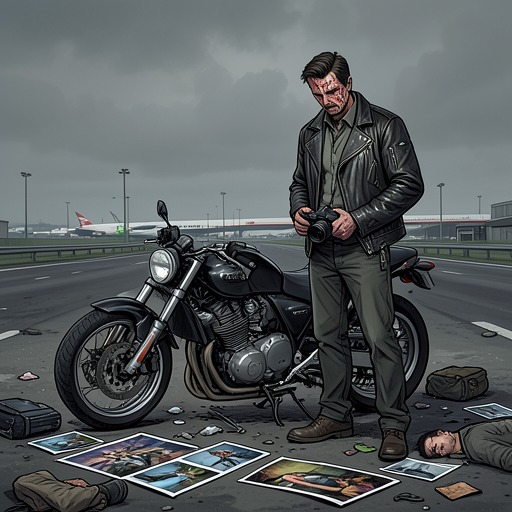
His photographic archive places the limousine within a larger collection of highway wrecks. The photographs in Vaughan's laboratory show frontal collisions, impacted radiator grilles, shattered windshields, spectators, police, and ambulance attendants; other images are taken from moving cars by a photographer who ignores the angry authorities trying to stop him. Against this coarse record of public accidents, the images of the actress are made with deliberate care through windshields and revolving doors. The limousine thus links two visual regimes: documentary images of anonymous destruction and controlled images of a famous woman whose body is being prepared for an imagined death.
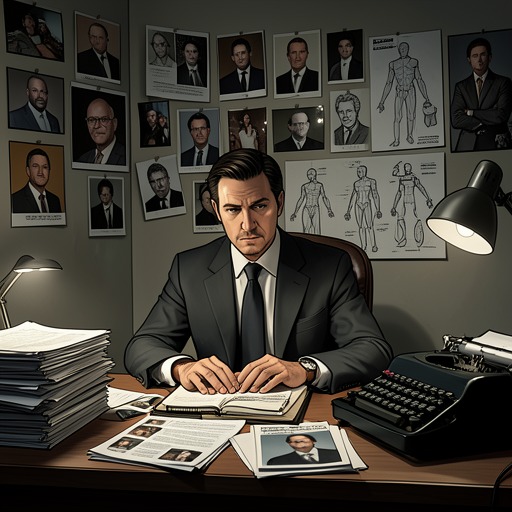
The questionnaires and marked photographs make that transformation explicit. Vaughan and his volunteer subjects draw imaginary wound sites across photographs of famous people, relating necks, breasts, thighs, mouths, and genital areas to the parts of their cars that might strike them. Elizabeth Taylor appears at the end of this sequence as the newest and most important victim. Vaughan examines her leg stance, kneecaps, the chromium door frames, and the cocktail-cabinet surfaces of the cars in which she travels, calculating how the limousine might become a device for producing a combined sexual and fatal tableau.
Construction of the Final Collision
Vaughan does not invent the limousine crash from a single impulse. He gathers its components from many earlier crashes and sexual encounters. He selects a section of the Western Avenue flyover associated with James Ballard's accident and the death of Helen Remington's husband, the fender of a black American limousine marked by Catherine Ballard's arm, the actress's movement as she leaves her car, changing traffic lights, different road surfaces, and the gestures of bodies inside vehicles. These fragments are stored in his mind as a repertory that can be recalled and fitted into the weapon of assassination he is designing.
The limousine consequently becomes the terminal point of a montage. Vaughan's desired crash is not an uncontrolled accident but a composition made from borrowed places, vehicles, wounds, postures, photographs, and memories. He questions James Ballard about the actress's sexual life and urges him to involve Catherine in researching old film magazines, even though Ballard knows nothing that could answer him. The limousine's imagined interior is populated by acts and positions that Vaughan has already devised for politicians, writers, athletes, astronauts, and criminals. Celebrity transport becomes a universal stage on which the sexual lives and deaths of public figures can be projected.
The object also supplies Vaughan's fantasy with a ceremonial scale. He thinks of the actress's death as a coronation of wounds and imagines the two vehicles meeting head-on in repeated slow motion. The limousine is not simply to be struck; it is to participate in a carefully staged encounter in which chromium, collapsing bulkheads, windshield glass, bodies, and sexual organs become parts of one emblematic mechanism. Its polished luxury intensifies the contrast between celebrity glamour and the damaged metal through which Vaughan seeks to expose a supposedly hidden truth about the body.
Crash and Aftermath
Ten days after James Ballard last sees Robert Vaughan, Vaughan takes Ballard's car and drives it toward the limousine carrying Elizabeth Taylor. The attempt occurs on the London Airport flyover. Vaughan's car jumps the rails and plunges through the roof of a bus filled with airline passengers, while the film actress's limousine escapes the collision. The limousine therefore survives as the intended target even though the attack produces another mass casualty scene below the flyover.
When James Ballard reaches the wreck, the bodies of package tourists remain across the bus's vinyl seats. Elizabeth Taylor stands under the revolving ambulance lights, holding her chauffeur's arm, and raises a gloved hand to her throat when Ballard kneels over Vaughan's body. Her gesture appears to register not only the violence that has occurred but the image of the death Vaughan had designed for her. The limousine's absence from the fatal impact is crucial: it remains intact enough to carry the actress away, while Vaughan's vehicle and body absorb the destruction meant for it.
The police initially identify Vaughan's disfigured body as James Ballard's because the impact has destroyed it so completely. The confusion binds the limousine to a further exchange of identities. Vaughan has used Ballard's car in pursuit of the actress, and his death is first attributed to the man whose fantasies he has helped activate. At the apartment, Catherine Ballard waits beside the rusting hulk of Vaughan's Lincoln and briefly seems to expect Ballard himself to return as Vaughan. The limousine's survival thus leaves behind not resolution but a residue of substitution, projection, and uncertain responsibility.
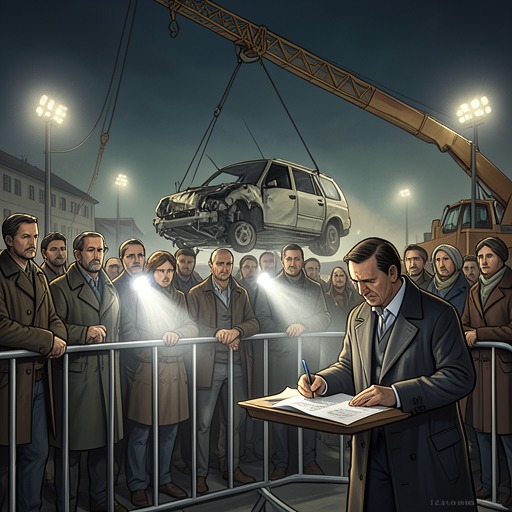
At the accident site, Elizabeth Taylor stands beside her chauffeur while spectators focus less on the human victims than on the deformed vehicles. The crushed roof of the airline coach rises beneath the flyover, Ballard's car lies unrecognizable beside it, and the actress is given a clear space among police cars and ambulances. Hundreds of spectators gather because she has narrowly escaped death; many may assume that she has already joined the pantheon of automotive disaster victims. The limousine is therefore present even in its absence, as the unseen vehicle whose threatened destruction organizes the crowd's attention.
Narrative and Thematic Significance
The film actress's limousine condenses the novel's recurring transformation of vehicles into anatomical and symbolic structures. Earlier crashes make radiator grilles, windshields, dashboards, and passenger compartments resemble bodily surfaces or wound sites; the limousine gathers these possibilities into a single object of desire. It is simultaneously inaccessible and obsessively visible, luxurious and vulnerable, a protective enclosure and a projected site of mutilation. Its imagined destruction promises Vaughan a union of celebrity, technology, sexuality, and death that ordinary life cannot provide.
The limousine also exposes the politics of looking. Vaughan watches from elevated platforms, bridges, balconies, and car parks, while the actress moves through spaces designed for public visibility but private protection. His camera converts distance into possession: a gesture at a hotel door or a moment beside a window becomes raw material for an attack. Later, the crowd at the flyover repeats that structure on a mass scale. Police, ambulance workers, and spectators surround the wreckage, yet their attention settles on the vehicles as if the machines were the true protagonists. The limousine's celebrity aura teaches the crowd how to regard the accident as spectacle.
Its final importance lies in the contradiction between Vaughan's totalizing fantasy and the event's incomplete realization. He has created countless possible deaths for Elizabeth Taylor, but the actress survives, while the person who designed the collision dies in a different vehicle and among unrelated passengers. The limousine remains the untouched centre of a catastrophe that has been organized around it. That survival does not cancel Vaughan's design; it reveals its structure. The vehicle has become so powerful as an imagined object that it continues to govern the scene even when it escapes the crash, leaving behind a public theatre of wrecked cars, mistaken identities, spectatorship, and desire.