N.C.L.
CrashN.C.L. is the large government laboratory from which Robert Vaughan departs when he turns away from computer-controlled traffic management and begins treating automobile crashes as a psychological, sexual, and visual field of investigation. Its decisive significance lies in the contrast it establishes: Vaughan presents himself as an outsider to bureaucratic expertise, yet his later methods retain the laboratory’s procedures of testing, classification, documentation, and controlled observation.
Institutional Background and Vaughan’s Departure
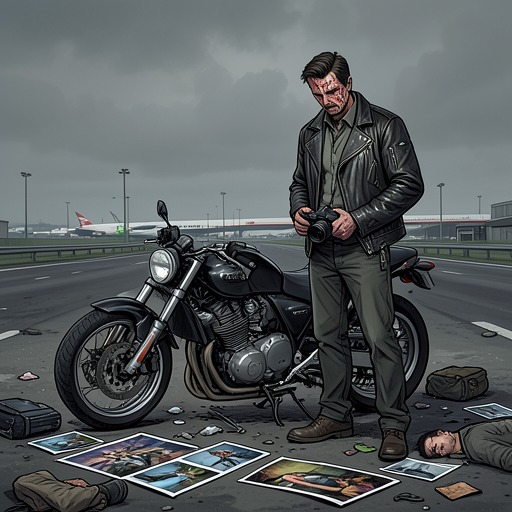
N.C.L. is identified as Robert Vaughan’s former workplace and as the institutional setting associated with his earlier public career. Vaughan had been a computer specialist and one of the first new-style television scientists, presenting computerized techniques for controlling international traffic systems through a combination of technical knowledge, personal glamour, aggressive lecturing, and calculated self-publicity. His career ended abruptly after he was seriously injured in a motorcycle crash, an impact whose memory remained physically inscribed in his scarred face and altered public persona.
Vaughan later tells James Ballard that he has left N.C.L. because his new project is too important for the institution. He insists that a large government laboratory is not equipped to handle it, psychologically or otherwise. The statement defines N.C.L. through Vaughan’s opposition to it: the laboratory can manage technical systems, but, in his view, cannot accommodate the unstable mixture of desire, violence, injury, and subjective fascination that he wants to investigate.
From Traffic Control to Crash Research
Although Vaughan repudiates N.C.L., his new work does not abandon scientific procedure. In a photographic workshop, he announces a proposed television series and displays hundreds of images of highway collisions, including frontal views of motor-cars and heavy vehicles, close-ups of impacted radiator grilles and windshields, and photographs taken hurriedly from moving vehicles. The workshop resembles a makeshift laboratory, with enlargers, enamel pails, discarded prints, and a leatherbound album replacing the formal equipment and administrative order of N.C.L.
The difference is therefore less a rejection of expertise than a transfer of expertise into a private and increasingly eroticized domain. Vaughan uses cameras, slow-motion films, accident scenes, medical images, and later questionnaires to turn crashes into objects of repeated observation. His visits with James Ballard to the Road Research Laboratory, where calibrated vehicles are driven into concrete target blocks, give him access to an official model of controlled collision. Back in his apartment, he screens the filmed impacts repeatedly, transforming an engineering demonstration into a hypnotic and sexually charged spectacle.
Knowledge, Classification, and the Questionnaires
N.C.L.’s computational and managerial shadow persists in Vaughan’s attempt to gather systematic evidence about people connected with his project. His questionnaires are completed by former laboratory colleagues, including two computer programmers, alongside airport stewardesses, a dietitian, a medical technician, Seagrave and Vera Seagrave, the television producer, and Gabrielle. The sample is presented as a cross-section of Vaughan’s social world, but its common feature is that every participant has experienced a minor or major automobile crash.
The forms convert private fantasy into a standardized research instrument. Subjects are asked to choose public figures from politics, entertainment, sport, crime, science, and the arts and imagine a car-crash in which one might die. The celebrity list appears to derive from the circulating material of newspapers, magazines, television news, and documentaries, while the catalogue of possible injuries has the density of forensic research. It includes passenger ejection, kneecap and hip-joint injuries, compartment deformation, roll-over abrasions, amputations by roof assemblies and door sills, dashboard and window injuries, whiplash, burns from ruptured fuel tanks, steering-column impalements, seat-belt injuries, windshield ejection, and the effects of specialized accessories and manufacturer’s medallions.
The most carefully assembled category concerns genital wounds. Vaughan collects photographs from forensic medical journals and plastic-surgery textbooks, copies internal monographs, and extracts operating-theatre reports obtained during visits to Ashford Hospital. In this process, the bureaucratic form of research survives while its purpose changes. Classification no longer serves public safety or traffic efficiency; it becomes a means of organizing fantasies of bodily violation and of making sexualized violence appear as a technical field.
Institutional Contrast and Narrative Significance
N.C.L. embodies the official promise that traffic can be rendered intelligible and controllable through computation, expertise, and systems management. Vaughan’s later practice exposes the limits of that promise by placing the body, sexuality, voyeurism, and death inside the same technological network. Yet he does not escape the system he criticizes. He continues to behave like an investigator, assembling archives, testing responses, photographing evidence, and seeking repeatable patterns in collisions and desire.
The contrast also clarifies Vaughan’s character. He moves from the public image of the computer expert who explains traffic systems to the private experimenter who makes damaged cars, injured bodies, cameras, questionnaires, and spectators part of a single apparatus. His contempt for N.C.L. is thus inseparable from his dependence on the authority its procedures have taught him to imitate. Even after leaving the laboratory, he continues to treat the automobile as a system whose hidden meanings can be extracted through data, images, and controlled impact. N.C.L. consequently functions less as a continuing plot location than as the institutional origin against which Vaughan defines his rebellion and the buried model that structures it.