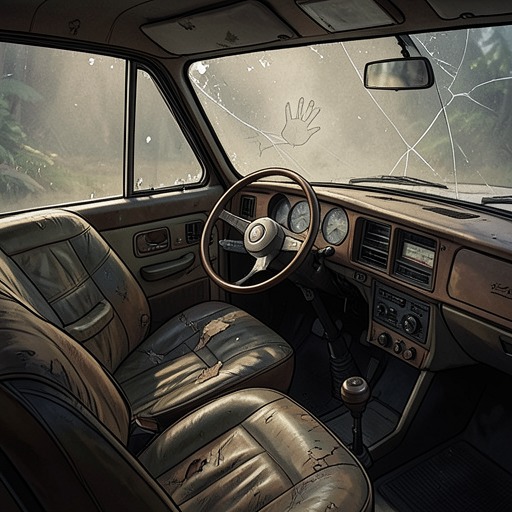
Vaughan attacking the narrator's vehicle
CrashVaughan attacking the narrator's vehicle is the decisive conversion of Robert Vaughan's automobile from a medium of erotic and traumatic fellowship into an instrument of attempted murder. After the narrator and Vaughan have shared their scars inside a wrecked car, Vaughan returns in his Lincoln Continental and drives directly at the narrator, transforming the language of accidental collision into an unmistakably intentional act of violence.
Causes and Background
The assault grows out of a relationship in which bodily damage, cars, and sexual fascination have become inseparable. Vaughan's scarred body appears to the narrator as a map of earlier crashes, while the interior of the car offers corresponding sites of injury and contact. The two men have recently sat together amid crashed vehicles, exposed their wounds, and imagined the traffic dead and the millions still destined to die. This intimacy does not produce safety. Instead, it gives Vaughan's later attack a terrible reversal: the same automotive world that seemed to unite their injuries becomes the mechanism by which Vaughan attempts to eliminate his companion.
The narrator's earlier collision with Dr Hamilton and his wife has already established the difficulty of separating legal accident from private meaning. The narrator survives with wounds to his chest and legs, while the other man dies; the police ultimately return a verdict of accidental death and bring no charges of manslaughter or negligent driving. Yet the narrator experiences the crash as a charged bodily event rather than as a neutral mishap, and Catherine repeatedly revisits the crushed radiator grille and blood spattered across the bonnet. The official language of accident therefore coexists with a more disturbing imaginative economy in which collision, desire, death, and responsibility continually overlap.
The Assault
After the narrator has spent an hour waiting for the effects of acid to pass inside an abandoned car, he emerges from the layby and sees a heavy black vehicle accelerating from beneath the overpass. The vehicle is Vaughan's Lincoln Continental. Its white-walled tyres tear through broken beer bottles and cigarette packets, mount the narrow kerb, and rush towards the narrator. Recognizing that Vaughan will not stop, the narrator presses himself against the concrete wall of the layby rather than remaining exposed in the road.
The Lincoln swerves after him and its right-hand front fender strikes the rear wheel housing of the abandoned car in which he has been sitting. The impact rips the open passenger door from its hinges and sends dust and torn newspaper into the air as the vehicle slides sideways across the access road. Vaughan's bloodied hands whirl at the steering wheel, making the attack visibly continuous with the wounds and scars that have defined his presence throughout the narrative.
The car recovers traction, remounts the kerb on the far side of the access road, and crushes a ten-yard section of the wooden palisade before swinging back onto the motorway. The damage is not incidental background detail: the crushed door and fused metal become a material counterpart to the scar tissue on Vaughan's body. The narrator sees the vehicle's deformation as an external version of the arbitrary seams produced by sudden violence, linking the automobile, the wounded body, and the act of assault in a single image.
Immediate Consequences
The narrator walks to the abandoned car and leans against its roof, physically shaken enough to retch acid mucus. He understands that Vaughan looked back while crushing the palisade, calculating whether another pass might be possible. That backward glance changes the event from a failed loss of control into a renewed threat. The first impact has not exhausted Vaughan's intention; the possibility of repetition remains active in the scene even as the Lincoln disappears onto the motor road.
The assault also destroys the fragile calm that had followed the men's shared exposure of their wounds. Earlier, the narrator had held Vaughan while he slept and felt tenderness toward both Vaughan and the metal enclosure around them. They had treated their injuries as a grotesque form of communion, celebrating the imagined rebirth of those killed by traffic. Vaughan's attack tears apart that communion and replaces mutual recognition with predation. The narrator's body is no longer being contemplated beside Vaughan's; it is being targeted by Vaughan's vehicle.
Legal and Social Context
The attack is framed by a wider chain of police inquiries, inquests, and official judgments. The narrator's own crash is processed as accidental death, while Vaughan's later conduct draws active police pursuit after an American serviceman is killed on the Northolt overpass. Vera Seagrave reports that Vaughan is following his film actress and that the police are after him, identifying the overpass death as a public consequence of the same violent automotive logic.
The contrast between the narrator's inquest and Vaughan's pursuit exposes a gap between legal classification and lived causality. The narrator escapes formal charges even though his thoughts have attached erotic and imaginative significance to the death of Dr Hamilton's husband. Vaughan, by contrast, moves into the category of the pursued offender as his collisions accumulate and their intentional pattern becomes harder to contain within the vocabulary of accident. The novel thus makes responsibility unstable but not meaningless: institutional language may hesitate over one crash, while repeated action gradually reveals a will organized around impact.
Narrative Significance
Vaughan attacking the narrator's vehicle is a value reversal. The wrecked car first shelters the narrator from the altered consciousness produced by acid; moments later, the same damaged automotive landscape becomes the setting for an attack from which he must protect himself against a second pass. Intimacy turns into pursuit, injury into weaponry, and the imagined brotherhood of scars into a contest over survival.
The episode also gives concrete form to the novel's recurring vision of traffic as a technological system that produces both desire and death. Vaughan does not merely attack the narrator as an isolated individual. He mobilizes the Lincoln, the kerb, the palisade, the access road, and the motorway as one continuous apparatus of force. The automobile's ability to carry, shelter, wound, and kill is concentrated in a single movement, while the fused wreckage afterward preserves the assault as a physical record. The scene's decisive significance lies in its refusal to let the car remain an object of transport or spectacle: in Vaughan's hands, it becomes a deliberate extension of the damaged body and the clearest expression of violence hidden inside the modern traffic landscape.