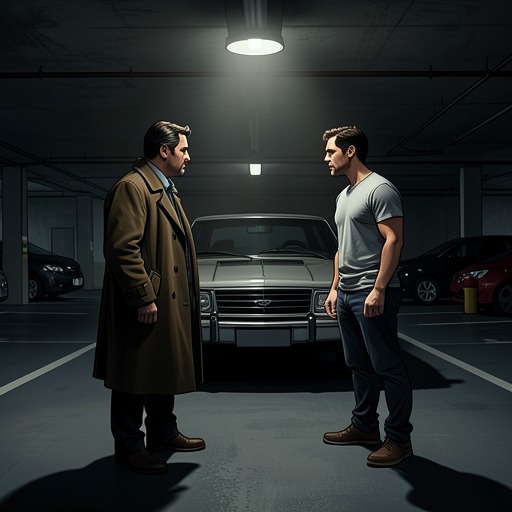
Vaughan inducing the narrator to crash under the influence of acid
CrashVaughan inducing the narrator to crash under the influence of acid is a decisive episode in which Robert Vaughan transforms a drug journey into a test of obedience, desire, and responsibility. During the drive from London Airport, the narrator is already entering an acid state when Vaughan places a bandaged hand on his thigh, gives him a sugar cube, and accepts his authority over the car. The episode develops from physical contact into psychological pressure: Vaughan repeatedly encourages the narrator to steer into approaching vehicles, while the narrator’s perception converts the motorway into an incandescent landscape of impossible traffic and airborne machines.
Causes and Background
The action follows the narrator’s earlier experience of an acid trip, which he remembers as a paranoid nightmare, and it occurs in the charged context of his relationship with Robert Vaughan. The two men travel together in Vaughan’s Lincoln Continental after leaving London Airport. Vaughan is already showing the first signs of an acid high: he squeezes and flexes his hands, wipes his scarred mouth, and watches the enclosed space around him as though gathering the first particles of altered light and movement. The narrator recognizes the progression because he has taken acid before, but recognition does not give him control. His own body begins to register the drug through cool, tender palms and the sensation that wings are about to grow from his hands.
Vaughan’s conduct is significant because he combines acceptance of the narrator’s authority with an intention to undermine it. He settles into the passenger seat as though arranging his wounds, and his faint smile acknowledges both the narrator’s long pursuit of him and Vaughan’s temporary submission. The bandaged palm laid across the narrator’s thigh makes the transfer of control bodily before it becomes mechanical. Vaughan then places a dented silver cube in the narrator’s hand and has him take the drug, binding intoxication to their physical and erotic proximity.
What Happens on the Motorway
The narrator initially drives along the Northolt expressway in the centre lane, allowing faster traffic to pass on either side. As the acid takes effect, ordinary vehicles become unstable visual phenomena. The concrete road becomes a curving bone; overtaking cars seem superheated and close to melting; oncoming vehicles carry cargoes of cool light; radiator grilles become mysterious emblems racing across the road surface. The narrator is no longer managing traffic as a field of practical objects but trying to preserve an entire hallucinated system through the force of his attention.
The effort exhausts him. He removes his hands from the wheel and lets the Lincoln continue forward. The car swerves across the fast lane, its tyres roaring against the concrete verge and throwing dust against the windshield. At that moment Vaughan takes the wheel, braces one knee against the instrument panel, and steers within inches of the central reservation. An oncoming truck approaches in the adjacent lane. Vaughan then removes his hand from the wheel and gestures for the narrator to drive across the central reservation and directly into the truck. The suggestion is not an accidental consequence of intoxication but a visible, repeated attempt to make the narrator perform the crash.
The narrator regains the wheel, yet Vaughan continues to urge him toward the vehicles coming in the opposite direction. The narrator’s attention fragments under the pressure of Vaughan’s body and the traffic’s visual assault. He can grasp only fractions of the messages transmitted by wheels, headlamps, windshields, and radiator grilles. His physical closeness to Vaughan becomes another distraction, so that the coercion works simultaneously through touch, hallucination, and the unstable mechanics of driving.
The narrator recalls leaving Ashford Hospital after his own accident, when the brightness of the traffic and the nervous perspective of Western Avenue had already seemed to anticipate the acid vision. His old wounds now appear to have flowered into the metallic paradise surrounding the car. This memory makes the present journey a recurrence rather than an isolated episode: the motorway repeats the earlier crash in transformed sensory language. When Vaughan urges him again to collide with the approaching traffic, the narrator is tempted to obey. An airline coach bears down on them across the lanes like an alighting archangel, while the narrator holds Vaughan’s scarred wrist and tries to close his eyes against the light.
Vaughan’s Control and the Halt
At the height of the episode, the traffic becomes an armada of luminous creatures landing on the motorway. The narrator imagines that roads and expressways were unknowingly built for their reception, turning modern infrastructure into a vast ceremonial platform. Vaughan leans across him and steers through these imagined flight paths. Horns and tyres scream around the Lincoln as Vaughan controls the wheel like a parent guiding an exhausted child, while the narrator holds the rim passively and follows the car down a slip road.
The immediate consequence is not a collision with the truck or coach but a controlled withdrawal from the traffic. The Lincoln stops beneath an overpass, its front fender rolling onto the concrete palisade separating the motorway embankment from an abandoned wrecker’s yard. The narrator switches off the ignition and listens to the engine’s final sounds. In the rear-view mirror, the traffic continues climbing the access ramp, appearing to join the aircraft Vaughan has watched for months. The abandoned cars in the breaker’s yard then become part of the same vision: rusting chrome, fractured glass, and damaged cellulose seem to emit signals that Vaughan and the narrator decipher while sitting together inside the electric storm of the acid experience.
The halt therefore does not resolve the episode morally. It prevents the immediate crash, but it leaves intact the intimacy through which Vaughan has attempted to make the narrator an instrument of destruction. The car’s illuminated dials, dashboard planes, radio, and ashtrays surround the narrator like machine-made altarpieces, their geometry reaching toward his body. The vehicle is at once a means of escape, a site of erotic contact, and the apparatus through which Vaughan tests whether the narrator will convert hallucinated revelation into real violence.
Responsibility and Aftermath
The event gains its full significance from the book’s surrounding history of crashes and official judgments. Earlier, the narrator’s collision with the Hamiltons had killed Dr Hamilton’s husband, while the police treated the death as accidental and brought no charge of manslaughter or negligent driving. At the coroner’s inquest, an accidental-death verdict was returned without ceremony, separating legal responsibility from the narrator’s intense bodily and imaginative relation to the dead man. The hospital nurse’s report that the wreck had been dragged to the pound and that the sergeant had doubted the narrator could have survived likewise frames catastrophe through institutional procedure rather than through the injured body’s experience.
The later acid drive exposes a more troubling version of that separation. Here Vaughan actively proposes a collision, yet the narrator’s drugged perception, exhaustion, and partial compliance make agency difficult to assign. The episode establishes a pattern in which the novel’s crashes cannot be understood solely as traffic mishaps: they are shaped by suggestion, fascination, bodily wounds, and the desire to make technology deliver an extreme experience. The narrator’s earlier accident, the damaged sports car later documented in Robert Vaughan’s photographic album, and Gabrielle’s transformation through her invalid car all contribute to the same recurring structure in which injury reorganizes sexuality and perception.
The danger also foreshadows Vaughan’s later pursuit of his film actress and the police response to his violence. Vera Seagrave reports that Vaughan is following the actress, that the police are after him, and that an American serviceman was killed on the Northolt overpass; she adds that she had been with him in the car. Against that later confirmation, the motorway episode appears as an early, concentrated model of Vaughan’s method. He eroticizes the wounded body, converts the automobile into an instrument of fantasy, and presses another person toward a fatal impact while preserving enough ambiguity for the crash to resemble an accident.
Narrative and Thematic Significance
The episode is narrated through the narrator’s restricted, chemically altered consciousness, so that the reader experiences the collision between external danger and internal metamorphosis without receiving a stable objective account of Vaughan’s motives. The hallucinations do not erase the concrete action: trucks, coaches, lanes, the central reservation, the steering wheel, and the abandoned yard remain legible beneath the visionary imagery. This tension allows the episode to function both as an altered-state sequence and as a plainly structured act of attempted inducement.
Its deepest pattern is the conversion of bodily injury into a language of technological desire. The narrator’s previous wounds, Vaughan’s scars, the car’s controls, and the motorway’s traffic all become linked surfaces. Later, the narrator reads Gabrielle’s braces, treadles, straps, and pressure marks as templates for new sexual organs, while her invalid car turns assistance technology into an intimate and disturbing extension of the body. The acid drive anticipates that logic: the automobile does not merely carry damaged people through the landscape but enters their sensory and erotic life, making the possibility of a crash feel like the final form of contact.
Vaughan’s coercion is consequently both physical and theatrical. He does not simply order the narrator to crash; he stages the road as a field of angelic arrivals, places his hand on the narrator’s body, withdraws and resumes control of the wheel, and invites the narrator to mistake annihilation for revelation. The car finally stops, but the episode leaves the narrator suspended between resistance and surrender. Its lasting consequence is the recognition that, in Vaughan’s world, an accident can be engineered through another person’s perception long before metal meets metal.