Vaughan's photographic album
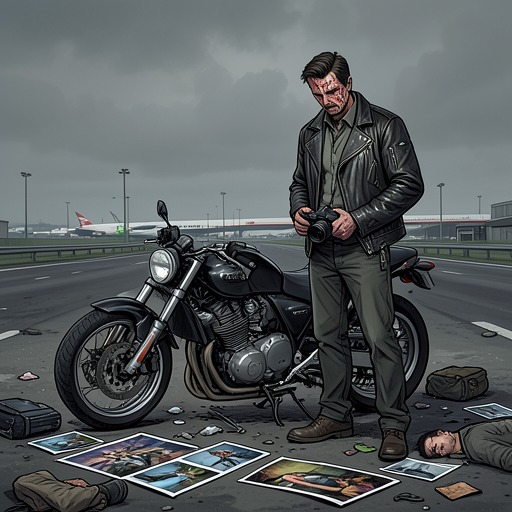
CrashVaughan's photographic album is the central archive of Robert Vaughan's way of seeing: a leatherbound collection that turns crashes, hospitalization, disability, sexuality, and ordinary movement through London's automobile landscape into connected photographic evidence. Its decisive significance lies in the way it shifts attention from James Ballard's personal recovery to Vaughan's controlling gaze, showing that the photographer is less interested in people than in the intersections between bodies, machines, wounds, and desire.
Form and Contents
The album is assembled in Vaughan's photographic workspace, where hundreds of other images cover the walls and benches among enamel pails, discarded prints, and photographic equipment. Those surrounding pictures show motor-cars and heavy vehicles involved in highway collisions, usually surrounded by spectators, police, and ambulance attendants. Some are crude frontal views; others are blurred images taken from a moving car while angry officials remonstrate with the cameraman. The album therefore belongs to a larger practice of mobile, opportunistic surveillance, but its leather binding gives the selected material the coherence of a private record rather than a random collection of accident photographs.
Vaughan opens the album at random and hands it to James Ballard, watching while Ballard adjusts the desk lamp. The first thirty pages document Gabrielle, a young social worker whose small sports car collided with an airline bus near the airport. The sequence follows her from the crushed driving seat, where firemen cut through the windshield pillar, through the emergence of bruises and other injuries, to her removal by ambulance attendants and the later images of her recovery. The accident is not presented as a completed incident but as a process whose stages Vaughan preserves, orders, and reinterprets.
The final photographs of Gabrielle show her in a chromium wheelchair at a convalescent institution, propelling herself at an archery meeting, and taking her first lessons in an invalid car. The album thus records not only injury but adaptation: wheelchair, auxiliary controls, treadle-operated brakes, and hand-operated gear changes become part of the visual narrative. Yet Vaughan's arrangement also subjects Gabrielle's altered body to an intensely objectifying interpretation. The images make her braces, damaged legs, and movements visible as lived material conditions, while James Ballard's response repeatedly transforms those conditions into erotic metaphors. The album exposes that collision between a person's practical recovery and the observer's sexualized projection without resolving it.
James Ballard's Sequence
The remainder of the album records James Ballard's own accident and recovery. Its opening image shows him being carried into the casualty unit at Ashford Hospital, establishing that Vaughan was present from the earliest stage of the aftermath. Vaughan had apparently followed ambulance broadcasts on the VHP band of his car radio, then tracked Ballard from the police pound to the airport reception area, the multi-storey car-park, and Helen Remington's house. The album consequently documents an investigation conducted through proximity, radio information, cameras, and repeated access to the spaces around the automobile.
The photographs do not make James Ballard their stable center. Apart from the zoom-lens images taken through the hospital window as he lies in bed beneath more bandages than he had recognized, the recurring background is the motor-car: vehicles moving along highways around the airport, caught in traffic jams on the flyover, or parked in cul-de-sacs and lovers' lanes. The sequence makes Ballard's life appear to occur almost entirely in or near cars. Vaughan's interest is therefore minimal at the level of Ballard's personality; what matters is the interaction between an anonymous individual and his vehicle, the transit of a body across polished cellulose panels and vinyl seating, and the silhouette of a face against instrument dials.
A further series freezes James Ballard's uncertain sexual return after the crash. It includes his wounded body and his relationships, mediated by the automobile, with his wife Renata and Dr Helen Remington. One photograph catches his hand extending across the transmission tunnel of his wife's sports car, the chromium gear lever pressing into his bruised forearm. Another records his numb mouth against Renata's breast beside the window-sill. A third shows Helen Remington astride him in the passenger seat of her black saloon, her scarred knees against the vinyl while the instrument panel rises behind their bodies. The album makes each encounter inseparable from the car's interior geometry, turning intimacy into a diagram of bodily contact with technology.
Vaughan's Gaze and Method
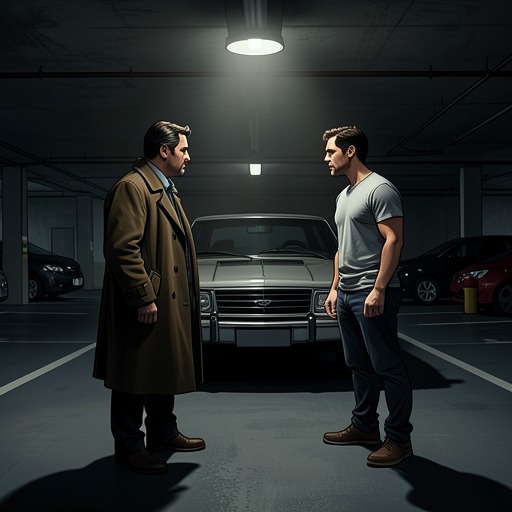
The album reveals Robert Vaughan as a photographer who seeks not merely to witness accidents but to possess their visual structure. In one set of images, he has photographed six middle-aged women with unusual care, using a zoom lens through windshields and revolving doors; James Ballard is struck by their resemblance to Vera Seagrave as she might appear decades later. Elsewhere, Vaughan photographs the aftermath of collisions from moving cars and follows accident sites with a persistence that brings him into conflict with police and ambulance attendants. His camera is both recording instrument and means of trespass.
The album's logic depends on seriality. Gabrielle's accident, hospitalization, convalescence, and first attempts to drive are placed beside James Ballard's crash, hospital stay, and post-accident relationships. The repeated pattern implies that the individual accident is one variation within a broader technological sequence. Bodies are shown before and after impact; cars appear as intact objects, crushed structures, and environments for sexual activity. Recovery does not restore a simple earlier identity. Instead, the album presents altered bodies and modified vehicles as new configurations whose meanings continue to develop after the collision.
Vaughan's photographs also make the act of viewing part of the subject. When James Ballard studies an image of himself at Renata's breast, Vaughan ignores the emotional significance of the scene and points instead to the chromium window-sill and the stretched strap of a brassiere. A freak alignment of metal and nylon appears to project a distorted nipple toward Ballard's mouth, and Vaughan directs attention to that mechanical conjunction. His broken thumbnail is caked with engine oil, materially joining the photographer's body to the machine he studies. The album's visual authority is therefore instructional: Vaughan behaves like an instructor helping a promising pupil learn how to see.
From Archive to Sexual Theory
For James Ballard, immersion in the album produces a disturbing recognition. He cannot summon the expected anger at Vaughan's intrusion because the photographs have already reorganized his perception of violence and sexuality. The deformed body of Gabrielle, like the deformed bodies of crashed cars, appears to disclose possibilities of a new sexuality. The album does not simply preserve evidence of events; it supplies a conceptual language through which Ballard can interpret his own injuries, his erotic encounters, and the automobile's role in both.
That interpretation is reinforced by the broader photographic culture surrounding Vaughan. He has created dossiers on injured women and gathered images of crash sites, while his apartment contains photographs of film actress Elizabeth Taylor taken from pedestrian bridges, motorways, and the roof of a multi-storey car-park. He matches magnified details of her knees, hands, thighs, and mouth with photographs of grotesque surgical wounds. The album belongs to this same practice of substitution, in which a body is studied through fragments, compared with damaged surfaces, and made into a catalogue of impacts and possible injuries.
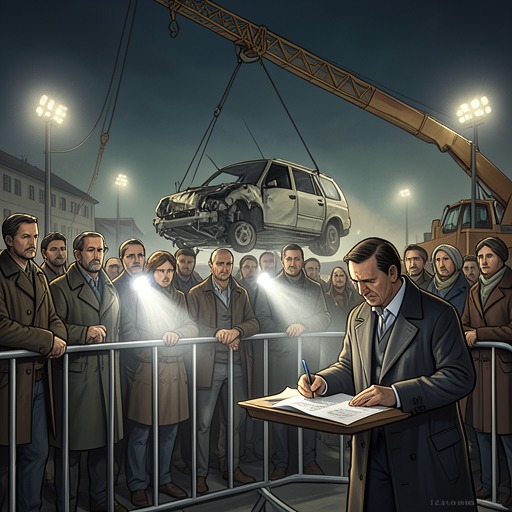
The archive also converges with staged observation. At the Road Research Laboratory, Vaughan watches a calibrated test crash with such absorption that his physical excitement becomes part of his spectatorship. He later screens slow-motion films of test collisions, and the repeated impacts first calm and then arouse James Ballard. At another test crash, Vaughan watches the motorcycle and mannequin family approach the collision course while manipulating himself beneath publicity folders, checking that Ballard is involved. The album's still photographs thus sit within a larger system of films, cameras, radio broadcasts, and live observation in which repetition converts catastrophe into study, ritual, and erotic stimulation.
Recurrence and Narrative Significance
The album's images continue to shape scenes beyond the room in which James Ballard examines them. At the motor show at Earls Court, Robert Vaughan guides Gabrielle among immaculate cars, displaying his scarred face beside her braced and injured body. She moves from stand to stand, enters sports cars and concept vehicles, and handles the machinery of invalid cars while salesmen and spectators confront the contrast between her altered body and the geometrical perfection of the exhibits. The showroom reproduces the album's fundamental arrangement: damaged or transformed flesh is placed against polished technology and made available to a public gaze.
James Ballard later makes love to Gabrielle in the rear seat of her small car, surrounded by the auxiliary controls designed for her. Her braces, straps, buckle grooves, and the depressions left on her skin become, in his perception, templates for possible new sexual organs. The scene demonstrates how thoroughly the album has taught him to read injury through automotive form. It also makes the ethical danger of that reading unmistakable: Gabrielle's practical devices and bodily discomfort are treated by the narrator as erotic signs, while her own experience remains partly obscured by the intensity of his projection.
The album's ultimate importance is therefore double. It is a material record of Vaughan's movements through accident sites, hospitals, roads, cars, and private encounters, but it is also a mechanism that transforms records into desire. By placing Gabrielle, James Ballard, Renata, Helen Remington, and the automobile within one sequence of images, it erases the boundaries between documentary evidence, surveillance, fantasy, and instruction. Its pages teach James Ballard to see the crash not as an isolated disaster but as a recurring structure in which technological surfaces, injured bodies, and sexual imagination continually reassemble one another.