Vaughan's cameras
CrashVaughan's cameras are not merely recording devices but the practical instruments of Robert Vaughan's obsessive vision. With zoom lenses, a Polaroid camera, a cine-camera, flash equipment, and related photographic apparatus, Vaughan converts automobile accidents and human bodies into images that can be collected, enlarged, compared, replayed, and used to construct an imagined future. The cameras give his fascination a method: they make looking mobile, repeatable, and increasingly inseparable from control, sexuality, and violence.
Equipment and Physical Presence
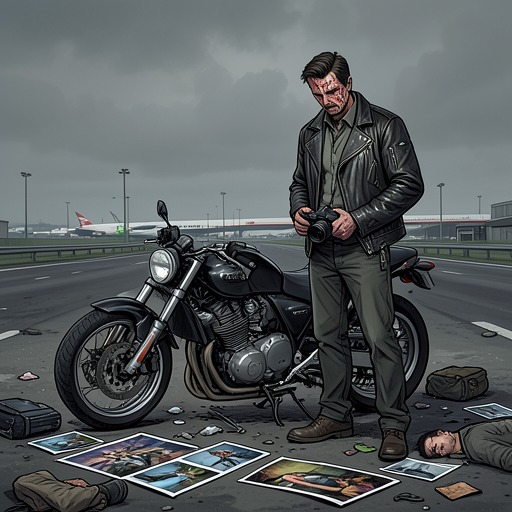
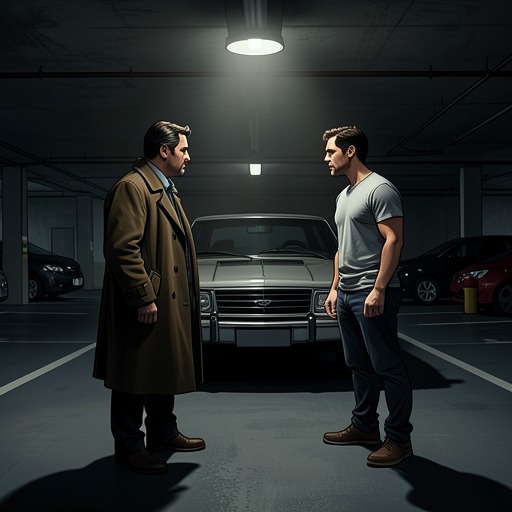
The apparatus is repeatedly associated with Vaughan's physical presence at the edges of accidents and other people's private scenes. When the narrator encounters him near an accident site, Vaughan watches through a mud-spattered windshield and raises a camera fitted with a zoom lens to his eye. Later, on the roof of a multi-storey car-park, he uses an opaque flash bulb and removes film from the back of his Polaroid camera while observing the narrator and a prostitute in a car. His equipment occupies the passenger seat of his own vehicle: cameras, a tripod, a carton of flashbulbs, and a cine-camera secured to a dashboard clamp. Held by its pistol grip, the camera resembles a weapon, an impression reinforced by Vaughan's deliberate, aggressive movements.
The cameras therefore extend Vaughan's body rather than standing apart from it. At a Western Avenue accident, one camera swings from his neck as he leans from the car and scans the wrecked vehicles. His eyes seem to photograph every bent fender and broken bone through rapid grimaces, but the physical camera makes this act of memorization material and portable. The device allows him to move between spectator, investigator, and participant, carrying the scene away while remaining close enough to contest the police and ambulance attendants for access.
Archive of Crashes and Recovery
Vaughan's photographic practice produces an extensive archive of automobile violence. In his apartment, hundreds of photographs cover the walls and lie across benches among enamel pails and discarded prints. Many show motor-cars and heavy vehicles in highway collisions, surrounded by spectators and police, while others isolate impacted radiator grilles and windshields. Some were taken hurriedly from a moving car, their blurred outlines preserving the anger of police and ambulance attendants as Vaughan swerved past them. The collection records not only the crash but also the conflict over who has the right to see and preserve it.
The most sustained photographic sequence follows the narrator's accident and recovery. Vaughan photographed the narrator being carried into the casualty unit at Ashford Hospital, having tracked the ambulance broadcasts on his car radio. He then photographed the narrator through the open hospital window, where the injured body lay under more bandages than the narrator had understood at the time. The sequence continues across the automobile landscape, following the narrator from the police pound to the airport reception area, the multi-storey car-park, and Helen Remington's house. Its apparent subject is the narrator, but its real subject is the interaction between an anonymous body and the car: movement across polished cellulose panels, confinement within vinyl seating, and the face silhouetted against instrument dials.
This archive changes the meaning of documentary evidence. The photographs do not simply preserve what happened to the narrator; they reveal Vaughan's route, interests, and compulsive presence. The record becomes a portrait of the photographer's obsessions, with the subject repeatedly displaced by the automobile and by the act of watching. Vaughan's cameras make the narrator's life appear to have been spent in or near cars, not because the photographs offer neutral proof, but because the apparatus has selected and arranged reality according to Vaughan's particular logic.
Surveillance, Desire, and the Enlarged Image
Vaughan uses the zoom lens to convert distance into possession. In the weeks before his final crash, the walls of his apartment near Shepperton Studios are covered with photographs of Elizabeth Taylor as she leaves her hotel in London, travels beneath motorway bridges, and moves through the studios. The images are taken from pedestrian bridges and from the roof of a multi-storey car-park. Their magnified details isolate her knees, hands, inner thighs, and the left apex of her mouth. The camera breaks the ordinary scale of the body into fragments that can be handled visually and matched to other images.
The narrator reproduces packages of these prints on a copying machine and gives them to Vaughan, treating the deliveries as installments of a death warrant. Vaughan compares the photographed details of Elizabeth Taylor's body with photographs of grotesque wounds in a plastic-surgery textbook. The camera thus joins celebrity surveillance to anatomical study: the actress's body is not viewed as a complete person but as a set of surfaces that can be aligned with future injuries. The image anticipates the wound, and the wound retrospectively completes the image.
The same apparatus participates in Vaughan's sexualized observation of injured and vulnerable women. He photographs nervous young women in sexual postures inside the crushed rear compartments of abandoned cars in breakers' yards. Their faces and thighs are illuminated by the Polaroid flash, while the photographs place them beside the injured bodies represented in surgical textbooks. In another series, six middle-aged women photographed through windshields and revolving doors resemble Vera Seagrave as she might appear twenty years later. These carefully composed images show that Vaughan's interest extends beyond spectacular crashes: the camera searches ordinary bodies for signs of deformation, decline, and technologically mediated sexual possibility.
Motion Pictures and Repetition
The cine-camera gives Vaughan's interest in collision a temporal dimension. At the Road Research Laboratory, he and the narrator watch calibrated vehicles crash into concrete target blocks. Later, Vaughan screens slow-motion films of test collisions that he has photographed with his cine-camera. The silent impacts flicker repeatedly on the wall above them, transforming the crash from a singular event into a sequence that can be halted, replayed, examined, and desired. Repetition makes violence both clinical and hypnotic: the narrator is first calmed and then aroused by the returning images.
The camera's power lies partly in this ability to detach impact from ordinary duration. A collision that would ordinarily be too fast to comprehend becomes a series of visible stages, while a death can be imagined as an endlessly repeatable composition. Vaughan's equipment therefore links technical observation to fantasy. It allows the crash to be studied as data, but it also supplies the slow-motion aesthetic through which bodies, metal, glass, and wounds become a single choreographed image.
Narrative and Thematic Significance
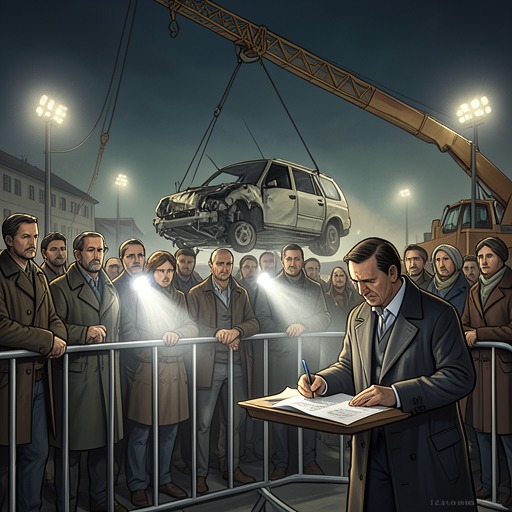
Vaughan's cameras establish a visual economy in which seeing is never innocent. Police, spectators, ambulance attendants, Vaughan, and the narrator all look toward crashes, but Vaughan's apparatus gives his gaze unusual persistence and reach. It permits him to watch from bridges, cars, hospital windows, car parks, and accident sites; it also allows him to preserve what he sees and return to it in private. The camera changes the observer's relation to the event by making absence temporary and distance permeable.
At the same time, the devices expose the material limits of control. Vaughan can photograph the narrator's recovery, assemble an archive of collisions, and prepare Elizabeth Taylor's imagined death by matching bodily fragments with surgical wounds, yet the final crash remains an event in which bodies and machines exceed the photographer's mastery. His cameras make the death imaginable before it occurs, but they cannot turn the image into a stable boundary between rehearsal and reality. In this sense, Vaughan's cameras are the instruments of a culture that tries to manage automobile violence by recording it, only to discover that repeated looking can intensify the very fantasies the record appears to contain.
Their decisive function is therefore double. They are evidence-gathering tools and instruments of erotic fixation; they preserve the past while manufacturing future scenes; they place Vaughan outside the wreck while drawing him psychologically into it. Through them, the automobile crash becomes not only something to witness but an image-system in which surveillance, celebrity, anatomy, sexuality, and death continually fuse.