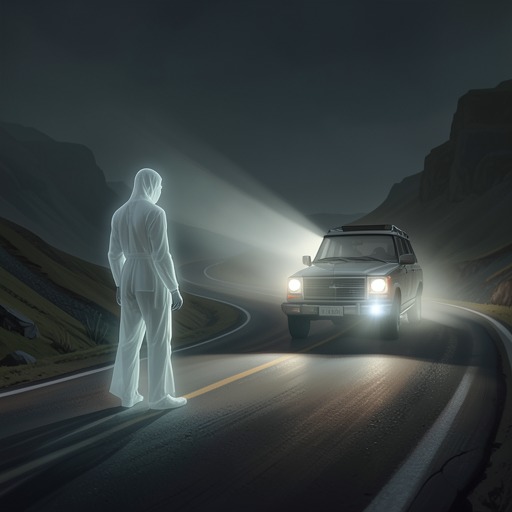
the narrator's collision with the Hamiltons
Crashthe narrator's collision with the Hamiltons is the decisive accident that transforms an ordinary drive into the novel's central pattern of bodily injury, erotic fixation, and disputed responsibility. The narrator survives a head-on impact that kills the young engineer Dr Hamilton, while Dr Hamilton's wife, later identified as Dr Helen Remington, escapes with comparatively minor injuries. The crash is legally treated as accidental, but its images and consequences continue to organize the narrator's relationships, his understanding of sexuality, and his attraction to Robert Vaughan's deliberate reenactments of automotive death.
Causes and Setting
On a rain-swept June evening, the narrator drives home from the film studios at Shepperton after leaving his secretary Renata. His car skids at the intersection below the Western Avenue flyover, enters the oncoming lane at about sixty miles an hour, strikes the central reservation, and loses its off-side tyre. The uncontrolled vehicle crosses the reservation and turns up the high-speed exit ramp, where three mass-produced saloon cars are approaching. The narrator manages to avoid the first two, but collides head-on with the third, carrying Dr Hamilton and his wife.
The accident is not presented as a simple lapse isolated from the narrator's inner life. He has deliberately fastened his safety belt to spare Renata the embarrassment of embracing him, and the belt becomes one of the small mechanical conditions that separate survival from death. The car's interior also becomes a second site of collision: his chest strikes the steering wheel and his knees crush into the instrument panel as his body moves forward into the vehicle. The road, the machine, and the body therefore form one continuous mechanism of impact rather than three separate elements.
The Collision and Immediate Aftermath
Dr Hamilton is killed instantly. He is propelled through his windshield and comes to rest on the bonnet of the narrator's car, his blood spraying through the fractured windshield across the narrator's face and chest. Firemen initially assume that the narrator is dying from a massive open-heart wound, although his serious physical injury is chiefly a severed nerve in his scalp. His chest is badly bruised and his knees are crushed, but the disproportion between his apparent condition and his survival gives the event an uncanny quality.
Dr Hamilton's wife survives with a bruised upper jawbone and loosened teeth. Supported by her diagonal seat belt, she remains behind the steering wheel while the narrator sees her through the fractured windshields, with her husband's body lying between them on the bonnet. His hand rests near the narrator beside the right windshield wiper, and the impact has marked it with a blood blister shaped like the triton signature of the narrator's radiator emblem. The emblem turns the corpse into a disturbing sign, as though the manufacturer's design has been stamped directly onto human flesh.
Rescue workers and spectators rapidly transform the scene into a public theatre of technology. A traffic jam forms along Western Avenue as police headlamps flare against stalled vehicles, while bystanders press their hands through the windows toward the surviving woman. She frees herself from the seat belt and is helped from the wreck by an Arab airline pilot. Her awkward movements seem to imitate the distorted streamlining of the two cars, and the involuntary stream of urine between her legs becomes another bodily trace of the collision. The narrator, still trapped in his car, reads the arrangement of bodies, machines, road, ramp, and aircraft as a stylized drama whose violence has acquired ritual form.
At the hospital, the narrator continues to experience the crash as a compound of physical fact and eroticized image. The dead man's wife appears to him as a bereaved, intelligent woman whose bruised face is slowly deforming, while the interlocked radiator grilles seem to establish an inescapable union between the two vehicles and, by extension, between the survivors. He fixes his attention on the contours of her thighs and imagines the untouched sexuality of her body presiding over the tragedy. The collision thus changes the meaning of survival: remaining alive does not release the narrator from the dead, but places him inside a new relationship with the widow and the wreckage.
Legal and Personal Consequences
During the narrator's recovery near London Airport, the accident remains present through police lights, hospital routines, and repeated visual memories. A nurse tells him that the police had to drag his wreck to the pound and that the sergeant did not believe anyone could have escaped from it alive. She expresses regret for Dr Hamilton, but the narrator regards ordinary condolences as a conventional performance that cannot approach the actual intimacy of the wounds, the dead man's final seconds, or the collision between his own body and the car's interior.
The widow, Dr Helen Remington, visits him in the hospital and speaks persistently about the crash and the police inquiries. Her account of the crushed radiator grille and blood-spattered bonnet has the persistence of a voyeur's description, and the narrator's sexual response becomes inseparable from the accident's imagery. Helen also says that she was not ready for the funeral and wishes the dead could remain visible for months rather than being buried quickly. Her refusal of conventional mourning makes the collision an unfinished event rather than a closed tragedy.
At the coroner's inquest, the verdict is accidental death. No charge of manslaughter or negligent driving is brought against the narrator. This official conclusion separates legal responsibility from the narrator's continuing sense that the crash has created a binding relation among himself, Helen, and her dead husband. Helen later walks through the airport car park with a scar on her face, turning away as if to erase the narrator's existence while appearing completely lost. The law closes the case, but the characters remain inside its emotional and erotic aftermath.
Recurrence and Narrative Significance
The collision introduces the narrator to the logic that Robert Vaughan will later pursue consciously. Vaughan is a scarred former television scientist whose career ended after a serious motorcycle crash, and he studies car accidents through photographs, damaged vehicles, and repeated experiments. When the narrator first meets him, Vaughan's aggressive handling of a Lincoln Continental establishes the pattern of their relationship: driving becomes a mixture of control, helplessness, mockery, and impending impact. The narrator's earlier collision supplies the experience that Vaughan converts into an obsessive system.
Vaughan's later discussion of car crashes, including the significance of the ten-year-old Continental and the possibility of treating Kennedy's assassination as a special kind of car crash, reveals how the narrator's accident has become part of a wider mythology of automotive violence. Vaughan's calmest moments occur when he describes wounds and collisions with the tenderness of a separated lover; the narrator recognizes that Vaughan uses sexual provocation and crash imagery to keep him attached. The original accident therefore functions not merely as backstory but as the first object in a chain of reenactments, fantasies, and deliberate threats.
The narrator eventually understands that Vaughan's violence toward him is connected to a submissive tenderness and to the belief that death in a car crash can become a form of rebirth. Even after Vaughan's death, the narrator imagines him returning through twisted radiator grilles and cascading windshield glass. The Hamilton collision is the event that makes this vision possible: it converts a fatal road accident into a durable technological and bodily emblem, one in which death, desire, memory, and responsibility can never again be cleanly separated.