The Water’s Edge Flood Disco
Dark Lies the IslandThe Water’s Edge Flood Disco is an improvised gathering at the Water’s Edge Hotel during the Killary flood, when rising water isolates the guests and begins entering the building. The host moves everyone to an upstairs function room, opens its stocked bar, and puts on familiar music. The dance is both a practical response to danger and a temporary social order: people share space, drink, and move together while the flood remains close below them. By the end of the sequence, the water has fallen by a couple of steps, and the narrator connects the night’s communal intensity with a new willingness to accept what life brings.
From warning to shelter
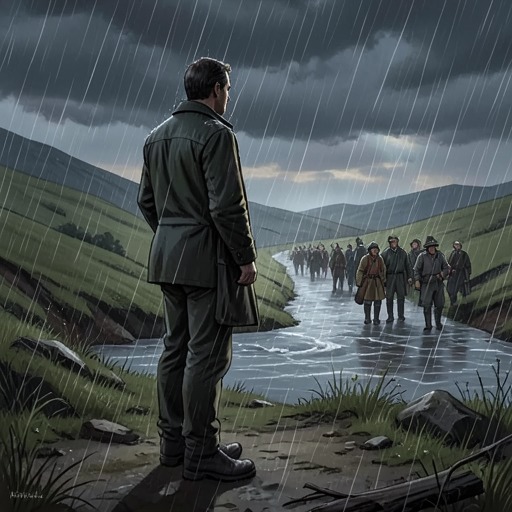
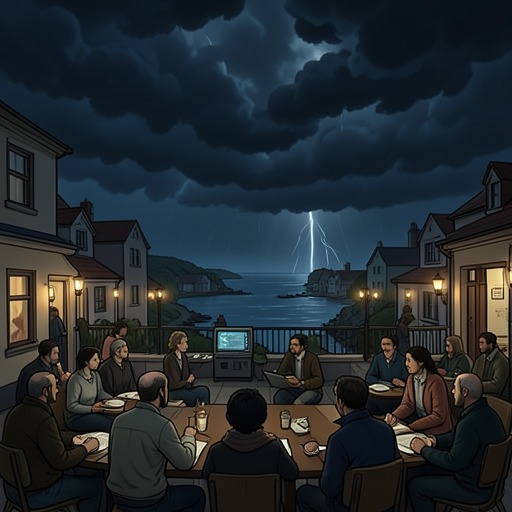
The disco grows out of a crisis that first appears through ordinary signs becoming impossible to ignore. Howling dogs draw people to the windows; there they see the roadway between the hotel and harbour wall disappear beneath the water. The last evening light and continuing rain frame a rapidly changing landscape, and the prospect of travel gives way to the recognition that roads will be impassable. The group retreats from the windows, makes quiet calls on mobile phones, and speaks in whispers as reports spread that the fjord’s waters have breached the harbour walls and emergency services have been alerted.
The hotel’s Belarusian guests try to block the doorways with old curtains brought down from the attic. Their improvised barriers do not hold: once the last box reaches the bottom of the stairs, water enters. The host then moves the group upstairs to the function room, which is used for occasional weddings and has both a fully stocked bar and working disco lights. The relocation is urgent rather than ceremonial; the host keeps to the rear as everyone climbs and looks back at the flooded space below. Promised emergency assistance has not yet arrived, so the upper room becomes a refuge as well as a place to wait.
The party takes shape
In the function room, the host switches off the harsh overhead strip lights and turns on the softer disco lighting. The bar opens, and the guests begin drinking. Rather than treating the gathering as a separate celebration, the host proposes a disco because the group is already stranded together. The decision gives the guests something to do in the face of an emergency they cannot control; their response is not to deny the danger, but to build a shared occasion inside it.
The music draws on familiar popular songs: the host selects Abba, The Pretenders, and Bryan Adams, and the guests dance to “Chiquitita,” “Brass in Pocket,” and “Summer of ’69.” The songs bring different moods to the room, from slow dancing to nostalgia and exuberant movement. The narrator recalls the old dance steps as if the year 1979 were near at hand. For a time, remembered music and communal movement organize the night more powerfully than the flood’s disruption does, although the water continues to press into the building.
Floodwater at the stairs
The dance is repeatedly interrupted by visible evidence of how close the danger remains. Looking from the landing, the host sees sheep bobbing in a rowing boat on the floodwater. Later, the six Belarusians are sitting at the top step of the stairs, while water has reached halfway up them. Objects from the lobby—including footstools, toilet rolls, place mats, and phone books—float past below. The party does not stop the flood or restore the hotel to safety; it persists alongside the damage, with the host returning to the function room to keep serving drinks.
The room also contains distinct forms of response rather than a single, uniform mood. Some guests dance, while others turn toward conversation or watch the rising water. Bill Knott, John Murphy, and the McAllisters and Fettles dance; the Belarusians dance in the darker corners; Mick Harty and Vivien Harty talk in a booth, with Mick holding napkins to his bleeding neck. The range of activity makes the disco less a seamless escape than a temporary gathering in which people carry on, attend to one another, and remain aware of the crisis outside the room.
A small reversal and a larger change
The flood’s course changes only slightly within the scene, but the small sign matters. The narrator runs onto the landing to check the water and meets Alexei, one of the Belarusians. Alexei indicates with a cheerful movement of his thumb that the level on the stairs has dropped by a couple of steps. The narrator pats him on the back, winks, and returns to the disco. The gesture registers relief without implying that the danger has ended: the water’s retreat is measured against the stairs, and the group is still in the hotel.
During the gathering, the narrator reflects on the need to accept life as it comes, including possible death in the fjord, a return to the city, the presence or absence of poems and children, illness, love, and success. The dance thus coincides with a change in outlook rather than simply supplying a cheerful interlude. The narrator takes to the floor, closes his eyes, and sees images of childhood pets in the shifting light; he later describes random phrases and images arriving as the beginnings of new writing. The episode ends with his sense that the gloom of youth has lifted. The disaster remains unresolved, but the disco gives the host and guests a temporary means of living through it together, and gives the narrator a moment of personal renewal.