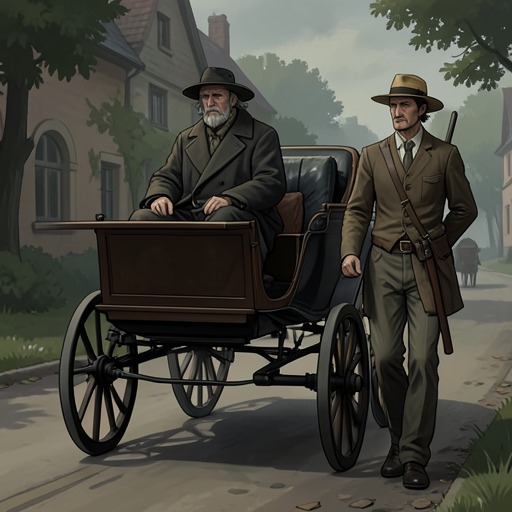
Chichikov and Selifan’s master-servant relationship
Dead SoulsChichikov and Selifan’s master-servant relationship is the practical engine of Chichikov’s travels and a recurring comic study in authority, labor, and dependence. Chichikov commands; Selifan drives, tends the horses, and carries the consequences of his own lapses. Their unequal bond is nevertheless rendered through more than orders: Selifan’s loquacity, his ideas about respect and discipline, and the changing manner in which he handles the team make the everyday workings of the hierarchy conspicuous.
Identity and Working Arrangement
Selifan is Chichikov’s coachman, one of the two attendants who bring the traveller’s luggage into his lodging. He appears beside Petrushka, Chichikov’s valet, as a small man in a large overcoat; once the portmanteau and other possessions have been carried in, Selifan leaves to look after the horses. The arrangement establishes the material basis of their relationship: Chichikov’s journeys depend on work performed by attendants, and Selifan’s assigned work is to manage the team and keep the britchka moving.
That work is not represented as smooth or invisible. On the road, Selifan is capable of letting the reins hang loose while he talks to the horses, and his attention can wander from the route. The narrative repeatedly sets the mobility Chichikov requires against the unevenness of the labor that provides it: travel proceeds through the driver’s skill and instinct, but also through his errors, exhaustion, and discipline.
Talk, Loyalty, and Deference
After leaving Manilov’s household, Selifan muses aloud about the people who had entertained them. He praises them as agreeable company and says that he likes speaking with a decent man over tea or a biscuit. He then invokes Chichikov’s status, observing that people look up to his master because he has served the government and holds the rank of Collegiate Councillor. Selifan’s remarks join personal sociability to formal hierarchy: a good host earns respect, while his master’s official standing is another reason for deference.
Chichikov does not hear this approving account. His thoughts are absorbed by his own plans as the coachman talks to the horses, making the contrast between master and servant structural as well as comic. Selifan’s voice fills the carriage’s immediate world, but Chichikov’s attention remains elsewhere. The intimacy of travel does not erase the distance between them; each occupies a different mental and practical role within the same vehicle.
Selifan also speaks as someone who accepts his subordinate position. After the britchka capsizes, Chichikov threatens him with the whip and recalls having warned him about getting drunk. Selifan does not challenge the master’s right to punish him. Instead, he reasons that a peasant who deserves it may be beaten, that a master may do as he likes, and that discipline is sometimes necessary. His complacent defense of punishment makes the power imbalance explicit: the servant explains the legitimacy of the very authority under which he stands.
The Overturned Carriage
The relationship’s sharpest early crisis begins with a lapse of attention. During a thunderstorm, Selifan has lost track of how many turnings the carriage has passed. He chooses a crossroad without knowing where it leads; later, Chichikov notices the britchka jolting across a ploughed field and asks which road they are following. Selifan answers that he does not know, blaming the darkness, and the vehicle tilts so severely that Chichikov has to hang on with his hands and teeth. Chichikov then realizes that the driver is drunk.
The mishap becomes physical before it becomes a dispute. Despite Chichikov’s order to stop, Selifan turns the vehicle until it falls onto its side, throwing his master into the mud. The horses are exhausted, and Selifan himself seems astonished by the accident, addressing the overturned britchka as though it had been responsible. Chichikov calls him drunk; Selifan denies it, describing his drinking as a conversation and snack with a decent man. The difference between their accounts is plain: the master identifies dangerous misconduct, while the servant recasts it as ordinary sociability.
Chichikov’s threat to use the whip briefly makes discipline the subject of the exchange, but Selifan’s ready acceptance leaves his master with no further reply. The episode does not end with punishment. A dog’s barking gives the travellers a direction, and Selifan manages to get them to a nearby house by instinct despite being unable to see through the rain. His failure and competence coexist: he has caused the danger, yet his driving sense still carries the party toward shelter.
Discipline and the Road
The journey out of the house shows a changed Selifan. When Chichikov sees the britchka approaching, he reproaches the coachman for lingering and suggests that the effects of the previous night’s drinking have not left him. Selifan offers no answer. The silence continues as he drives, gloomy but attentive, a manner the narrator identifies as customary after he has been drunk.
The details of the team register that change. The horses look unusually well groomed, and a collar that had long allowed its stuffing to protrude has been neatly mended. But Selifan no longer speaks to the horses with the affectionate and instructive familiarity heard on the earlier journey. He snaps at them to get on, and the skewbald receives harsh blows, including blows to sensitive parts of its body. The other horses, accustomed to being addressed as pets or good lads, also seem put out by the difference. The team’s response makes Selifan’s altered manner legible through the animals that depend on him, just as Chichikov depends on Selifan.
The girl who guides the travellers points out a road leading to the right, but Selifan dismisses her direction as if she cannot tell right from left. In fact, the landscape makes guidance necessary: the ground is so sodden that mud cakes the wheels like felt, increasing the carriage’s weight, while roads branch and wind in every direction. Without the girl, finding the way would have been impossible. Selifan’s confidence therefore sits beside his dependence on another person’s local knowledge; the driver who is responsible for his master’s route still needs help to navigate it.
Labor, Land, and Narrative Significance
The novel’s broader account of estate work gives this small household relation a larger context. In conversation at Kostanzhoglo’s estate, the factor who walks beside the landowner addresses him about a request; Kostanzhoglo insists that he does not wish to act like a huckster and says that he would not demand interest on a loan merely because it remained unpaid for years. This exchange, though not a scene between Chichikov and Selifan, underscores the varied forms of dependence and obligation surrounding land and service in the novel.
Kostanzhoglo describes estate management as continuous labor shaped by the seasons: preparing seed and dividing workers before spring, ploughing and sowing once the ground dries, reaping and storing grain in summer and autumn, and threshing and inspecting mills and workmen’s huts in winter. Against that sustained work, Selifan’s task is more mobile but no less necessary. Chichikov’s progress depends on a man attending to horses, vehicle, weather, and road—sometimes competently, sometimes carelessly, and often under command.
The relationship therefore links comic misadventure to the conditions of movement through the book. After the funeral procession, the britchka returns to a landscape of road-menders, inns, villages, repaired bridges, fields, and long stretches of open horizon. Chichikov’s journeys carry him through this materially worked country, but the carriage does not move by itself: Selifan’s labor is the immediate means by which his master crosses it. Their unequal partnership is at once a recurring comic exchange and a practical dependence, with authority most visible when the road fails and the servant’s work becomes impossible to overlook.