Cancer
DeceptionCancer in these conversations is neither a settled prognosis nor a simple recovery story. An unnamed patient moves from fear of an aggressive disease to the relief of a CAT scan showing no trace of pathology, while further treatment and surgery remain ahead. The shifting medical picture gives illness a practical timeline, but the dialogue also shows how that timeline presses on writing, ordinary plans, and the question of whether there will be a future.
Diagnosis and the weight of uncertainty
Before the unexpectedly clear scan, the patient describes the disease as having been called incredibly virulent. The initial estimate was that there was a thirty-to-fifty-percent chance of things being all right; if they were not, the patient had been told that death could come within a year. That warning gives the later test its high stakes. The CAT scan is not merely another appointment: it may indicate whether the drugs are working, and its answer is awaited against a prognosis that had made time feel sharply limited.
On the morning of the scan, the patient says there is nothing new to report and calls it a heavy day. When Philip Roth asks what the test will establish, the answer is stark: “How much longer.” The patient immediately qualifies that fear with the actual medical possibilities. Tumors on the scan would mean bad news and that the drugs were not working; a scan without visible tumors would still not settle the matter, because surgery would be needed to find out what was happening. The conversation preserves this distinction between a test result and a definitive account of the disease.
Treatment and the limits of a clear scan
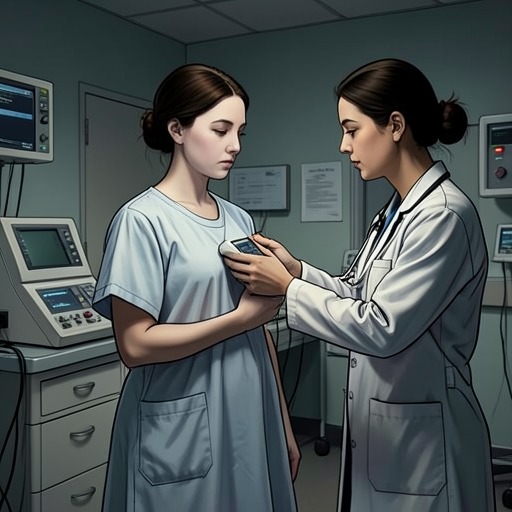
The later telephone call brings a reversal. The patient calls the scan result a miracle: after three months, it shows no trace of pathology, and the doctor is pleased enough to say that the prognosis has changed. The speed of the response is itself unsettling. The disease had been described as aggressive, but the scan now appears to show that the treatment is working unusually quickly. In the patient’s immediate reading of the images, there is no longer evidence of cancer; that relief is real, but it does not remove the need to check what the scan cannot show.
The patient still expects to be opened up in June so that the doctors can compare what the scan reveals with an inspection of a test tube. The cancer could recur, and the patient understands that the CAT scan may not capture every small cell. The doctors’ satisfaction therefore coexists with a plan for further investigation. The scan alters the prognosis, but it does not transform uncertainty into certainty: the patient still has to finish the course of treatment and wait to learn whether the apparent response will hold.
Chemotherapy, surgery, and the fear of recurrence
The course of treatment remains physically and emotionally consequential even after the favorable scan. On another day, the patient tells Philip Roth, “I have chemotherapy today,” then anticipates an operation as an ordeal and worries that feeling well may be followed by a medical setback. Looking and feeling well are encouraging, but they are not proof that the disease has disappeared. The patient explains that tiny cells might remain beyond the scan’s reach, in which case another six months of treatment could be necessary.
The feared alternative is more severe: the doctors might open the patient up and discover that the body is full of tumors. The patient does not think that outcome likely, but cannot rule it out. This gap between what seems probable and what remains possible governs the exchanges after the scan. A favorable image offers evidence and relief; it cannot answer every question that surgery is meant to resolve. The patient also reports that the doctors think the treatment course can be completed and that recurrence may not happen, but describes this as a hope rather than a guarantee. Even the possibility of remaining on the drugs for life is framed conditionally, as a way life might be possible if continued medication proved necessary.
Mortality and reassurance
The patient makes the personal stakes explicit: “I may be bald but I’m not even forty. I really don’t think I should die.” The sentence holds together the visible cost of treatment, youth, and a refusal to accept death as an appropriate outcome. Philip Roth answers with certainty, promising that the patient will not die. When the patient recalls that this was also what Philip Roth said in a dream, the reassurance becomes part of a repeated exchange rather than a conclusion established by medical evidence. Philip Roth says again, “You’re not going to die,” and then, “You’re going to live.”
That repetition matters because the clinical picture remains open. The patient has a clear scan, but still faces chemotherapy and an operation; the patient has reasons for hope, but no assurance against recurrence. Philip Roth’s promise does not resolve those conditions. Instead, the conversation sets an intimate act of reassurance beside the uncertain work of diagnosis and treatment, showing how confidence between two people may be sought precisely where the medical answer is incomplete.
Living and writing during illness
The conversations also register the way illness reorganizes the patient’s immediate life. Asked whether writing is possible, the patient says, “Not a lot,” and explains that narrative crumbles under the weight of endless stories. The remark appears in the same exchange as the approaching scan and the patient’s efforts to cope with an indefinite situation. It links the difficulty of writing not to a lack of stories, but to their unmanageable accumulation while the medical outcome remains unknown.
The patient describes trying yoga, eating some macrobiotic food, and living with whatever joy is available. These are reported as present practices, not as a cure or an alternative prognosis. The patient also says the support system is going well and mentions that even the patient’s father has phoned. Together, these details counterbalance the frightening medical possibilities without cancelling them: life continues through treatment, attempts at routine, family contact, and the effort to find joy. Cancer’s significance in the exchanges lies in this unsettled coexistence. The scan can bring extraordinary relief; the next treatment and operation can still be feared; and the future remains something the patient and Philip Roth try to speak into being without pretending that the outcome is already known.