early in the affair
The Escape Questionnaire
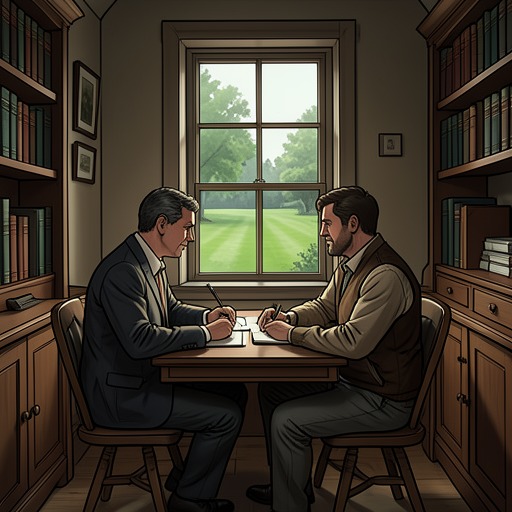
In the [Narrator's London writing room](entity:location-recall-location-310a97d705ea), Philip and the [Unnamed English woman](entity:character-recall-character-42ce2cbcec8f) invent a questionnaire for lovers contemplating running away together. Its questions move briskly from irritations and sexual expectations to money, honesty, aging, and whether marriage can still be mistaken for a love affair.
early in their relationship
A Marriage Under Strain
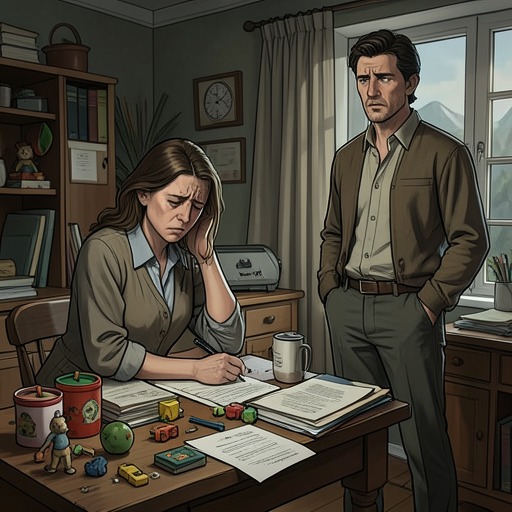
The [Unnamed English woman](entity:character-recall-character-42ce2cbcec8f) tells Philip about her husband’s girlfriend and about the drinking, exhaustion, and domestic compromises that have become part of her life. She resists telling him whether she and her husband still sleep together, while floating the thought of escaping with Philip to Amsterdam.
during the affair's first year
The Affair's Confined Room
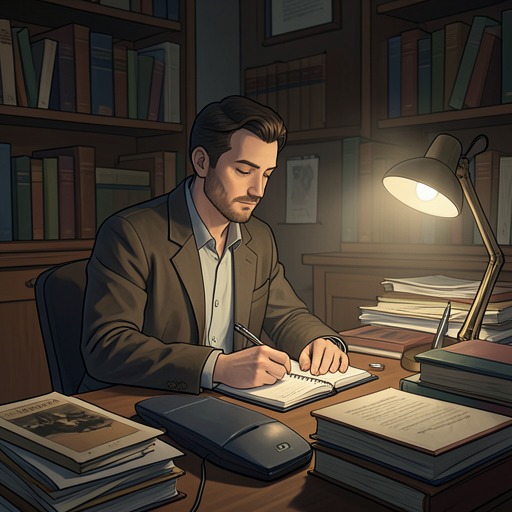
The lovers acknowledge that their meetings usually happen in Philip’s small writing room, where work papers, the typewriter, and the view through bare windows define their private world. The [Unnamed English woman](entity:character-recall-character-42ce2cbcec8f) describes the room in exact detail, and Philip turns their narrow, secret arrangement into both a refuge and a subject for attention.
during the affair
The Husband's Girlfriend
The [Unnamed English woman](entity:character-recall-character-42ce2cbcec8f) explains why she has not demanded that her husband give up his girlfriend: she thinks the other relationship matters to him, and that insisting otherwise might be selfish. Philip is struck by this unexpected generosity, even as it exposes the unequal freedoms and private bargains shaping both marriages.
during the affair
A Visit to a Friend Alone
After visiting a clever, beautiful, financially secure friend who has recently left her husband, the [Unnamed English woman](entity:character-recall-character-42ce2cbcec8f) sees how hard independence can look even when money is no obstacle. The visit deepens her fear that she cannot begin again, with children, work, and exhaustion already consuming her days.
during the affair
The Gifted Record
The [Unnamed English woman](entity:character-recall-character-42ce2cbcec8f) recounts marking up the grandiose sleeve notes on a record given to her husband by his girlfriend, then asking Philip whether her prank was cruel. Their conversation turns from the joke to her husband’s hospitalization, her own relief at sleeping better, and the clandestine objects she must hide at home.
during the affair
Exhaustion at Home
The [Unnamed English woman](entity:character-recall-character-42ce2cbcec8f) describes the demands of children, nannies, work, and a critical family circle, along with a worrying medical lump and a marriage whose sex life feels lonely and difficult. Philip advises her to make an effort to enjoy sex with her husband; she objects that desire cannot simply be summoned and recognizes the depth of their antagonism.
around Valentine's Day
Valentine's Day Jealousy
After a quarrel with her husband, the [Unnamed English woman](entity:character-recall-character-42ce2cbcec8f) confesses that she longs for privacy and sleep without him, yet would miss him and still cares for him. Philip recalls dreaming of her hand on him and wonders how he became so attached; she suggests that his isolation in the writing room has helped make their affair loom so large.
after Valentine's Day
The Prospect of Separation
The [Unnamed English woman](entity:character-recall-character-42ce2cbcec8f) asks whether therapy might help her discover what she wants and admits that her sexual interest has diminished to the point of pain. She fears that seeking treatment could later be used against her as a mother, and she remains unsure whether she can or should leave her husband.
later in the affair
The Solicitor's Questions
The [Unnamed English woman](entity:character-recall-character-42ce2cbcec8f) visits a solicitor to learn what divorce might involve, but the discussion of her husband’s adultery and the lawyers’ questions make the prospect feel bewildering and exposed. She reflects that tolerating adultery for months may mean it no longer counts as a fresh legal cause, and says she has stopped wanting sex with her husband.
during the affair
The Bruise and the Truth
When her husband asks about a bruise on her thigh, the [Unnamed English woman](entity:character-recall-character-42ce2cbcec8f) claims that she told him the truth about her encounter with an unemployed writer. She enjoys the absurdity of the explanation and the appearance of honesty, even as the lovers recognize that candor can serve as a screen for deception.
during the affair
The Affair's Cultural Frame
The [Unnamed English woman](entity:character-recall-character-42ce2cbcec8f) presses Philip to explain why he is involved with her and why his domestic dissatisfaction stays obscure. He suggests that cultural displacement may matter more than marital unhappiness, linking his attraction to English women with his outsider’s fascination with [England](entity:location-recall-location-england-b153c1f368ea) and its habits.
before the London affair, recounted during it
The Czech Woman's American Story
A Czech woman tells Philip that she left [Czechoslovakia](entity:location-recall-location-czechoslovakia-79ba61246389) for the [United States](entity:location-recall-location-united-states-2f533bc8d0b9) after the Warsaw Pact invasion of Czechoslovakia, hoping to make a life through modeling, fashion, and wealthy men. Her account grows darker as she describes exploitation, a marriage in Kuwait, political intimidation, and her eventual appeal for help with a book about prostitution.
about a decade before the London affair
The Prague Meeting Revisited
A Czech woman recalls meeting Philip in [Prague](entity:location-recall-location-prague-cf59465294ca) when she was a young literature student and helping him with books at his hotel. Their walk across the Charles Bridge and his attention to her left a strong impression, while the authorities’ questioning after he left made the encounter frightening and politically consequential.
after the Prague meeting and before her marriage
The Recruiters' Ultimatum
The Czech woman explains that her job at the American Library brought pressure from the [Czechoslovak secret intelligence agency](entity:organization-recall-organization-39405d1d5608) to cooperate, followed by a similar approach from Americans. She refuses both, loses her professional future in the library, and leaves the work rather than sign herself over to either side.
years after her departure from Czechoslovakia
The Czech Woman Leaves Her Husband
After marrying an Englishman partly to leave [Czechoslovakia](entity:location-recall-location-czechoslovakia-79ba61246389), the Czech woman describes struggling to adjust to life in [England](entity:location-recall-location-england-b153c1f368ea) and being dismissed from a bookshop job. When she accepts work as a tour guide, her husband tells her to leave; she spends a night on her suitcases before friends take her in.
before the London affair
A Love That Would Not Choose
The Czech woman describes a later affair with a married Englishman who initially seemed to understand her, but whose wife fought to keep him and whose family life he would not abandon. She wanted love rather than marriage or money, and the loss leaves her feeling socially and culturally misplaced.
during the affair
The Lovers' Sexual Bargains
The [Unnamed English woman](entity:character-recall-character-42ce2cbcec8f) and Philip discuss sexual preferences, masturbation, and the room where they meet, mixing candor with teasing. Their private talk makes listening itself part of the intimacy, while the absence of an ordinary shared home keeps their relationship suspended outside daily life.
during the affair
Thoughts of Jumping
The [Unnamed English woman](entity:character-recall-character-42ce2cbcec8f) admits that she often thinks about jumping out a window, then distinguishes the thought from a wish to die: she wants life to improve. Philip listens as she describes the pressure of her responsibilities, making clear how close her marital misery and exhaustion have brought her to despair.
during the affair, while she is pregnant
A New Baby and Fear
The [Unnamed English woman](entity:character-recall-character-42ce2cbcec8f) recounts her anxiety about what might happen if her baby were born severely disabled, including disturbing conversations with doctors about ending a newborn’s life. She has also learned that the law may treat women leniently for crimes committed soon after giving birth, a discovery that reveals the extremity of her fear and distress.
later in the affair
The Husband's Night Out
After her husband leaves a dinner party early with a young woman and goes dancing, the [Unnamed English woman](entity:character-recall-character-42ce2cbcec8f) is furious and jealous despite admitting she has little sexual feeling for him. Philip argues that she must either accept an arrangement that humiliates her or leave, and insists that her fear of separation is evidence of how much she wants an alternative.
after the husband's night out
The Family's Financial Fear
The [Unnamed English woman](entity:character-recall-character-42ce2cbcec8f) says that she remains paralyzed by the thought of being alone and penniless, a fear rooted in what she witnessed in her own family. Though she again considers consulting a lawyer, the prospect of fighting her husband and his mother over money and access to the child seems overwhelming.
during the affair
The Mother's Recovery
After visiting her mother, the [Unnamed English woman](entity:character-recall-character-42ce2cbcec8f) feels drained rather than relieved, despite her mother’s improving health. She remembers the family’s wish that her mother’s spirit be broken so the rest of them could remain sane, and describes feeling as if she were waiting for life to run out.
before the affair's ending
The Father's History Lesson
Philip tells the [Unnamed English woman](entity:character-recall-character-42ce2cbcec8f) how he argued with his father over a grandson’s marriage to a Puerto Rican. He laid out the dangers faced by Jews in Galicia and [Israel](entity:location-recall-location-israel-ecf64b6f6a44), then contrasted them with the ordinary risks of living in America, turning family conflict into a defense of Jewish survival and mixed American life.
during the affair
The Israel Argument
Philip and the [Unnamed English woman](entity:character-recall-character-42ce2cbcec8f) debate the hostility he encounters toward [Israel](entity:location-recall-location-israel-ecf64b6f6a44) in British literary circles. He sees selective outrage and romantic political posturing, then recounts defending American policy and the [Atomic bombings of Hiroshima and Nagasaki](entity:event-recall-event-40e6794b5bf0) at dinner parties, where being Jewish and American has made him more contentious.
during the affair
The Czech Writer's Betrayal Story
[Ivan](entity:character-recall-character-6c857b812801) tells Philip that his wife, [Olina](entity:character-recall-character-fa763ac860c0), has left him for Andrew, a Black man she met while Ivan was away. In jealous, racist fury, Ivan accuses Philip of having slept with Olina and attacks his interest in listening to women’s stories, claiming that Philip turns other people’s lives into material instead of living them.
immediately after Ivan's accusation
The Writer's Counterstory
Philip denies having had an affair with [Olina](entity:character-recall-character-fa763ac860c0) and argues that [Ivan](entity:character-recall-character-6c857b812801)’s jealousy has turned suspicion into a story. Ivan’s denunciation nevertheless lands as an artistic challenge: he says Philip ruins the latent force of lived experience by forcing it into fictional plots, and Philip asks him to explain what he believes is wrong with his writing.
during the affair
The Biographer's Improvisation
Philip invites the [Unnamed English woman](entity:character-recall-character-42ce2cbcec8f) to play a biographer investigating [Nathan Zuckerman](entity:character-recall-character-ed0c9c60c6e3), whose conflicting life stories make the task nearly impossible. She improvises an account of the biographer’s work on a reclusive writer and of [Nathan](entity:character-recall-character-nathan-45665ec11941)’s permission to break through reverent restraint, turning their role-play into an argument about the writer’s appetite for transgression.
during Philip's years in England
The Chelsea Street Insult
Philip recounts an encounter in Chelsea in which a man glared at him and complained that he did not dress properly while he walked with Aharon Appelfeld and Appelfeld’s son. Philip took the remark as antisemitic, but the English guests at dinner dismissed his interpretation as paranoia, deepening his sense that Britain’s prejudices are often denied by those around him.
during the affair
The Courtroom of Accusations
In a comic courtroom fantasy, Philip is interrogated over misogyny, sexual relationships with students, adultery, and the alleged harm of his books to women. The questioning collapses into erotic play, exposing how easily moral accusation, literary argument, and sexual performance blur in his imagination.
years before the reunion conversation
The Former Student's Collapse
A former student meets Philip again and describes memory loss, hospitalization, shock treatments, paranoia induced by medication, and a prolonged pattern of destructive relationships. She remembers their earlier affair as both frightening and exciting, while Philip recalls her sharp intellect and the literature seminar where she impressed him.
1975
The Prague Police Stop
Philip recounts being stopped by uniformed police in [Prague](entity:location-recall-location-prague-cf59465294ca) and ordered to go to a station, despite having valid papers. He refuses, attracts witnesses, then escapes by boarding a tram and changing direction; afterward he cannot obtain another visa, and the police interrogate a Czech friend about his visits.
during the later phase of the affair
A Polish Woman's Displacement
At a party, Philip meets a Polish woman who describes her political engagement, her rejection of Catholic authority, and the oppression her family experienced under communism. She recalls panic in a crowded station, where a railway worker unexpectedly grabs her and tells her to cheer up, and a glimpse of a former American lover sends her thoughts back to an unsettled past.
late in the affair
An Offer of Independence
As the [Unnamed English woman](entity:character-recall-character-42ce2cbcec8f)’s marriage remains unstable, Philip gives her a check and urges her to keep it for a rainy day. She refuses to treat his money as an easy escape, while explaining that continuing the affair makes her feel dishonest in a dispute where she is demanding honesty from her husband.
late in the affair, before her illness
The First Break
The [Unnamed English woman](entity:character-recall-character-42ce2cbcec8f) says she needs to end the affair, both because it has become a guilty secret and because she wants to face life on her own without leaning on Philip. He accepts that he will miss her, and they part with a quotation about desire born from impossibility, leaving their relationship unresolved rather than neatly concluded.
after the first break
The Cancer Scare
The [Unnamed English woman](entity:character-recall-character-42ce2cbcec8f) tells Philip that doctors are investigating cancer and that a CAT scan will determine whether the treatment is working. She tries to describe the exhausting uncertainty, while Philip promises to call from [London](entity:location-recall-location-london-420923d4a60a) and learns that her former lovers and even her father are offering support.
the following Monday
The Clear Scan
The CAT scan shows no visible trace of pathology, a result the [Unnamed English woman](entity:character-recall-character-42ce2cbcec8f) calls a miracle after the frightening prognosis. Philip is relieved but warns that surgery and the possibility of recurrence remain; she jokes that he can return to normal when she is completely well, then asks him to stay a little kind while she remains at risk.
during her continuing cancer treatment
The Chemo Call
Before chemotherapy and surgery, the [Unnamed English woman](entity:character-recall-character-42ce2cbcec8f) calls Philip after dreaming about him and seeks reassurance that she will live. He asks about her baldness, treatment, and fears that doctors might discover tumors, then repeats his promise that she will not die.
months after the first break
The Affair Resumes
The [Unnamed English woman](entity:character-recall-character-42ce2cbcec8f) considers visiting Philip again and acknowledges that her ideas about honesty and secrecy have changed. She no longer wants him drawn into the details of her domestic life or to lean on him as she once did, but their mutual longing overcomes her hesitation and Philip invites her back as his little liar.
during the renewed relationship
The Notebook Discovery
Philip’s wife discovers his notebook and confronts him, believing that its intimate conversations describe a real woman with whom he is having an affair. Philip explains that some passages draw on real encounters while others are invented, including material linked to [Rosalie Nichols](entity:character-recall-character-rosalie-nichols-8ef773b7d30e), and insists that the notebook records an imagination at work rather than a hidden affair.
immediately after the notebook discovery
A Fight Over Fiction
Philip’s wife argues that even an imaginary lover represents a real desire to escape their marriage and that publishing the notebook would humiliate her. Philip refuses to let shame or another person’s demands censor his writing, while she insists that the woman in the pages is also a human being and not merely words.
after the argument
The Notebook's Uncertain Status
Philip admits that he does not know whether the notebook will become a book or how it should sit beside his novel about [Nathan Zuckerman](entity:character-recall-character-ed0c9c60c6e3). He describes the work as an imaginative impersonation of himself, leaving open whether it falsifies experience, reveals it, or does both at once.
some time after the lovers' separation
The Published Affair
Philip turns the affair into a published novel, disguising the [Unnamed English woman](entity:character-recall-character-42ce2cbcec8f) without removing the recognizable intimacy of her voice. Years later, she tells him that people recognized her in the character and that she was angry to see their private life made into literature, even as she found the book tender and understood that Philip had loved her.
after Philip leaves England
The Return to New York
Philip explains that he returned to America for many reasons, including the end of the relationship and his growing sense of alienation in [England](entity:location-recall-location-england-b153c1f368ea). Walking through [New York City](entity:location-recall-location-new-york-city-65df0a129d4c), he finds himself smiling and saying that he is home, drawn back to the noisy, argumentative Jewish life he had missed.
during their reunion call
The Proposal of Kiss and Tell
The [Unnamed English woman](entity:character-recall-character-42ce2cbcec8f) jokes that she might write a book about Philip called [Kiss and Tell](entity:expression-recall-expression-kiss-and-tell-c555ff502430), despite her misgivings about turning real people and their words into fiction. Philip argues that no agreement ever required him to give up his profession, while she insists that the question of betrayal remains complicated even when a book is tender.
years after their last meeting
The Reunion Phone Call
Philip and the [Unnamed English woman](entity:character-recall-character-42ce2cbcec8f) speak again after years apart, following the publication of the novel based on their affair. She has two children, remains with her husband, and says their marriage is better; they remember their secret life with affection and acknowledge that the written version altered how each understands it.
near the ending
The Life That Happened
The [Unnamed English woman](entity:character-recall-character-42ce2cbcec8f) tells Philip that the novel’s passivity frightened her and asks why he both hid their affair and later wrote about it. Philip says he had imagined a life with her while they were apart, and she answers that his real life continued with his wife while the imagined one remained in the book.
at the ending
A Tender, Unfinished Goodbye
The [Unnamed English woman](entity:character-recall-character-42ce2cbcec8f) says she had been angry for months after reading the novel but could not stay angry because it seemed so tender and contained private jokes intended for her. Philip calls their affair a life that might have been; they leave their shared history suspended between what happened, what was imagined, and what the novel made possible.