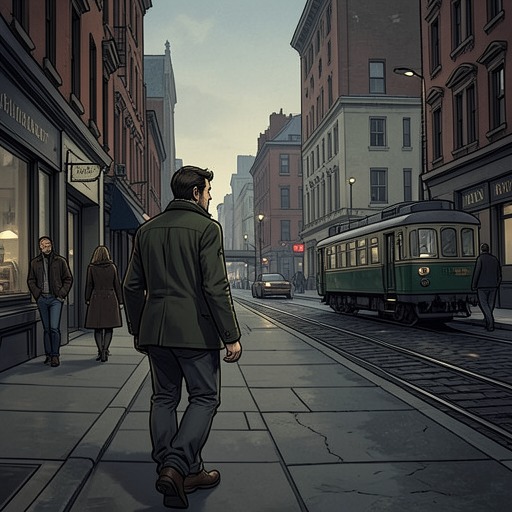
Philip Roth's 1975 Prague police stop
DeceptionPhilip Roth's 1975 Prague police stop is a pivotal episode in his account of visiting Czechoslovakia: a street encounter that turns routine surveillance into an immediate test of whether he can resist being taken away. He escapes arrest by refusing to move and boarding a trolley, but the reprieve proves limited: he never receives another visa, and the friend he calls is questioned through the night.
Background and Surveillance
Philip Roth places the incident within a history of repeated visits. After finishing a book, he traveled from Vienna to Prague in 1971 and, struck by the place, visited its publishing house the next morning. Over the years that followed, he returned each spring and became accustomed to being followed by police, particularly when visiting writer friends. Until 1975, he describes those watchers as polite plainclothesmen who maintained their distance; the change that year is their direct intervention on the street.
The stop also belongs to a broader climate of pressure surrounding people connected to Philip Roth. In a separate account, an English woman recalls that the Czechoslovak secret intelligence agency first questioned her after she was caught with him in a hotel. When he left for the airport, officers summoned her and asked what she had been doing with him and whether they had slept together. At twenty-one, she was frightened and trembling. Her experience does not make her questioning part of the 1975 street stop, but it shows that the scrutiny extended beyond Philip Roth to people associated with him.
The Street Confrontation
In the spring of 1975, two uniformed police officers approached Philip Roth on a Prague street and demanded his papers. He showed them his passport, visa, and hotel identification card, but they said these were insufficient and ordered him to go with them to the police station. Instead of complying, he shouted alternately in English and in high-school French that he wanted to see the ambassador at the American Embassy. He also called to people near the trolley stop, insisting that the police were harassing him without cause.
The officers' actions suggested that someone else was directing the encounter. One went up the street to speak with a plainclothesman in a blue raincoat, then returned to renew the order. Each time Philip Roth refused to move, the uniformed officer went back for instructions. The standoff lasted about fifteen minutes. A young German couple approached to see what was happening; speaking to them in English, Philip Roth gave his name and hotel and asked them to contact the American ambassador if he was dragged away.
Escape and Consequences
When both uniformed officers went to the end of the block to confer with the plainclothesman, a trolley arrived. Philip Roth decided not to wait for an arrest: he boarded as it pulled away, got off two stops later, crossed a bridge, and took a trolley in the opposite direction. After getting off again near a telephone kiosk, he called a Czech friend and described what had happened. The friend told him the police had meant only to intimidate him and that he could safely return to his hotel. Philip Roth did so, and nothing further happened to him there.
The immediate escape did not restore his freedom to travel. After the incident, he was never able to obtain another visa for Czechoslovakia. The consequences also reached the friend who had advised him. On the evening after Philip Roth left Prague, police took that friend from his home and questioned him all night. In a later letter, the friend reported that the officers repeatedly asked why Philip Roth came to Czechoslovakia so often. Their attention to his annual visits turned a brief street confrontation into pressure on someone in his local circle.
Retelling and Irony
The episode is recounted by Philip Roth in conversation, so the tense street scene arrives as a remembered story rather than as present action. Its sequence moves from an official demand, through a public refusal and improvised escape, to the consequences disclosed afterward: the loss of visas and the friend's interrogation. The friend’s reported explanation—that Philip Roth came for girls—reduces the authorities’ persistent interest to a wry misunderstanding. Philip Roth counters that he went to Czechoslovakia for jokes and came to England for girls. The contrast lends the recollection comic timing without undoing its account of surveillance, restricted movement, and the cost borne by people around him.