Math Rules
DecodedMathematical chess, later known as Liseiwicz chess, is a strategy game devised by Jan Liseiwicz and Rong Jinzhen. Its rules make control deliberately unstable: each player directs pieces that may begin in positions selected by the opponent, and the pieces’ possible movements change as they pass between two differently governed encampments. The game turns that shifting control into a mathematical problem, requiring a player to plan against an opponent while also managing the consequences of the opponent’s choices.
Invention and Board
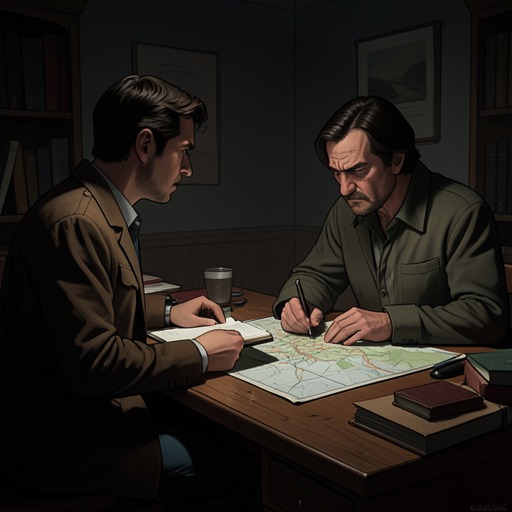
The game began as a private collaboration between Jan Liseiwicz and Rong Jinzhen. Their chess games brought them beyond the ordinary teacher–pupil relationship; during one winter, Rong Jinzhen spent much of his time away from home, and it emerged that the pair were not simply playing chess but developing a new board game. Rong Jinzhen called it mathematical chess.
The board was approximately the size of a desktop and represented two military encampments: one shaped like a hatch and the other like a Coptic cross. Players used mahjong tiles as pieces. Four routes crossed the board, with each player controlling two routes extending from the encampments. The layout makes the game’s military metaphor more than decoration: position, access, and the terms under which pieces can advance are built into its structure.
Setup and Movement Rules
The two camps do not begin on equal terms. Pieces in the hatch encampment have a prescribed arrangement, compared in the account to the fixed starting positions of elephant chess. Pieces in the Coptic-cross encampment, by contrast, may begin in any arrangement, but the opponent chooses their positions. The opponent therefore sets those pieces according to a plan of their own, placing them where they seem most advantageous to that opponent. Once play starts, however, control passes to the player whose pieces they are. That player must try to move them as quickly as possible from positions favorable to the opposition into positions useful to their own plans.
Pieces can move between the hatch and Coptic-cross encampments, but entry into the opposing camp is governed by strict conditions that require advance planning. The timing matters: the rules allow each player, at the appropriate point, to move a piece into the enemy camp simultaneously with the opponent’s move. Successful advancement therefore depends not only on an individual route through the board but on arranging pieces and preparing the moment when both crossings can occur.
Movement also depends on which encampment a piece occupies. In the hatch, pieces cannot move diagonally or jump over other pieces. Both kinds of movement are permitted in the Coptic-cross encampment. Crossing between camps thus changes what a piece can do, making a move a change in both position and available options. Players must plan along the two routes they control, arrange their pieces for intended moves, improve the positions of pieces initially set to the opponent’s advantage, and prepare for entry into the opposing camp.
Strategy and Mathematical Complexity
The rules create a contest with an unusual inward dimension. A player is trying to defeat an opponent, but must also work with pieces whose starting positions were chosen to frustrate that player’s plans. In the narrator’s account, each participant is effectively playing against two opponents at once: the other player and themselves. The game can be understood as three games in one, since each player faces both the shared contest and a separate struggle to put their own pieces into usable positions.
Jan Liseiwicz described the game as the result of extensive research in pure mathematics. Its intricate rules and the way a player’s subjective choices alter the organization of the game were, in his view, a challenge to the limits of intelligence. Its complexity also restricted who could play: Liseiwicz maintained that it was designed for mathematicians. The account compares its structure to a battle in which each commander must fight while commanding the opposing army. That reversal helps explain why the rules demand more than straightforward calculation: a player must anticipate not only an opponent’s decisions but the future consequences of controlling pieces initially arranged for the opponent’s purposes.
Attribution and Later Standing
The game’s name and reputation changed after its creation. Originally called mathematical chess, it later took Jan Liseiwicz’s name as Liseiwicz chess. It became influential among mathematicians in Europe and America, and published assessments compared its importance with John von Neumann’s theory of chess as a two-person zero-sum game. The comparison distinguished their proposed fields of significance: von Neumann’s concept was associated especially with economic theory, while Liseiwicz chess was associated with military strategy. The account notes that practical applications for either game had not been demonstrated, even as their theoretical importance was considered substantial.
The later name also concealed part of the game’s history. Liseiwicz was celebrated as the youngest recipient of the Fields Medal, and Liseiwicz chess was described as the major original achievement of his later career after he went to China. But Rong Jinzhen had helped develop the game and, by the narrator’s account, deserved a share of its credit. Once Liseiwicz named it after himself, Rong Jinzhen’s role disappeared from the public story. Their close friendship complicates that erasure: Liseiwicz had recognized Rong Jinzhen’s rare mathematical ability and had tried to support his future, even as the game that they made together became associated with one name alone.