Devdas and Chandramukhi's Relationship
DevdasDevdas and Chandramukhi’s relationship moves from an encounter defined by contempt to an intimacy formed through care, recognition, and an avowal of love. Its decisive turn is not a conventional courtship but Devdas’s gradual perception of the woman he first rejected: Chandramukhi becomes his attendant during illness and, eventually, someone he says he loves, even as he continues to measure their bond against Parvati and the unequal regard each woman receives.
First Encounter and Rejection
At Chunilal’s insistence, Devdas goes out with his friend one night, dressed more finely than he wishes. At nine o’clock their hired buggy stops at a two-storied house in Chitpore, where Chunilal takes Devdas by the hand and brings him inside. The owner, Chandramukhi, comes out to greet them. The circumstances establish the contrast at the heart of their first meeting: Chunilal treats the visit as an ordinary social outing, while Devdas arrives already recoiling from the setting and from women more generally.
Seeing Chandramukhi, Devdas feels disgust and directs his anger at Chunilal for bringing him to what he considers a hideous place. Inside, he sits on a mattress with a sickened expression, while Chandramukhi silently takes a seat in another corner. A maid prepares a silver-rimmed hookah, which Devdas refuses to touch. When the maid leaves after handing it to Chandramukhi, she takes a few puffs. Devdas then insults both her manner and her appearance. The abruptness matters: Chandramukhi is used to managing encounters, but his sincere hostility catches her unprepared and wounds her. She forgets to exhale, passes the hookah to Chunilal, and sits staring at Devdas in silence. The room’s ordinary object becomes the only sound in the pause: the hookah continues to bubble intermittently as the three say nothing. His rejection is therefore not simply a refusal to participate in the visit; it is the emotional fact that will remain vivid to Chandramukhi long after the first encounter.
Rejection Becomes a Point of Attachment
When Chandramukhi later recalls that first visit, she tells Devdas that she had been attracted to him then, despite his fervent hatred of her. She remembers his rejection as unusually bold, unlike the men who had come and gone before him. She also distinguishes her interest from his wealth: she knew he was the son of a wealthy man, but says that this was not what drew her to him. Her explanation reverses the meaning of the original scene. What Devdas intended as repulsion becomes, for Chandramukhi, a singular encounter whose force lies in his refusal to behave like the others.
Much later, when Devdas is in her room and drinking, Chandramukhi speaks from concern and asks him not to drink any more. He puts his glass down, frowns, and asks why. The exchange is brief, but it shows how her place in his life has changed: she is no longer only the person he condemned on arrival, but someone who addresses the danger of his drinking directly. That concern does not erase the earlier humiliation. Instead, the relationship develops with the memory of rejection still active, giving Chandramukhi’s later tenderness a history that Devdas has not yet fully understood.
Recognition Through Care
Before she is to leave, Chandramukhi hesitantly tells Devdas that she had hoped to see him once more and had wished he would return. She asks where she should go, revealing that her next arrangements remain unsettled. Devdas is surprised that she wanted simply to see him. Chandramukhi explains that perhaps it was a whim, but connects it to the lasting impression of his first rejection. Her guarded disclosure makes the relationship’s imbalance plain: she has carried the encounter as an emotional landmark, while he has not understood what it meant to her.
In a later scene, Chandramukhi comes close, takes Devdas’s hand, and draws his hands onto her lap, looking at them with affection. She tells him this is the last day and asks him not to be angry; she has long wanted to ask whether Parvati hurt him badly. Devdas cannot bring himself to tell her not to touch him. The hesitation marks a change from the physical and emotional recoil of their first meeting: he does not reject her touch, even though the question turns their intimacy toward the pain he associates with Parvati.
When Chandramukhi later asks whether he hates her quite as much, Devdas says that he does not, and then tells her that he loves her. He also recognizes her care as familiar, even when he has failed to recognize her. In this exchange, affection is no longer only hers to express or his to resist; Devdas names it himself. Yet his recognition arrives after a long interval in which Chandramukhi has continued to carry the memory of his contempt.
Bou, Parvati, and the Unequal Terms of Love
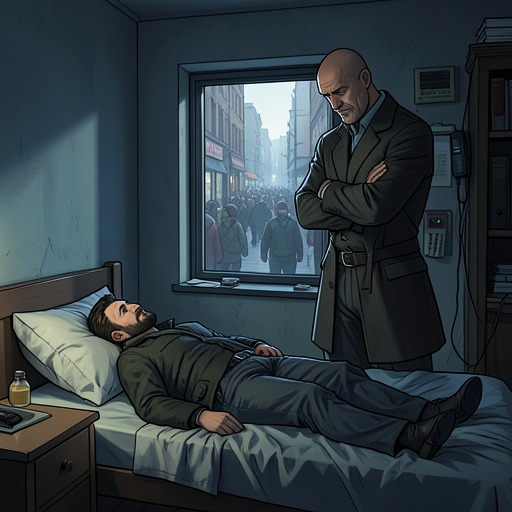
During Devdas’s illness, Chandramukhi wipes away her tears and tends to him in earnest, praying that he will recover. He remains bedridden for nearly a month; afterward he slowly improves, and the malady is contained, though he is not fully recovered. In this period of dependence, Devdas gives Chandramukhi a shorter name because her full name is long for him to say: he tells her he will call her Bou. The renaming is an intimate, practical gesture, made within the routine of his convalescence, and it gives their bond a form of address distinct from the hostility with which he first spoke to her.
Devdas’s clearest account of what separates and connects the two women is also its sharpest acknowledgment of social inequality. He describes Parvati as proud and haughty, Chandramukhi as gentle and restrained; he says Parvati has little patience while Chandramukhi is forbearing. He contrasts Parvati’s good name and respect with Chandramukhi’s life in shame, and says that everyone loves Parvati whereas nobody loves Chandramukhi. Then he affirms that he loves Chandramukhi. His declaration does not make the women interchangeable or settle the past: he explicitly insists that they are unlike each other even as he finds a resemblance between them. The comparison recognizes the different regard each receives, but also leaves Chandramukhi’s love framed against Parvati’s place in Devdas’s emotional life.
Chandramukhi weeps silently and prays that, if she is granted pardon in a future life, she may receive this love as her reward. Devdas says that if they meet after death, he will never be able to part from her. Their words give the relationship its most intimate promise, but the promise is deferred beyond death rather than made into a shared future in the present. Soon afterward, Devdas is healed but still not fully recovered and leaves westward with Dharmadas. The parting follows a period of care and mutual declaration; it does not undo either the affection they have reached or the separation on which their bond remains founded.