Dingo's Death and Burial
DingoDingo’s death and burial bring the animal’s illness to its end and turn private grief into a quiet act of shared mourning. After a veterinarian predicts that the jaundice will almost certainly prove fatal within eleven days, the narrator’s care keeps Dingo alive until the seventeenth. Dingo dies against the narrator’s knees while his wife sleeps; the next morning, Victor Flamant helps carry and bury him, declining payment because he remembers Dingo’s attention and companionship.
Illness and the Failed Prognosis
Dingo’s illness is visible in the changing colors of his body: yellow and brown marks spread across his eyes, the membranes of his mouth, and his eyelids, and he vomits blood. The veterinarian identifies the disease as jaundice and gives a bleak prognosis, saying that only one dog in a thousand survives and that he has never saved one; in his experience, they die after eleven days. Against this forecast, the narrator’s persistent care keeps Dingo alive through the seventeenth day. The extra days do not become a recovery, but they give the household time in which hope can persist beyond the veterinarian’s count.
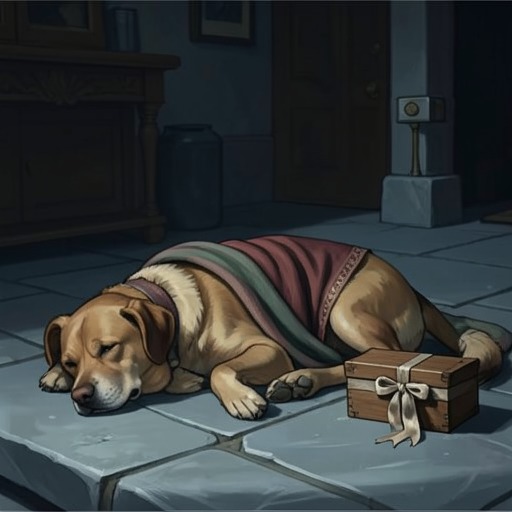
The contrast between the vigorous dog the narrator remembers and the animal now lying on the floor makes the decline difficult to reduce to a diagnosis. Dingo’s body becomes painfully thin: his bones protrude beneath contracting muscles, his once-full tawny tail looks withered, and his head seems too large for his shrunken frame. At night, under the dim lamp, he appears to the narrator like a discarded toy. The image registers not only the severity of the disease but the distance between Dingo’s former physical power and his helplessness now.
Dingo accepts the household’s care without resistance. He gives up his paws, head, and body to be washed or medicated, looking away with docile, slightly anxious eyes while treatment is administered. Afterwards, he looks back at the narrator with a gentle, sad expression, weakly wags his tail, and makes his interrupted, wavering way to lie down again. His trust remains legible in these small responses even as the body that once moved with force can scarcely carry him.
The Final Night
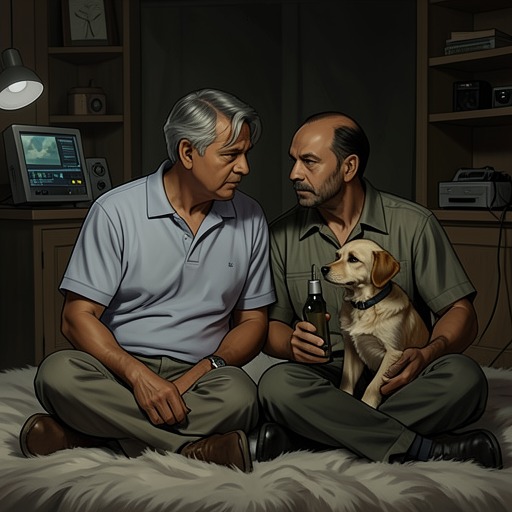
On the night Dingo dies, the narrator keeps watch beside his wife, who is asleep in bed, while Dingo lies on a mattress at his feet. The dog’s breathing is short and labored, and fever makes him tremble. Because he has already lived beyond the predicted eleventh day, the narrator still has hope. When Dingo gives small cries, the narrator gently washes his throat, mouth, and lips, which are coated with long yellow strings of saliva; the washing seems briefly to ease him.
Then, with a sudden effort that the narrator experiences as an extraordinary act of tenderness, Dingo stands and raises his limp forepaws toward the narrator’s chest. He collapses immediately afterwards, his head falling onto the narrator’s knees. The movement makes his death a final contact between them: the dying dog reaches the person caring for him, and the embrace lasts only for the instant before his body gives way.
Dingo’s wife does not wake. Through the night, in the pale light of the lamp, the narrator repeatedly sees in memory the blackened fir box in which he first found Dingo, then so tiny and comical. The return to that first image places the end of the dog’s life beside its beginning, while the narrator’s prolonged, silent crying makes clear that the memory offers no release from the loss. He carries Dingo’s body to another room so his sick wife will not see it; when he returns, she is still asleep in the attentive, precarious sleep of the ill.
Burial with Victor Flamant
At dawn the next morning, the narrator tells Victor Flamant that Dingo is dead. Flamant has just come back from the forest, where he has been resetting his snares, which remain empty; his shoes and trousers are soaked with dew. On hearing the news, he lets the snares fall and reacts with an unmistakable gesture of pity. When the narrator asks him to help with the burial, Flamant answers not with words but by taking a pick and shovel and following him.
The narrator has chosen a place at the far end of the garden, beneath an oak. Flamant agrees that it is a good place. Once the grave is dug, the two men fetch Dingo. Flamant handles the body delicately, laying it on a wheelbarrow with gentle, reverent movements. He leads the barrow slowly to the grave, buries Dingo as he would someone very dear, and covers the earth with pieces of turf lifted from the lawn. The care given to the body forms a deliberate counterpoint to the dog’s physical wasting: in death, Dingo is handled with a tenderness equal to the trust he showed while alive.
The narrator thanks Flamant, calls him a good man, and slips him several gold coins. Flamant returns them, shaking his head. He admits that he did not know Dingo very well, but remembers that the dog was beautiful, stayed near him when he worked at the house, lay in the path facing him, watched him, and sometimes licked his hand. His refusal makes the burial more than paid labor: an animal’s quiet gestures have established a bond that Flamant will not price. His voice trembles with emotion, and he says more than he ever has before. He then shoulders the tools, walks away silently, and disappears behind the house.
Grief and the Meaning of the Ending
The narrator’s mourning is accompanied by an argument with the necessity of death. He reflects that human beings resist the evidence of a human corpse through inherited and taught faith in the soul’s immortality, whereas people more readily accept that a dead dog is simply gone. That distinction does not make Dingo’s death easier; instead, it exposes how little consolation the narrator can find in inherited formulas. His grief remains attached to the particular animal he has lost, not to an assurance that death can be explained away.
He also tries to imagine that Dingo’s death may have spared him a harsher fate. Dingo had an appetite for killing and had preyed on poultry; the narrator pictures farmers chasing, catching, and torturing him. Yet this attempt at consolation meets the memory of Dingo’s affection. Addressing Sir Edward Herpett, the narrator insists on the incompatibility of turning a bush dog into an apartment dog, while holding together the dog’s violence and his love: Dingo killed animals, but loved the narrator, and the narrator loved him. The thought does not settle the question of whether death was better. It preserves the contradiction that makes the loss personal: Dingo was neither harmless nor merely a beloved pet, and the tenderness between them was real despite the danger he posed to other animals.
The burial beneath the oak, and Flamant’s refusal of money, give that bond a social witness beyond the narrator’s household. Dingo’s final reach, the narrator’s vigil, and the former poacher’s careful work at the grave turn the ending away from a simple verdict on the dog’s predatory nature. His life ends in illness, but the final scenes insist on the relationships formed through care, attention, and remembered contact.