American Civil War era
DopesickThe American Civil War era is presented as an early chapter in the history of Iatrogenic opioid addiction and as a warning obscured by time. In the aftermath of the war, medical treatment brought morphine into veterans’ homes; the resulting dependence unfolded alongside bereavement and economic uncertainty. The book returns to this period to show how a medical practice can expand exposure to opioids, while later generations forget the dangers and mistake a new wave for an unprecedented one.
Morphine and the wartime aftermath
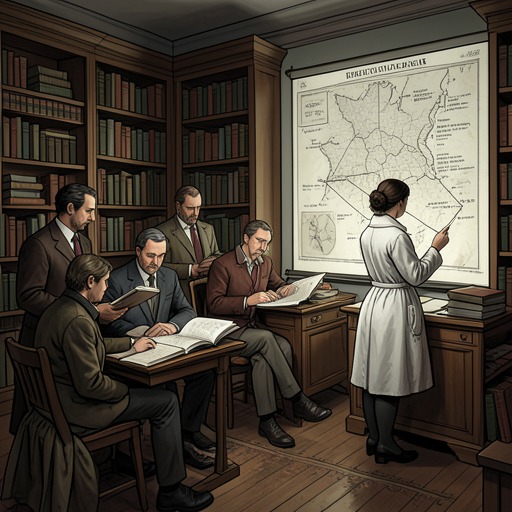
Doctors treating injured veterans commonly left morphine and hypodermic needles behind, with instructions for their use as needed. The account estimates that about one hundred thousand veterans became addicted. Many carried leather bags containing needles and morphine tablets, a visible sign of a dependency that had moved beyond the temporary treatment of wartime injuries.
The effects were especially severe among white Southerners in small cities and towns. Families were contending with deaths from the war and the economic uncertainty that followed the end of slavery. An opium dealer in New York described impoverished men who had once been wealthy turning to opium to drown their sorrows. The drug wave is therefore situated not only in clinical practice but also in the social losses and dislocations surrounding the war.
Containment and historical forgetting
The book sets this earlier wave against the mid-twentieth-century image of narcotics addiction. The Harrison Act helped contain addiction associated with prescribed painkillers, and the small-town woman dependent on morphine receded from view. In her place, public understanding increasingly centered on the urban, male heroin user. Doctors advocated restricted narcotics prescribing, while pharmacists made refills difficult to obtain without checking with a doctor.
That change in visibility did not mean that opioid risks had disappeared. Rather, the book’s historical sequence shows how the dominant picture of addiction can change, leaving earlier patterns easy to forget. This historical amnesia becomes significant when the later expansion of prescribed opioids is treated as a new and manageable problem, despite an earlier example of medical access contributing to widespread dependence.
A modern recurrence through medical care
The modern comparison is not a claim that the two periods were identical. In the 1990s, OxyContin entered a health-care system increasingly organized around the assessment and treatment of pain. Pain was being elevated as the fifth vital sign, and the Joint Commission on Accreditation of Healthcare Organizations approved mandatory pain-assessment and treatment standards in 1999. Patient-satisfaction measures also gave hospitals and clinicians incentives to treat pain liberally.
Purdue Pharma promoted OxyContin for chronic and noncancer pain as well as for cancer, and its representatives carried that message to doctors and dentists nationwide. The company presented addiction as exceptionally rare and saw the new standards as an opportunity to position itself as a leader in pain management. The earlier practice of leaving morphine and needles with veterans and the later commercial promotion of OxyContin arose in different settings; the historical connection is the expansion of opioid access under assurances that muted concern about dependence.
Rural lives and the limits of a single explanation
The book brings this long history into contact with small-town present-day experience. In Strasburg, Virginia, Jesse Bolstridge’s grave stands within sight of the football stadium where he once played. The town’s identity is shaped both by football and by the Civil War battlefields in the surrounding foothills. Jesse’s mother, Kristi Fernandez, seeks an account of how her son went from a high-school football player and construction worker to a person who died of a heroin overdose. His story gives the modern epidemic a family’s unanswered questions, rather than leaving it at the level of historical patterns or statistics.
The investigation also emphasizes that no single individual timeline necessarily yields a complete explanation. In Jesse’s case, investigators believed a local user-dealer connected to the Jones and Shaw network may have supplied the heroin, but the interval between the purchase and his death, and the number of people with him in between, made the case difficult to prove. The evidence gap is part of the book’s account: an epidemic can have a traceable history and still leave families without a fully resolved explanation of one death.
The period’s place in the narrative
The American Civil War era serves as a historical measure against which the book tests the idea that each opioid crisis is wholly new. Its account links medical availability to the social conditions in which people live, then follows how public attention shifts and the past recedes. The modern rural crisis is likewise described through the collapse of work, rising disability, and the flood of painkillers; in Virginia, blocked Medicaid expansion left many low-income residents without coverage that could pay for treatment and addiction medications.
Against that record, the book treats recovery as more than removal from a drug supply. Historian Nancy D. Campbell argues that people need rewarding activities and relationships around which to build their lives, and that communities must be rebuilt if drug waves are to subside. The Civil War era thus matters not simply as background: it establishes an early pattern of opioid exposure amid profound social disruption, while the present-day stories show the continuing human cost of forgetting that history.