Eileen and her mother's relationship
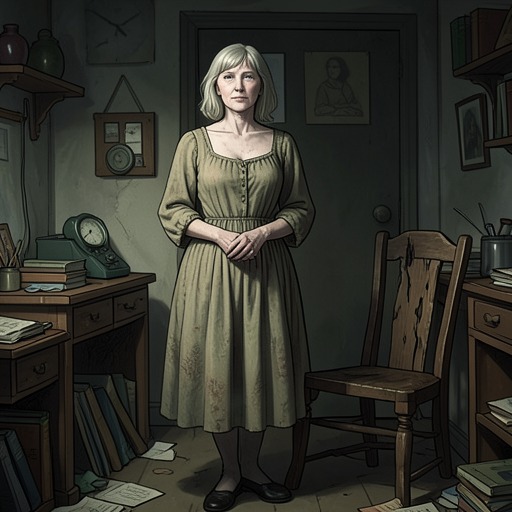
EileenEileen and her mother's relationship is presented through sparse memories rather than a sustained account of shared life. Its significance lies in the way small details—a too-tight childhood wardrobe, a ring, praise for thinness, and the scene of her mother's death—remain available to Eileen when a fuller family history does not. Her recollections register both attachment and uncertainty, without resolving the relationship into a simple portrait of either affection or harm.
Childhood and the Body
Eileen remembers being a pudgy child who struggled in physical education and felt awkward in her clothes. Eileen's mother bought garments a size too tight, hoping that Eileen would somehow change to fit them. The recollection places the mother's practical choice beside the child's experience of her own body: Eileen remembers clothes that did not accommodate her as she was, and later describes herself as having felt homely and out of place. The account does not explain what Eileen's mother intended beyond hoping the clothes would fit; its importance lies in the bodily memory Eileen retains.
As Eileen grew older, she became short and slight, and eventually describes herself as extremely thin. She recalls that Eileen's mother praised her for being so thin when Eileen was nineteen. That praise sits uneasily beside the earlier memory of clothes bought too small: the two details show how the mother’s responses to her daughter’s appearance changed, or at least how Eileen remembers them at different stages. Eileen also judges her own thinness as troubling, even while recalling that she liked her diminished stature. The relationship is therefore filtered through a conflict between the approval she remembers receiving and her later recognition that her body had become alarmingly slight.
Eileen’s appearance remains a subject of intense self-scrutiny in her account. She describes hiding behind heavy, covering clothes and believing herself ugly and unfit for the world. A small ruby ring that had belonged to Eileen's mother is one of the few personal objects associated with her: Eileen wore it for a time. The ring offers a tangible link between them, although the narrative does not say when it was given to Eileen or what either woman made of it. In a story crowded with Eileen’s judgments of her body, the inherited object marks a quieter form of connection.
Her Mother's Death
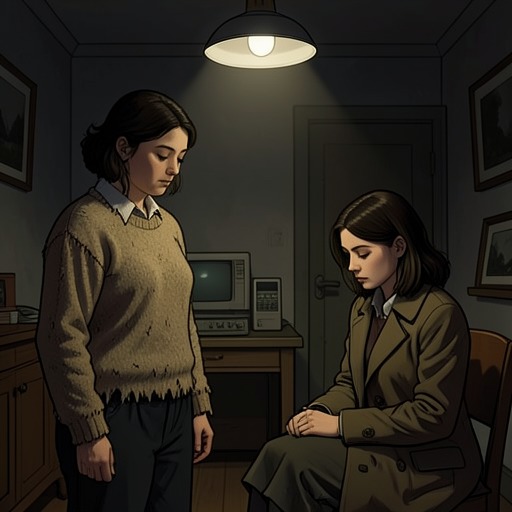
Eileen's mother died when Eileen was nineteen. In the memory Eileen recounts, she is beside her mother's body and has to gather herself before going to tell Eileen's father. He has already been drinking for weeks; when Eileen tells him, he asks whether she is sure. The brief exchange leaves the daughter carrying the news into a household where her father's response does not provide an evident shared moment of mourning.
Eileen remembers the half-open door to the room where her mother lay, then going to the bathroom to cry. She describes seeing her own swollen, red-eyed reflection and breaking down in the shower. These details place grief not in a conversation between mother and daughter, but in Eileen's solitary aftermath: she is left to absorb the death and then communicate it to her father. The account does not elaborate on the illness or circumstances that led to her mother's death, and it gives no final conversation between them. That silence limits what can be said about their last days together, while making the remembered sequence—finding her mother, telling her father, and crying alone—central to Eileen's account of the loss.
Memory and What Remains
Eileen says that Eileen's mother is harder for her to picture than the other members of her family. What she can summon is a partial image: her mother's graying hair, and the memory of lying beside her after death. The contrast between a sharply remembered scene and an indistinct person is important. Eileen can name the loss and recall its setting, but she cannot turn those fragments into a comprehensive portrait of her mother or their life together.
The absence of photographs intensifies that dependence on memory. Eileen left X-ville without a single family photograph and says that shifting recollections are all she has to go on. Before leaving, she felt an urge to look at childhood photographs and to kiss and caress the young faces in them. That impulse suggests a wish to make contact with the family she was leaving, but the pictures do not become possessions that accompany her. Her mother's image consequently remains part of an unstable private archive, reconstructed from recollection rather than fixed by photographs.
The Relationship in Retrospect
Eileen's account does not assign Eileen's mother a single, settled role in her daughter's life. The mother appears in concrete acts and remembered judgments: she bought clothes for Eileen as a child, praised her thinness near the end of her life, and left behind a ruby ring that Eileen wore. Alongside those details is the decisive absence of a fuller record. Eileen acknowledges that her mother's image is difficult to recover, even as she describes the death scene with particular clarity.
That imbalance gives the relationship its retrospective shape. The surviving memories join ordinary material traces to grief, but they do not establish the mother's motives or supply a complete account of their emotional bond. Eileen's narration preserves what can be recalled while making its limits visible. Her mother remains both intimate—the person whose ring Eileen wore and whose death she witnessed—and difficult to picture, a presence encountered through fragments after Eileen has left X-ville.