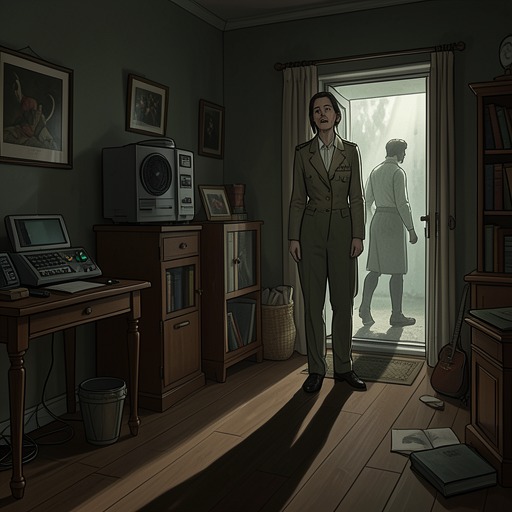
Eileen’s unrequited love for Randy
EileenEileen’s unrequited love for Randy is a private, largely imagined relationship that gives emotional shape to her lonely working life at Moorehead. She watches the guard from her desk, studies his habits, and builds hopes around a man who does not appear to know her well. The attachment sustains her for a time, but its intensity belongs chiefly to Eileen’s fantasies; its abrupt disappearance when Rebecca enters her attention reveals how quickly her longing can relocate.
Identity and Setting
Eileen’s attraction takes form in the ordinary routines of her job at Moorehead, where she works in the office and sees Randy during his shifts as a guard. He sits in the hallway linking the office to the rest of the facility, and his uniform, manner, and appearance become familiar objects of her attention. Eileen describes him as handsome and youthful, with a prominent profile and carefully styled hair. She remembers his casual posture as well as the way he turned the pages of a comic book. These observations are small and repeated: their accumulation gives her the feeling that she knows him, although they do not establish a mutual relationship.
Eileen recognizes the imbalance from the beginning. She believes Randy prefers a different kind of woman—pretty, long-legged, and possibly blond—and knows she is not his type. That awareness does not end the attraction. Instead, she treats it as an obstacle that fantasy might overcome. She imagines that Randy could eventually see her differently, while acknowledging that this hope is not based on signs of interest from him.
Watching and Interpreting Randy
Randy’s presence offers Eileen a focus within a workplace she experiences as isolating and grim. She watches him from her desk and finds reasons to approach him: once, she nervously asks whether he feels cold in his short sleeves during winter. His brief response gives her no evidence of deeper feeling, but she interprets his reserve as a possible sign of depth. His silence and ordinary habits become material for an imagined character rather than grounds for knowing him.
The attachment also shapes how Eileen experiences visitation hours. She looks forward to being near Randy while doing her duties, including directing visitors and carrying out security procedures. During pat-downs of mothers visiting the boys, she sometimes imagines that the person she is touching is Randy. In reality, he is present as a guard, and she feels that he barely notices her. The gap between physical proximity and emotional recognition is central to the fixation: being in the same hallway feels meaningful to Eileen even when Randy gives no indication that he shares her attention.
Eileen’s interest extends beyond their workplace encounters. She remembers Randy’s address and, on weekends, drives past his apartment in a neighboring town to see whether he is home. In winter she parks across the street and watches the house from the Dodge car, sometimes noting another motorcycle in the driveway and wondering who has come to visit him. She admits that Randy might not recognize her if he saw her there and doubts that he even knows her name. The surveillance does not bring them closer; it gives Eileen a way to maintain the imagined connection without risking a direct conversation.
Romantic Fantasies and Emotional Dependence
Because Randy does not provide a shared story, Eileen supplies one. She pictures him asking to escort her to her car after work and imagines a moment in which an accident on the ice would bring them physically close. More broadly, she imagines becoming the person Randy needs: someone who might save his life, comfort him in grief, or be discovered as the right partner after a period of separation. These scenarios turn chance and rescue into possible routes to being loved. Eileen herself describes her hopes as fantasies, not as plans Randy has encouraged.
The attachment can make ordinary disappointment feel catastrophic. When Randy is absent from his apartment, Eileen’s thoughts move toward the possibility that another woman might be in his life. She considers how she might respond, but also describes herself as shy and lazy, and cannot say what she would have done in a more painful encounter. On the drive to the cinema, she imagines that losing Randy to another woman would leave her with nothing to live for. Yet she also rejects suicide as an action she intends to take and recognizes running away as another possibility. Her longing therefore exists alongside despair, without becoming a reciprocal courtship or a concrete attempt to make Randy choose her.
Eileen further imagines that Randy would regret her departure. In this imagined future, he learns too late that he loved her and mourns the separation. She finds comfort in picturing him as a man who might eventually recognize her worth, even though their actual encounters offer no such promise. She also imagines that he rarely cries and finds the thought of him grieving beautiful. Such scenes show how little the real Randy needs to do: Eileen’s imagined version of him can supply the attention, emotion, and recognition she does not receive from the man himself.
Displacement and Ending
The attachment has an identifiable limit. After Rebecca appears and Eileen’s affection turns toward her, Randy loses his emotional importance almost at once. During a later day of visitation, Eileen sees him leaning in the doorway and realizes that she is no longer in love with him. He seems ordinary and insignificant to her, rather than the compelling figure around whom she had arranged her hopes. She describes love as capable of disappearing in an instant, and presents the change as something she has experienced more than once.
This ending does not resolve the relationship through a confession, rejection, or reconciliation: Randy never appears to understand the extent of Eileen’s feelings. The change occurs within Eileen, as attention once concentrated on Randy transfers to Rebecca. In retrospect, the episode reveals both the sustaining and unstable nature of her fantasies. They help her endure isolation by promising rescue and recognition, but the promise is self-generated and can collapse as quickly as a new object of affection comes into view.