Ghosts
EileenGhosts are recurring figures of fear in Eileen’s account, but the novel does not establish them as supernatural creatures. They appear most insistently in Eileen’s father’s paranoid visions, where they become spies and tormentors hidden around the house. For Eileen, the same imagery gathers around the basement and memories of childhood abandonment. The contrast matters: what her father treats as an external conspiracy, Eileen understands as delusion, while the loneliness and family history attached to the images remain real.
Identity and Manifestation
The figures are described by Eileen’s father as quick-moving shadows that he can barely see. He says they duck under porches, hide in bushes and trees, and watch or taunt him. Inside the house, he imagines them entering through the basement and moving through the walls like rats. He gives them names including hoodlums and black ghosts, turning indistinct shapes and noises into a hostile population with intentions of its own.
These descriptions keep the supposed creatures just beyond clear view. The father claims to perceive signs of them, but no independent appearance or action confirms that they exist. Their form is therefore less that of a revealed monster than of a threat assembled from shadows, sounds, and suspicion. The uncertainty belongs to his experience of the house; the narrative’s account places that experience within his delusions rather than confirming a supernatural presence.
Eileen’s Father and the Conspiracy
The ghosts are central to Eileen’s father’s account of his persecution. He believes the mob has sent them and interprets the presence of police as protection connected to his supposed past service to the town. When Eileen gives him a warning letter from Officer Laffey, he dismisses it as merely for show. Even snowballs thrown from his window become part of his explanation: he says they were meant to show the hidden figures that he knew what they were doing.
The conspiracy extends throughout his ordinary life. He says the figures torment him day and night, including in dreams, and presents drinking as a way to calm the resulting nerves. When Eileen tells him he is drunk, he denies having been drunk for years and insists the beer is medicinal. The exchange links his imagined attackers to a pattern of evasion: he treats the haunting as fact while rejecting the visible evidence of his drinking.
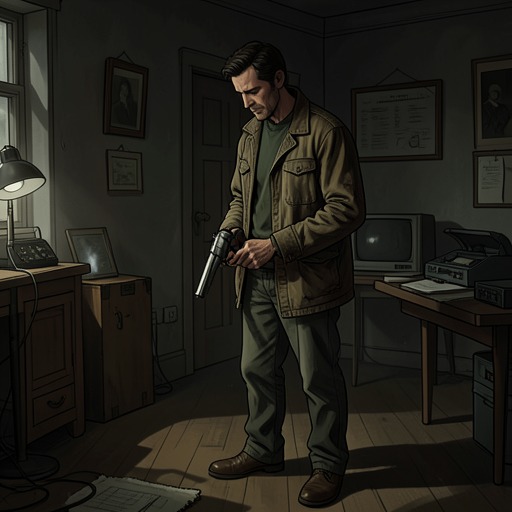
His suspicion also carries into his conduct outside the house. After retirement, his driving and nighttime behavior lead to police intervention; he wanders in a blackout, conducts invented searches of neighbors’ homes, and points his gun at shadows. Eileen’s father calls the figures the devil’s spawn, making them enemies in a private moral war. His language casts him as a besieged defender, although Eileen observes that his supposed battle against the mob has no basis in what he actually did as a police officer in X-ville.
The Basement and Eileen’s Memories
The basement gives the ghost imagery a second, more personal setting. Eileen associates it with the time her mother spent there and with secrets she still cannot explain. She speculates that if her father’s hoodlums and dark ghosts came from anywhere, it was from that part of the house. Yet she also says she could feel fine there while using the toilet. Memories, ghosts, and dread, in her account, do not remain fixed to a place or arrive on command.
A childhood memory makes the basement’s emotional force clearer. After falling down the stairs while fleeing her mother, Eileen recalls looking up at the kitchen light as her mother appeared at the doorway and then shut it. In the dark cellar, no angry spirits attacked her; she remembers that they left her alone, which was itself painful. The memory does not prove a haunting. Instead, it sets supernatural fear beside a concrete experience of being hurt and left without comfort.
Later, after drinking and taking laxatives, Eileen lies on the cellar floor and wishes that one of her father’s dark figures would appear and pull her into its underworld. No one comes. The episode turns the image of a ghost into an expression of desperate escape, not evidence that the creature is real. The imagined threat that terrorizes her father becomes, for a moment, something Eileen longs to answer her own misery by taking her away.
Narrative Function
The ghosts connect the household’s hidden spaces to its visible conflicts. For Eileen’s father, they explain the police, the mob, the sounds in the walls, and the danger he believes surrounds him. For Eileen, they recur beside her mother’s unexplained time in the basement and her memories of being left alone there. The shared image does not make their experiences equivalent: her father insists on an external conspiracy, while her narration identifies his visions as delusions and preserves uncertainty only around the family secrets she cannot resolve.
The figures also sharpen the difference between imagined danger and actual neglect. Eileen’s father is absorbed in shadowy enemies and describes himself as their target; Eileen’s childhood memory centers on a mother who closes the cellar door and leaves her alone. The ghost story supplies an elaborate explanation for his fear, but it cannot explain away the household’s isolation. Its force comes from that mismatch: the unseen attackers command her father’s attention, while the painful events Eileen remembers require no supernatural cause.
Because the account is retrospective, the recurrence of ghosts also marks how an image can change with its teller. They begin as her father’s supposed persecutors, become associated with the basement’s unresolved past, and finally surface in Eileen’s own wish for disappearance from suffering. Across these appearances, the novel keeps the creatures unverified. What it does reveal is how fear can furnish a person with a world of enemies—and how the same dark image can carry a different meaning for someone living beside him.