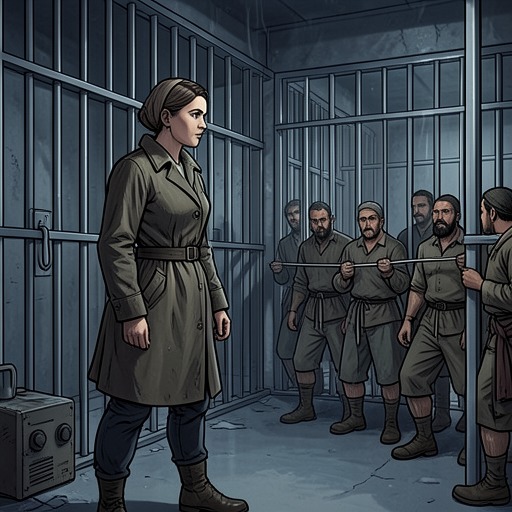
Moorehead’s “Cave” confinement rule
EileenMoorehead’s “Cave” confinement rule made an obsolete meat locker into a cell for boys punished for bad behavior. A boy sent there could be kept for weeks, with only narrowly permitted movement and basic bodily needs folded into the punishment. The room’s bucket toilet, iron door, and padlock make the rule a particularly stark expression of Moorehead’s punitive control over its young inmates.
The cell and its conditions
The Cave was the old meat locker behind Moorehead’s kitchen. Its original stainless-steel door had been replaced by a heavy iron one with a small window, and the door was padlocked. The room had once served a practical purpose; as a cell, its cold-storage origins became part of a system that reduced confinement to a locked space at the edge of the institution.
A boy sent there was not allowed out except to shower and wash more dishes. He ate his meals in the room and used a bucket as a toilet. These arrangements made isolation comprehensive: even eating and using the toilet, ordinarily private and separate activities, took place within the same confined space. The account describes one boy remaining there for several weeks, establishing that the punishment could be prolonged rather than a brief interruption of ordinary routine.
Work and punishment
The Cave was part of a broader disciplinary practice. Boys punished for bad behavior were made to do double duty washing pots and pans, and the confined boy’s only authorized exits were for showering and further dishwashing. Labor therefore did not simply accompany confinement; it was built into the limited route out of it, returning the punished boy to work before he went back behind the locked door.
Moorehead’s ordinary rules also constrained the boys’ conduct well beyond the cell. They were forbidden to dance, sing, gesture, talk loudly, listen to music, or lie down without permission. In this setting, the Cave intensified an already pervasive regulation of movement and behavior by imposing a specific place where even meals and toilet use were controlled by confinement.
What the rule reveals
The Cave’s small window offered a view into a system whose staff and records classified boys by their offenses and managed them until their sentences ended or they turned eighteen. The youngest boy the narrator had seen at Moorehead was nine and a half. The warden also threatened to transfer larger or troublesome boys early to the men’s prison, warning that conditions there would make them bleed for weeks. Such threats placed the Cave within a continuum of institutional coercion: punishment at Moorehead was reinforced by the prospect of something worse beyond it.
The rule’s force lies in its treatment of the body as an object of administration. In the Cave, sleeping, eating, washing, and using the toilet were not separate from discipline but were reorganized by it. The room’s bucket drew the narrator’s attention because bodily functions were usually hidden from view; here, the punishment itself made that private boundary part of the confined boy’s daily existence. The Cave thus condenses Moorehead’s larger regime into one room: a locked door, restricted movement, compulsory labor, and ordinary bodily life made inseparable from punishment.