X-ville Police Department
EileenThe X-ville Police Department is both Charlie Dunlop’s former workplace and a continuing presence in his daughter Eileen Dunlop’s home life. The force’s local familiarity with the family takes several forms: it sends Charlie’s pension checks, officers visit the house, and they sometimes bring him home after his behavior has become unmanageable. Its treatment of him combines personal regard with institutional accommodation, leaving Eileen to live with the consequences.
Local Force and Public Standing
Charlie served as a police officer at the county precinct, in a close-knit group of local officers whose routine work, as Eileen recalls it, rarely extended beyond such tasks as rescuing cats from trees or driving intoxicated people home from a nearby veterans’ hospital. Her portrait of the force is small-town and personal: its members knew one another, and Charlie was well regarded by those who had worked alongside him.
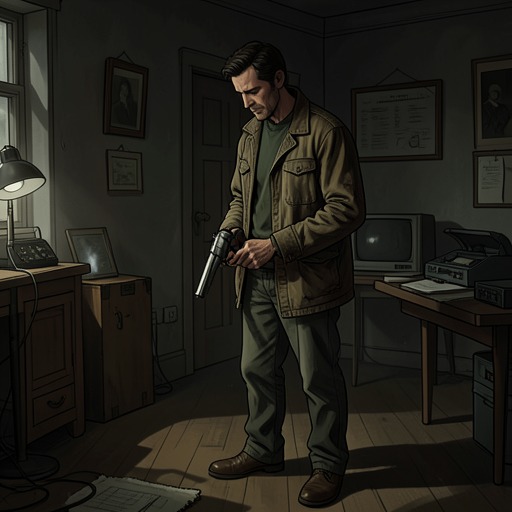
That standing was reflected in Charlie’s nickname, Father Dunlop, which Eileen links to his cold blue eyes and his moralizing manner. He retained the bearing of a Marine and took pride in the uniform. During his years on the force, he often slept in it, with his gun close by, imagining a dramatic call that would let him confront a criminal. In Eileen’s account, the heroism he anticipated never arrived; the uniform and badge instead became emblems of the self-importance she saw in him.
Charlie Dunlop’s Decline and Retirement
Eileen did not initially regard her father’s drinking as unusual. That changed after her mother became ill: Charlie began taking time off, drinking at home, wandering the streets at night, and falling asleep on neighbors’ porches. His drinking escalated to mornings and to times when he was still working. He totaled a squad car and accidentally fired his gun in the locker room, serious incidents that might have prompted open scrutiny.
According to Eileen, they did not. Charlie’s seniority and the affection the department felt for him kept these lapses from being discussed openly. Instead, he was encouraged to retire early, with a pension, while the department continued to keep watch over him and, in Eileen’s phrasing, to baby him as his difficulties increased. The accommodation preserved his connection to the force financially even as his working life ended: the X-ville Police Department sent his pension checks to be deposited each month.
Continued Contact with the Household
Retirement did not sever the department’s contact with Charlie. After he was caught driving the wrong way on a freeway and later left his car in a public cemetery, the chief took away his license. Charlie stayed home more, but his behavior on foot could still alarm neighbors: he went out during blackouts, conducted invented searches at their doors, drew his gun on shadows, and sometimes lay in the road or gutter. Officers returned him to the house quietly. One would then scold Eileen for allowing him to get so far out of hand, a response she experienced as an additional burden despite the officers’ apologetic manner.
The department also appeared in less dramatic encounters. One winter night, Officer Laffey approached Eileen outside her home and explained that the school had complained about Charlie throwing snowballs at children from the porch. He handed her a warning letter and left. Eileen invited him inside to speak with her father, but he declined, saying it was late. The brief exchange shows Eileen acting as the point of contact between the police and Charlie, while the officer’s warning records the consequences of Charlie’s conduct without resolving the problem at home.
Institutional Contradiction and Narrative Significance
The X-ville Police Department is not depicted simply as an adversary or a source of protection. Its members’ loyalty to Charlie helps secure his pension and continued attention, but that same loyalty coincides with the quiet handling of his professional misconduct and a pattern in which Eileen is left to manage the effects. Officers bring him home and check on the household, yet one also places responsibility for his behavior on his daughter. The force’s personal familiarity therefore offers care without removing the strain imposed on her.
Eileen’s account is retrospective and openly critical: she recalls Charlie as admired within the department for reasons she could not understand, while describing the limited work, early retirement, and surveillance that followed his deterioration. The contrast matters because it makes the department’s role less a matter of formal policy than of local relationships. Its presence reaches Eileen through routine pension deposits, a warning letter, and officers arriving at the house; in each case, the institution is close enough to intervene, but its intervention leaves the family’s underlying difficulties intact.