Bangkok
EmmanuelleBangkok is more than the exotic setting in which Emmanuelle joins her engineer husband at the age of twenty. It is the novel’s active geography of transformation: a tropical capital whose European enclaves, sports club, embassy society, canals, markets, and illicit rooms place regulated respectability beside forms of desire that challenge it. Through Bangkok, travel becomes disorientation, accidental meetings become instruction, and the city’s sharply contrasting spaces turn erotic freedom into a practice of moving beyond the ordinary.
Arrival and Colonial Enclave
Bangkok first appears as the destination of Emmanuelle’s journey to reunite with her husband, and its importance is established before she has even entered the city. After arriving from London, she is carried through the airport toward futuristic buildings of concrete and glass beneath a sky already whitened by heat. The tropical atmosphere gives the city an immediate sensory force, while the presence of her husband at the barrier places her arrival inside the social structure of expatriate marriage and professional life.
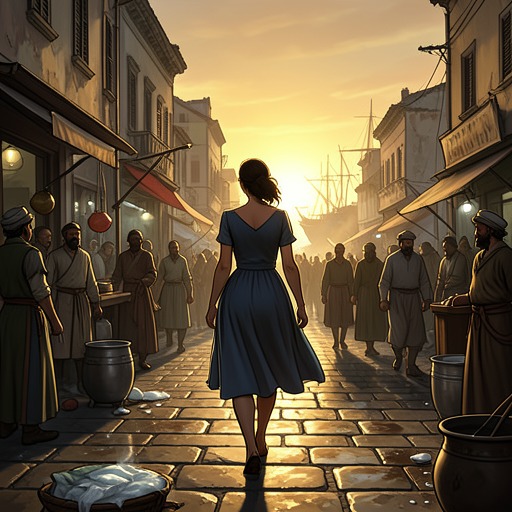
The Bangkok that receives her is not a single, homogeneous place. On arrival she knows avenues bordered by concrete buildings and villas concealed by garden vegetation and the embrace of ceiba trees. This is the polished, restricted world of European residents and diplomatic connections: refined, enclosed, and apparently ordered. Yet the city’s exoticism is inseparable from its neocolonial arrangement. Bangkok supplies the setting for a society that is European in manners and privilege while surrounded by a landscape, population, and urban life that continually exceed that enclosure.
Public Respectability and Social Display
The Royal Bangkok Sports Club embodies one of Bangkok’s most visible social spaces. Its mosaic pool, filled with pink water, belongs to a male-dominated circle that admits wives and daughters as carefully observed participants in a ritual of display. On weekends, women show their legs and breasts through translucent clothing as they move around the sporting grounds; during the rest of the week, they display them uncovered at the pool’s edge. The club therefore joins athletic modernity to eroticized surveillance, presenting the body as both social ornament and instrument of communication.
Emmanuelle’s acquaintance Ariane belongs to this milieu as the wife of Gilbert, Count of Saynes, an adviser at the Embassy of France in Bangkok. Ariane’s three nights of escape, followed by her sensible return home on the fourth night after the Filibuster had left, expose the instability beneath the club’s decorum. The polished social world does not eliminate desire; it organizes desire into stories of offense, absence, reputation, and return. Bangkok’s respectable spaces thus function as thresholds rather than sealed compartments, preparing the movement from public display to more radical experiments in pleasure.
Canals, Markets, and Urban Drift
The city changes character when Emmanuelle leaves the avenues and villas. During a solitary drive into the center, she circulates for an hour without a destination, repeatedly losing her way, stopping in shops, and becoming paralyzed by the sight of a leper dragging himself along the filthy pavement on damaged limbs. The encounter breaks the illusion of controlled, decorative Bangkok. Her healthy hands and feet become suddenly conspicuous to her, and the city’s everyday street life overwhelms her capacity to act. At the moment of this shock, she recognizes Bee emerging from a Chinese shop and calls out as though seeking help.
A still more drastic spatial reversal occurs when Mario leads Emmanuelle through a district unlike the concrete avenues and garden villas she knew on arrival. Under the full moon, the neighborhood seems like an unstable theatrical set: false perspectives, cardboard walls, platforms, and scaffolding replace the solidity of the expatriate city. She follows Mario across a narrow plank roughly ten meters long and thirty centimeters wide, balanced on two trestles over the motionless, greasy water of a canal that resembles a sewer. The group’s weight bends and trembles the board, making the passage physically precarious and turning urban movement into an ordeal.
Mario’s house stands on a black canal disturbed by reflections and has the outward appearance of a one-story forest refuge. Inside, however, it contains luxurious furniture and tapestries. From the red leather sofa, Emmanuelle can see bark boats carrying sweet drinks, durians, coconuts, and bamboo tubes overflowing with cooked rice as they cross among islands of vines and leaves. Bells on a nearby temple repeat two notes in the wind, a gong summons monks to sleep, and a woman begins a shrill lullaby. Bangkok here is layered rather than merely picturesque: commerce, religious sound, domestic life, luxury, water, and erotic possibility occupy the same night space.
Movement Toward Illicit Freedom
The canal routes make Bangkok a city of changing rules. Emmanuelle repeatedly asks whether activities are forbidden, and Mario answers that smoking opium is prohibited just as making love outside marriage is prohibited. If the police came, he says, the participants would go to prison. The city’s erotic spaces therefore do not exist outside law; their intensity depends partly on the knowledge that police authority, marital convention, and public morality remain close at hand.
Yet the same movement that brings Emmanuelle through dangerous passages also gives her a new mobility. After another walk, Mario brings her to an unfamiliar broad khlong, perhaps a natural stream, whose banks are covered with grass. He then leads her back toward a real street and proposes taking a sam-lo, a now-obsolete three-wheeled vehicle whose name means “three wheels.” Emmanuelle prefers its indolent rhythm beneath the bright sky to the danger of a taxi at every bend. In the cramped seat, Mario’s arm passes behind her shoulders, she presses against him, and the jolting vehicle becomes the setting for her first initiative of this kind in the open street. Bangkok’s transport network turns private desire into a public experiment.
This progression from club to road, from road to canal, and from canal back to street gives the city an episodic, drifting structure. Emmanuelle’s movement is not a straightforward tour through landmarks. She gets lost, follows guides, crosses unstable surfaces, enters unfamiliar districts, and discovers that each change of route alters what can be imagined and attempted. Bangkok repeatedly makes the familiar strange, allowing the city itself to function as an erotic pedagogy.
Narrative and Thematic Significance
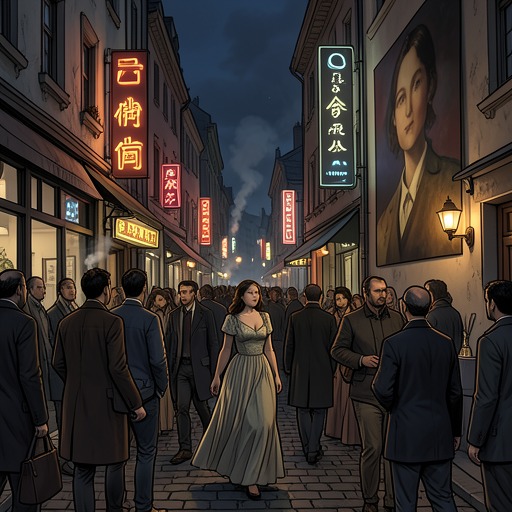
Bangkok gathers the novel’s central contrasts into one environment. Its European society is restricted yet refined; its public bodies are carefully displayed yet socially controlled; its futuristic buildings stand beside canals, boats, temples, markets, and precarious walkways. The city’s beauty is never separable from inequality, danger, or legal prohibition. Its tropical surface can appear paradisal, but its streets also confront Emmanuelle with illness, filth, vulnerability, and the limits of her sheltered existence.
The location is consequently tied to the novel’s larger conception of eroticism as an invention that contests nature, convention, and fear. Mario’s lessons are not delivered in an abstract classroom: they occur amid Bangkok’s water, traffic, social hierarchies, police restrictions, and multilingual international community. Even the book’s publication history extends this geography beyond the plot. The original work, titled “Emmanuelle. La leçon d'homme,” was translated by Carmen Artal and presented in a Spanish edition issued by Tusquets Editores in the La Sonrisa Vertical collection. The author’s identity is described as mysterious, while Emmanuelle Arsan, the pseudonym associated with Marayat Andrienne, is linked to Thai origins and a diplomatic marriage in Bangkok. The city thus belongs both to the fictional initiation and to the transnational circulation through which that initiation reached readers.
Bangkok’s decisive narrative function is to make boundaries permeable. Airport and embassy, sports club and canal, street and private room, law and transgression, foreign privilege and local urban life continually touch one another. The city does not simply host Emmanuelle’s transformation; its routes and contrasts produce the conditions in which she can move from observation to participation, from being carried through an unfamiliar world to choosing her own direction within it.