Rue Docteur Blanche
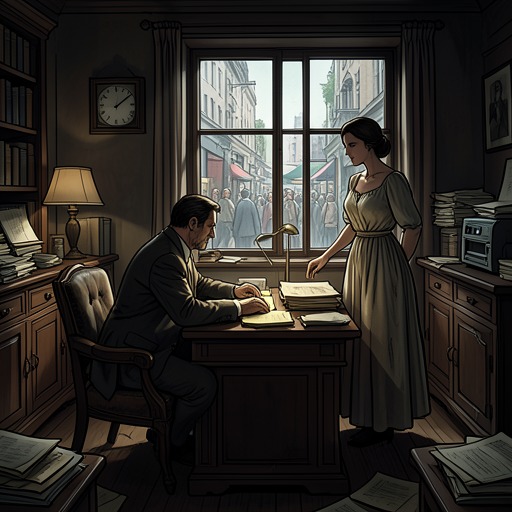
EmmanuelleRue Docteur Blanche is identified in the novel as the Paris apartment shared by Marie-Anne and Jean after their marriage. More than a street address, it marks the domestic setting in which marriage temporarily accommodates an already established erotic relationship: Marie-Anne can become Jean’s legitimate wife without immediately abandoning the life she had known as his lover.
Domestic Setting and Marriage
Marie-Anne explains that Jean was originally expected to leave after their wedding, but, through an arrangement attributed to her father, he remained for six months. This delay allowed the newly married couple to avoid immediate separation and gave Marie-Anne a period in which the legal condition of marriage could coexist with the intimacy that had preceded it. Her account presents the apartment not as a retreat from desire but as the place where desire is transferred into a different social form.
The location is named specifically as their apartment on Rue Docteur Blanche. Marie-Anne emphasizes that she lived there alone during Jean’s absence rather than returning to her parents’ home. The apartment therefore signifies a limited independence: it is technically a marital residence, yet it also becomes the space of her solitary continuation after the husband’s departure. Its ownership or domestic authority is not described, but the narrative makes clear that the address is associated with both of them rather than with her parental household.
Continuity Between Lover and Wife
Marie-Anne describes the experience of being married as as entertaining as being a sinner, while acknowledging that making love at night initially felt strange. The apartment embodies that contrast. Its social meaning is respectable and domestic, but the emotional memory attached to it remains connected to the transgressive identity she had occupied before the wedding. The same woman can be Jean’s lover and his legitimate wife, and the residence gives that contradiction a concrete architectural form.
The six-month interval is decisive because it prevents marriage from functioning as an abrupt break. Jean’s anticipated departure would have separated the couple almost at once; his continued presence instead lets Marie-Anne inhabit both statuses in succession without losing the bodily and emotional continuity between them. When he finally leaves, the apartment remains as the material setting of that transition, preserving the marriage’s domestic claim even as the relationship becomes physically discontinuous.
Contrast With Bangkok’s Moving Spaces
Rue Docteur Blanche belongs to a remembered Parisian domestic world, while the novel’s Bangkok episodes repeatedly place Emmanuelle in unstable, transitional, or socially exposed environments. The contrast is sharp. In Bangkok, she moves through a club, a bathhouse, streets crowded with smoke-filled tricycles and motorcycle taxis, a poor neighborhood of canals, and a precarious plank crossing over stagnant water. She is guided from one setting to another, often accepting unfamiliar rules and routes; the city becomes a field of drift, surprise, and erotic re-education.
Against those itinerant spaces, the Paris apartment represents an address, a shared household, and a recognizable marital arrangement. Yet it is not presented as a final resolution. Its apparent stability contains absence: Jean leaves, and Marie-Anne remains. The location thus joins two kinds of discontinuity, the legal transformation produced by marriage and the physical separation produced by Jean’s departure. Its significance lies precisely in that tension between domestic permanence and impermanence.
Narrative and Biographical Resonance
The address also participates in the novel’s broader transnational frame. The work is presented as Emmanuelle. La leçon d'homme, translated by Carmen Artal, while the surrounding narrative moves among London, Bangkok, Paris, and other international settings. Rue Docteur Blanche supplies a specifically Parisian point of reference within that circulation, grounding an intimate marital episode in a named urban location rather than leaving it as an abstract anecdote.
In the closing note about Emmanuelle Arsan, the author is associated with a diplomatic marriage in Bangkok and with a body of erotic fiction that includes Emmanuelle and other novels. That biographical frame does not expand the apartment’s depicted history, but it reinforces the text’s recurring connection between erotic life, marriage, travel, and diplomatic or cosmopolitan mobility. Rue Docteur Blanche consequently functions as a compact emblem of the domestic side of a story otherwise propelled by international movement: a Paris residence where legitimacy briefly shelters, rather than suppresses, an erotic past.