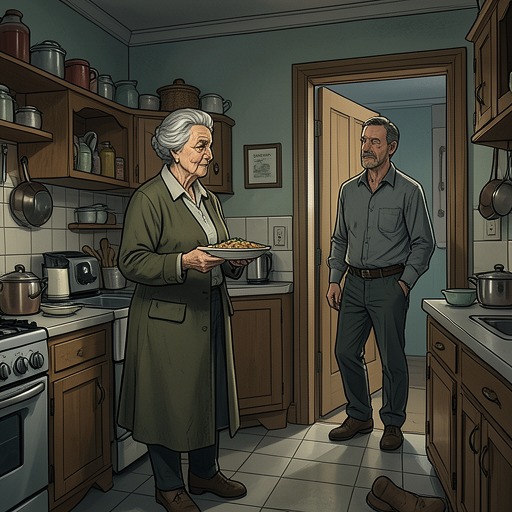
Agnes Ellison and Lorraine's caregiving relationship
ErasureAgnes Ellison and Lorraine’s caregiving relationship is at once a household arrangement and a durable bond formed over decades. Lorraine has worked for the family since before Agnes’s children were born, providing the practical care that sustains the home. As Agnes’s cognition and independence decline, that familiar arrangement comes under increasing strain: Lorraine remains present through episodes of risk, while Thelonious Ellison faces the question of how to keep Agnes safe without treating Lorraine’s continued service as limitless.
A Household Relationship Built Over Time
Lorraine had been part of the household for so long that Thelonious Ellison describes her as having known him first as a child and then as a young adult. The family’s reliance on her was intimate but defined. She was not their nanny: when the children needed advice or a ride, they went to Agnes; when they needed food or clean clothes, they went to Lorraine. That division places Agnes and Lorraine in different roles within the same family life, with Lorraine responsible for essential daily work rather than parental authority.
The house itself makes the arrangement concrete. It is a large, two-story home with many rooms and a finished basement apartment where Lorraine lives. She has days off, but Thelonious Ellison does not know where she goes or whether she goes anywhere; he remembers her accompanying the family to the beach in summer. His uncertainty is revealing without proving that she had no life beyond the household. From his perspective, her working life has been so closely woven into theirs that its boundaries and private spaces remain largely unseen.
As an adult, Thelonious Ellison participates in the employment arrangement by writing Lorraine’s checks. He knows that her wages are supplemented by free rent and food, and asks whether she has saved money. The exchange brings her material circumstances into view, but does not make the arrangement simple: Lorraine says she has saved a little, while her long service and limited account of family elsewhere suggest how little the household relationship can be separated from the structure of her life.
Care as Daily Practice and Shared History
Lorraine’s work is repeatedly rendered through ordinary tasks rather than declarations of affection. Thelonious Ellison finds her in the kitchen over a pot of rice, wearing a yellow apron over a dark dress. He recalls having imagined, as a child, that she owned a whole collection of such aprons for different occasions. The remembered image joins routine domestic labor to a child’s effort to imagine a private world for the person whose work he sees every day. In the present, Lorraine tells him that coming home to care for Agnes is a good thing he has done, recognizing both his return and the responsibility it entails.
Her own connection to the family is starkly expressed when Thelonious Ellison asks about relatives. Lorraine says that the aunt she once had died long ago, and that the Ellisons are the only family she has ever known. She does not describe herself as grieving for relatives she never knew. The statement does not erase the employer–employee distinction, but it clarifies why the household may mean more to her than a place of work. The relationship has accumulated a familial meaning without changing the fact that her service is labor.
That meaning also appears in the contrast between her earlier ease with Thelonious Ellison and a later reserve after she encounters a word in one of his books that displeases her. She remains polite, but their former warmth is diminished. The detail marks a boundary in their shared history: long familiarity does not prevent estrangement, and household closeness does not guarantee agreement or affection at every stage.
Agnes’s Decline and Lorraine’s Presence
As Agnes becomes less reliable in her perception and behavior, the household’s care demands grow more urgent. Medical examinations do not identify a lung infection, stroke, or vitamin B-12 deficiency, and the doctor reports tangled nerve fibers. The account offers no simple explanation that resolves the family’s uncertainty. It instead situates Lorraine and Thelonious Ellison in the practical aftermath of changes that are difficult to interpret and harder to manage.
One episode makes the risks of Agnes’s altered state unmistakable. Lorraine sees Agnes standing in a small boat on the pond and points her out to Thelonious Ellison, who enters the cold water to reach her. Agnes resists his approach with an oar. He eventually gets her to sit by addressing her formally as Mrs. Ellison and telling her that standing is not allowed in the boat. Lorraine, together with Maynard Boatwright, helps Agnes out of the boat and up the ramp. Her role here is immediate and practical: she notices the danger, directs Thelonious Ellison to it, and assists when Agnes is brought back to shore.
The episode also shows how care can depend on recognizing a person’s condition without assuming that familiar words will restore familiar understanding. Thelonious Ellison cannot make Agnes recognize him simply by identifying himself; he finds a way to reach her through an instruction she can follow. Lorraine’s presence does not resolve the confusion, but her alertness helps make a response possible. The scene gives her care a form beyond cooking, clothing, and household upkeep: she is among the people watching over Agnes when ordinary supervision is no longer enough.
Promises, Limits, and Changing Arrangements
The future of care becomes a direct subject when Thelonious Ellison asks Lorraine what will happen after Agnes dies. Lorraine says she will stay and take care of him. Her offer reverses the expected direction of support: the person who has spent decades serving the family proposes to remain a caregiver even after the family’s immediate need for her work has changed. Thelonious Ellison accepts the offer, though the exchange does not establish what arrangements ultimately follow.
That promise stands beside his later recognition that he has his own agenda. As Lorraine prepares to marry Maynard Boatwright, Thelonious Ellison realizes that he wants to see her married partly so that he will not have to care for her in her remaining years. At the same time, he is considering placing Agnes in a care home. He distinguishes his motives: he does want Lorraine to have a life beyond his mother’s care, but he insists to himself that placing Agnes is not simply an attempt to be free of responsibility. He also wants Agnes safe, and wants relief from the fear and desperation that her condition produces. His discomfort with the word he associates with institutional placement underscores how final the decision feels to him.
The burden of supervision is especially clear after Lorraine’s wedding. Thelonious Ellison spends the night awake, watching Agnes and fearing that he will find her missing or seriously harmed if he sleeps. He is exhausted and distrustful even when she seems stable; arranging more dependable care has become urgent both for her safety and for his ability to live outside constant alarm. This is not a rejection of Lorraine’s earlier promise so much as a recognition that a family arrangement built around her labor cannot, by itself, answer every need.
Later, Agnes is in a care facility, where nurses and an orderly attend to her increasing incontinence and reduced willingness to move herself. Thelonious Ellison sees how far her condition has progressed and remembers the woman who once described seeing colors while listening to Mahler. The contrast registers a profound change in Agnes, while also showing that care has shifted from the familiar household to institutional staff. The narrative does not say that Lorraine provides care there. Rather, it traces the limits of the home-based relationship: Lorraine’s long presence, practical help, and promise matter deeply, but Agnes’s worsening needs eventually exceed what that familiar arrangement can safely contain.