Lorraine and Maynard Boatwright
ErasureLorraine and Maynard Boatwright’s relationship develops into a marriage at a moment when the Ellison household is already shaped by Agnes Ellison’s worsening condition. Their union is presented through small, observed scenes rather than a sustained account of courtship: the two drift together across a moonlit pond, share laughter, and then announce that they are marrying within days. The relationship brings Lorraine happiness, but its consequences are not uncomplicated for Thelonious Ellison, who welcomes her joy while worrying about his mother’s loneliness.
A Courtship Seen from the Household
Thelonious first sees Lorraine and Maynard together on the pond. He hears oars dipping and soft laughter before noticing them floating past in a small skiff beneath the moon. The scene gives their relationship a quiet, self-contained ease: they are together away from the house, sharing an evening that Thelonious recognizes as sweet. No account is given of how they met or how long they have been close; their companionship is instead conveyed through this brief glimpse of two people at ease together.
That happiness reaches Thelonious through a divided response. He wants to feel glad for Lorraine, yet his attention returns to Agnes, alone in the house. His belief that his mother’s loneliness is killing her is his own anxious judgment, not a claim about Lorraine’s intentions. The contrast matters to the relationship’s place in the story: Lorraine’s prospect of a new life appears alongside, rather than replacing, the family’s ongoing worry about Agnes. Thelonious can recognize the tenderness of the scene and still experience it as painful.
The Marriage Announcement
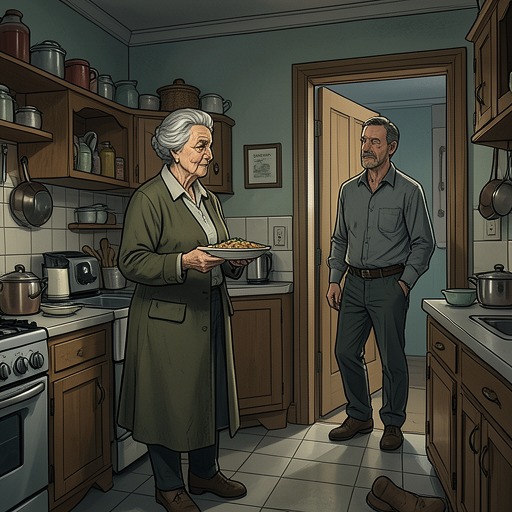
Later, when Agnes is asleep, Thelonious steps outside to the pier and then returns to find Lorraine and Maynard together in the house. Their closeness is now part of the domestic space, not only something glimpsed at a distance on the pond. Maynard asks after Agnes, and Thelonious answers that she is not doing well. Maynard then tells him that he and Lorraine are getting married. Thelonious is shocked even though he understands the news; the marriage makes sense to him, but its sudden announcement catches him off guard.
The wedding is to be small, and the timetable is strikingly short: when Thelonious notes that it is only two days away, Maynard replies that they are old and have no time to waste. Their laughter at this exchange is genuine, and Thelonious is glad to hear Lorraine laugh that way. The scene gives their decision a briskness grounded in their own stated sense of age and urgency. It does not present the marriage as a long-planned family arrangement; the news arrives as a decision already made, with little time for Thelonious to adjust to it.
Thelonious’s Place in Their Union
Maynard asks Thelonious to be his best man. His explanation is relational rather than formal: the Ellison family has been kind to Lorraine, and Thelonious means a great deal to her. The request therefore acknowledges Thelonious as someone important to Lorraine’s life, even as the marriage marks a change in the household. His surprise at the invitation sits alongside the practical and emotional questions he does not voice aloud, including whether he will pay for or attend the ceremony. The evidence establishes the invitation and his uncertainty, but not what he ultimately contributes to the wedding arrangements.
The shared laughter also prompts Thelonious to compare Lorraine and Maynard with his parents. He realizes that, although he has no doubt his parents loved each other, he has never heard the same quality in their laughter together. This is his perception of the contrast, not a judgment that his parents lacked love. The new couple’s ease makes a different kind of companionship audible to him, and the comparison complicates his response: he is happy for Lorraine while seeing, through her relationship, a form of warmth he does not remember from his parents’ marriage.
Marriage and Departure
Lorraine and Maynard do marry, though the account does not describe the ceremony itself. That evening Lorraine comes to collect her things on her way to a honeymoon in Atlantic City. She does not speak to Agnes and says little to Thelonious, telling him only that this is the thanks she gets. The departure turns the earlier announcement into a concrete separation from the household. It also leaves an unresolved injury in the exchange: Lorraine’s words register her dissatisfaction, but the account does not specify what she believes she has been denied or why she does not speak to Agnes.
Thelonious hands Lorraine an envelope, apologizes, and says he hopes it helps; its contents are not identified. Maynard gives him a weak, understanding smile. These gestures close the episode without explaining away the tension. Maynard’s smile indicates understanding, while Lorraine’s brief reproach and Thelonious’s apology leave the emotional cost of the transition visible. Their marriage offers Lorraine and Maynard a shared future, but the scene ends with her leaving the family home, Agnes absent from the exchange, and Thelonious caught between affection for Lorraine and concern for his mother.