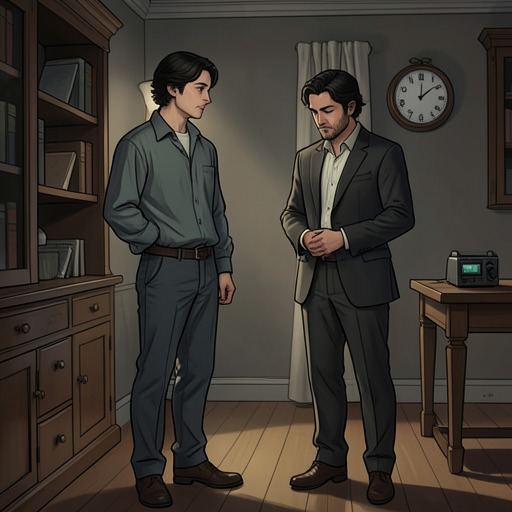
Labud discovers Lida's infidelity and breaks up with her
FabianLabude’s discovery that Leda has been unfaithful turns a long-distance relationship sustained by scheduled visits into an irreversible break. He recounts the episode to Fabian as a sequence of suspicion, all-night surveillance, a morning’s confirmation, and a confrontation in which Leda denies what he has seen. The betrayal is not only the presence of another man: Labude comes to understand the previous five years as a life lived under a false assumption, and the act of telling Fabian becomes his way of putting that life behind him.
Background: A Relationship Undermined by Distance
Labude explains that he and Leda had been together for years while seeing each other only two days and one night each month. The repeated pattern of a visit, a kiss, a theatre outing, conversation, a night together, and another separation had made intimacy feel scheduled rather than shared. He argues that the distance between Hamburg and Berlin had prevented them from knowing one another’s changing worries and acquaintances; letters could not bridge the gap. In his formulation, geography had helped love die.
His suspicion had grown over the preceding months. He had already hinted to Fabian that Leda seemed changed, and he had begun to experience their meetings with dread. He describes her greetings, tenderness, and passion as performances, and recalls wishing he could tear away the mask he thought she wore. In this account, the discovery is preceded by a sustained mismatch between the relationship’s affectionate appearances and Labude’s sense that its emotional substance has disappeared.
The Night of Surveillance
Labude says he went to Leda’s home after leaving a gathering with Rassow and the others on the night the initiative group was founded. The windows were dark, but he did not leave. Across the street, on a bench opposite the house, he smoked countless cigarettes and waited from midnight until three in the morning. Each passerby briefly seemed as though it might be Leda. While he waited, he imagined violent arguments and bitter scenes, turning uncertainty into a night-long rehearsal of confrontation.
Shortly after three, a taxi stopped outside the house. A tall, slender man got out and paid the driver; a woman then sprang from the car, hurried to the entrance, unlocked the door, and held it until the man followed her inside. Labude watched the taxi return to the city. He identifies the woman as Leda and describes lights appearing in different rooms, shadows moving behind curtains, and the bedroom lighting up. From the street he sometimes heard her laugh; in the silences, he heard only his own heart beating. The scene gives his suspicion a concrete basis, but it also makes him a witness at a distance, confined to signs visible and audible from across the road.
The visitor left at seven in the morning, whistling as he came out. Leda appeared on the balcony in a Japanese dressing gown and waved to him. She briefly spread the gown so that he could see her body, and he blew her a kiss before whistling away. Labude watched with disgust, lowered his head, and saw the balcony door close. The exchange made the intimacy he had feared legible as a scene he could observe but could not interrupt.
The Confrontation and Separation
At noon, Labude telephoned Leda. She sounded pleased that he had come again and asked whether he would visit at five. He went to her home later that day. She had prepared tea and cake, welcomed him tenderly, and began to undress automatically before putting on her kimono and lying on a couch. Against this familiar, intimate setting, Labude asked what she would think if they ended their relationship. Leda responded with surprise, asked whether he no longer loved her, and reminded him that they had planned to marry once he had completed his habilitation.
Labude said that the question was not simply whether he loved her: in his view, the growing estrangement, for which he held her responsible, made separation advisable. Leda acknowledged how difficult it was to cross the emotional distance between Hamburg and Berlin and described the frustration of sexual intimacy constrained by their visits. When she wanted him, he was absent; when he was present, she said, their love had to be fitted into a meal-like appointment whether or not either felt desire. She argued that marriage would change matters.
She also disclosed that she had undergone a medical procedure several weeks earlier, saying that she wanted to have their children as his wife and had withheld the information so as not to worry him. Labude asked who the pregnancy had been by. He then asked who the man was who had slept at her home that night. Leda dismissed his accusation as jealousy and said he was seeing things. Labude slapped her and left. She followed him down the stairs and stood naked beneath her blowing dressing gown outside, calling for him to stay; he ran away and went to the railway station.
The breakup follows a conflict between what the two characters treat as evidence. Leda invokes their intended marriage and the emotional and sexual problems produced by distance; Labude answers with the visit he witnessed and the secrecy around the medical procedure. Her denial does not settle the disagreement for him. Instead, the gap between her explanation and his observation makes continued trust impossible, and the confrontation ends not with negotiation but with departure.
Retrospective Meaning and Aftermath
The story reaches the reader through Labude’s account to Fabian, rather than through a directly narrated scene of discovery. His report moves between places and times: the bench across from Leda’s house, the morning balcony, and the afternoon visit. In the present of the telling, Fabian sits uncertainly, then places his hands on Labude’s shoulders. The physical gesture offers support without undoing what Labude has described. Labude later says he can get over the breakup, but that being lied to is what wounds him.
He calls the matter settled and says he has spent five years living under a false assumption. He insists that he has not yet told Fabian the worst: he concludes that Leda does not love him and never has. Only after the final break, he says, does the account of their past suddenly add up; in five minutes, he understood everything. His certainty gives the breakup its force, while its retrospective character leaves that judgment rooted in the shock of discovery and in Labude’s interpretation of the years that preceded it.
The episode also places private intimacy beside a broader uncertainty about responsibility. Elsewhere in the same evening, Ruth Reiter describes women who give up what they had when they love a man, only to be left alone; Fabian answers that men face a bind between taking responsibility for a woman’s future and fearing that their own unstable employment will ruin it. That exchange does not explain Labude and Leda’s particular betrayal, but it sharpens the contrast between a planned marriage and a relationship already damaged by distance, unequal expectations, and mistrust. Labude’s declaration that the case is closed ends the relationship in the account; his immediate turn toward a new invitation marks his attempt to move on, not a reconciliation.